

Summer is shaping up to be a busy one for Canadian homebuyers. National home sales edged up another 0.5% in June, according to the Canadian Real Estate Association (CREA), marking a third straight month of gains and building on May’s surprise 5.5% jump and April’s 0.9% uptick. Altogether, that’s a market running roughly 7% hotter than it was back in March, a quiet but unmistakable sign that the slow start to 2026 is officially behind us.
CREA Senior Economist Shaun Cathcart pointed to easing fixed mortgage rates since their April peak, along with a much lower likelihood of further Bank of Canada rate hikes this year, as welcome news for borrowers. With home prices no longer falling in most markets, sidelined buyers appear to be re-entering, and CREA expects the second half of 2026 to be considerably more active than the first, echoing the pattern seen in 2024 and 2025.
New listings fell 1.3% month over month in June, the second straight decline, pushing the national sales-to-new-listings ratio up to 50.2% from 49.3% in May, the first time this year the measure has moved back above the 50% mark. For buyers and sellers alike, rising sales paired with shrinking new supply suggest the summer market is tightening rather than cooling.
“The stage is set for a busier fall market,” said CREA Chair Garry Bhaura, pointing to the return of certainty around both interest rates and home values as more buyers step into the market. He noted activity could pause briefly as Canadians enjoy their summer, but that the usual post-Labour Day wave of new listings should give both buyers and sellers the runway they need to make their move.
Toronto and Vancouver: Fewer Listings, Firmer Demand
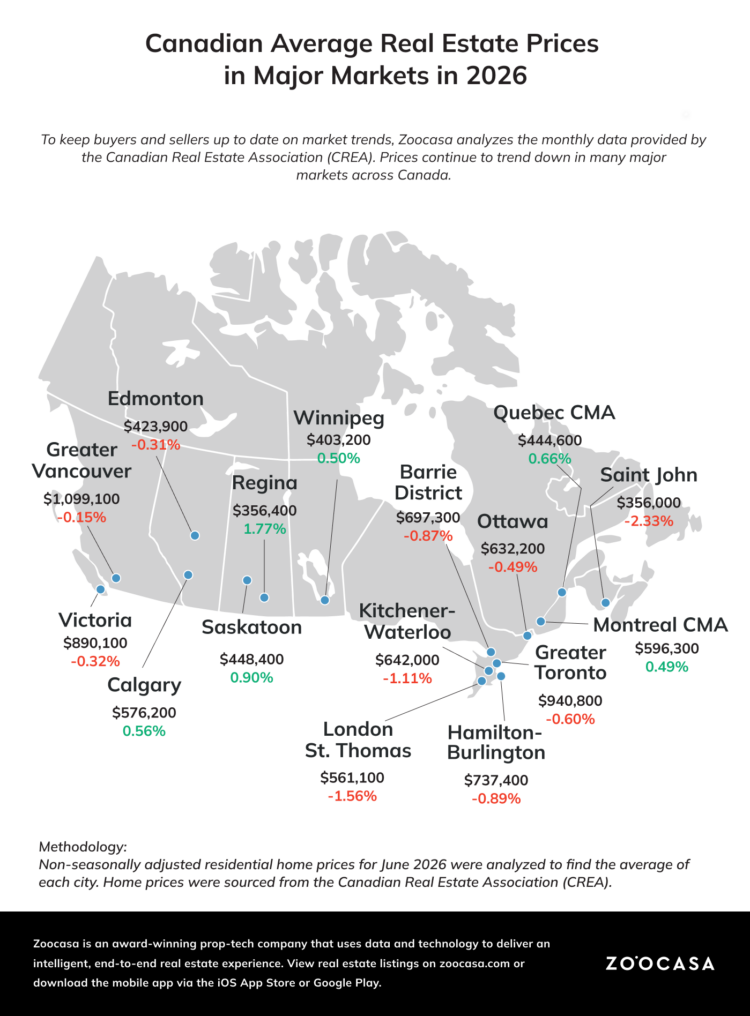
Ontario’s biggest market is still caught between softer prices and resilient demand. In the Greater Toronto Area, the average price was $1,058,658 in June, down 3.9% from a year earlier. Toronto sales rose 9.4% to 6,770 while new listings fell 12.9% to 17,282, leaving buyers with a thinner pool of homes despite softer prices.
Elsewhere in Ontario, Hamilton–Burlington and Niagara Region both posted year-over-year sales gains above 8% despite softer prices, while London & St. Thomas remained a rare spot offering buyers real negotiating room, with prices down 6.8% to $606,536.
In British Columbia, Greater Vancouver’s average price slipped 2.1% year over year to $1,249,098 even as sales rose 9.4% to 2,388 and new listings dropped 7.7% to 5,860. Fraser Valley told a similar story: sales eased slightly to 1,097, new listings fell14% to 2,921, and the average price was down 6.6% to $966,171. In both markets, fewer new listings, alongside firmer demand, point to gradually tightening conditions even as prices remain below last year’s levels.
Alberta and the Prairies Push Prices Higher Despite Softer Sales
Alberta’s price recovery held firm in June. Calgary’s average price rose 2.6% year over year to $681,563, while Edmonton climbed 4.8% to $477,636, even as sales pulled back in both cities. Saskatchewan demand continued, with Saskatoon’s residential average sale price climbing 5.3% year over year to $444,216 and Regina’s average price jumping 8.5% to $399,263.
Winnipeg wasn’t far behind, with its residential average price up 2.4% to $446,030. Firmer pricing alongside softer sales suggests sellers still hold the edge across the Prairies. If you’re house hunting in Calgary, Edmonton, Saskatoon or Regina, expect to compete on price even where inventory has loosened. And if you’re selling, there’s little reason to wait for a stronger offer later in the year.
Quebec and Atlantic Canada Remain the Strongest Markets
Quebec’s markets remained among the country’s strongest on price. Montreal CMA’s average price rose 4.1% year over year to $681,045, while Quebec CMA climbed 7.5% to $502,929. Saguenay CMA was up 10.2% to $380,150, and Trois-Rivières CMA was the lone soft spot, roughly flat on the year.
Atlantic Canada is running just as hot. Newfoundland & Labrador’s average price rose 6.1% year over year to $375,334, with St. John’s up 10.9%, and CREA’s forecast update names the province Canada’s last remaining full-on seller’s market. New listings there fell 8.0% year over year, underscoring how limited supply keeps propping up prices even as sales moderate. Buyers in the Quebec CMA, Saguenay, or St. John’s should brace for firmer asking prices and a shrinking selection, while sellers in these markets are working from a rare position of strength.
What June’s Housing Trends Mean for Your Next Move
Taken together, June’s numbers point to a market quietly firming up rather than overheating: sales ticking higher, new listings pulling back for a second straight month, and prices holding steady nationally for the first time in over a year. For buyers, tightening listings in hot spots like Greater Vancouver, the GTA and Fraser Valley mean less choice ahead, even where prices remain below year-ago levels. For sellers, especially in markets posting sustained gains such as Quebec CMA, Saguenay, Newfoundland and Labrador and much of Alberta, conditions still favour listing sooner rather than later, particularly with CREA expecting a busier fall market after Labour Day.
CREA Trims Its 2026 Forecast, but Points to a Bigger Rebound in 2027
Alongside June’s results, CREA trimmed its 2026 outlook slightly to reflect a slower-than-expected start to the year. National home sales are now forecast to total 463,336 units in 2026, a 1.4% decline from 2025, with Ontario the only province expected to post an annual sales increase. The national average price is still forecast to rise 1.1% to $686,710 in 2026, as modest declines in B.C. and Ontario are offset by continued, if slower, growth elsewhere.
Looking further out, CREA expects 2027 to bring a stronger rebound, with national sales climbing 3.7% to 480,567 units and the average price edging up another 1.1% to $694,164. That would mark the seventh straight year the national average has hovered close to the $700,000 mark. The Prairies and Ontario are expected to do a little better than previously forecast, while Quebec and the East Coast are expected to cool slightly from earlier projections.
Curious what this could mean for your own plans to buy or sell? If you’re trying to understand what these national numbers mean in your market, connect with a local agent who knows your neighbourhood inventory, pricing, and competition.