

Canada’s housing market showed renewed momentum in May 2026, with home sales rising 5.5% month over month, the first meaningful gain this year, according to the Canadian Real Estate Association (CREA). The increase marks an early turning point after a quieter start to 2026, as improving conditions begin to draw both buyers and sellers back into the market.
“The national sales increase from April to May was broad-based but driven disproportionately by Ontario, suggesting the [Harmonized Sales Tax (HST)] rebate on new builds may have only briefly drawn the attention of buyers away from the existing home market,” CREA Senior Economist Shaun Cathcart said.
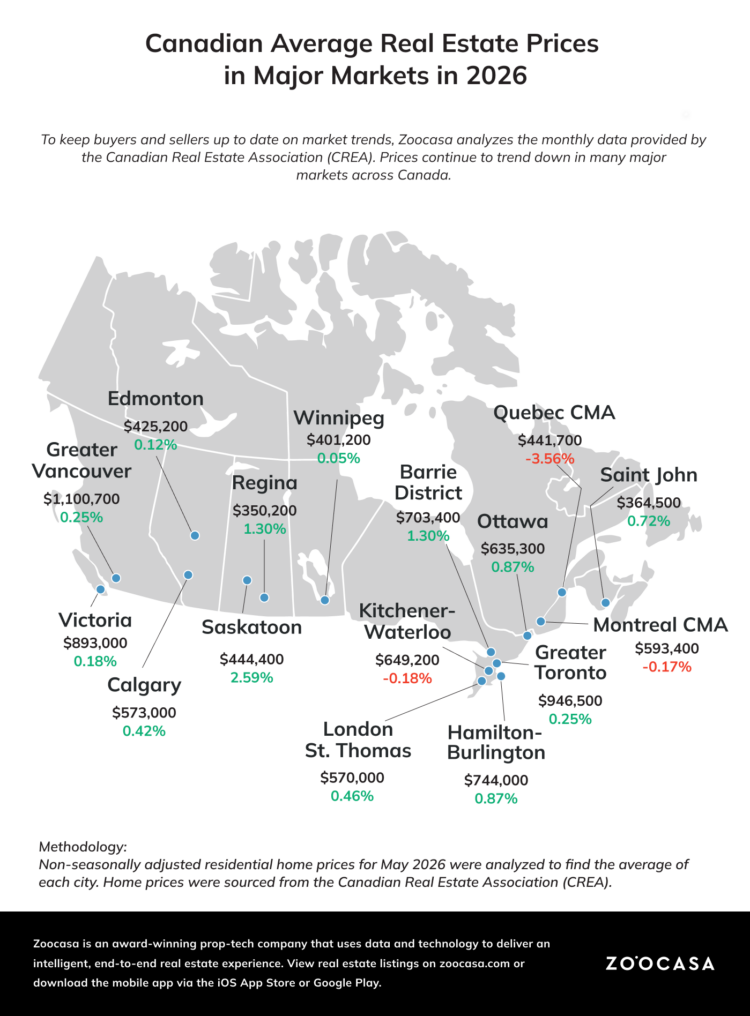
In May, Canada’s housing market began to recover, with seasonally adjusted national home sales up 5.5% from April and the sales-to-new-listings ratio rising to 49.2% from 46.2%. The national average home price reached $702,079, up 1.5% from $691,717 in May 2025, and moved back above $700,000 for the first time in nearly two years. For buyers and sellers, this mix of increased activity and slowly rising prices suggests the market is waking up rather than overheating and could lead to a busier summer.
“While it was just the first month in 2026 to see any meaningful upward momentum in headline demand, under the surface, conditions have been improving for some time,” Cathcart said. “Sellers’ and buyers’ expectations are increasingly aligned, as evidenced by tightening sale-to-list price ratios and shorter periods between listing and sale dates. As a result, prices have largely stabilized following some softness earlier in the year.”
What Ontario’s Softening Home Prices Mean for Buyers and Sellers
Ontario’s housing market is still seeing year-over-year price declines in many areas, but buyer interest remains strong. In the Greater Toronto Area, the average home price dropped to $1,069,700, down 4.6% from $1,120,716 a year ago, but sales rose 6.3% to 6,583. At the same time, new listings in the GTA fell to 17,698, an 18.9% drop from 21,830 in May 2025, so buyers are competing for fewer homes even as prices dip.
Outside the GTA, London and St. Thomas saw sales rise 9.7% to 766. Meanwhile, markets like Niagara Region and Thunder Bay recorded year-over-year sales declines and among the steepest inventory pullbacks in the province, with declines of 18.2% and 23.2% in new listings, respectively.
Buyers in these regions can take advantage of more negotiating room on price in some communities, but also less choice. For sellers, especially in pockets where demand is still resilient, well-priced listings can stand out quickly.
Falling Rates, Rising Inventory: Unpacking the B.C. and Alberta Housing Markets
In Western Canada, Alberta and British Columbia are seeing different trends in their local real estate markets.
In B.C., prices have eased a bit in the main coastal markets: Greater Vancouver’s average price fell 2.2% year over year to $1,238,181, and Fraser Valley dropped 1.4% to $985,718. Both areas also had fewer sales than last year. New listings are down as well, with Fraser Valley falling 20.2% to 2,888 and Greater Vancouver down 9.1% to 6,004. This means buyers have fewer homes to choose from, even as demand slows, which can keep some sellers cautious about adjusting their prices too aggressively.
In contrast, Calgary’s average price went up 2.5% to $682,701, and Edmonton’s rose 5.5% to $480,436, even though sales dropped by 13.4% and 12.5%.
If you are buying a home in these Alberta cities, rising prices and slower sales can make it hard to stick to a budget. Sellers, however, still have the upper hand in setting strong prices because there aren’t many houses available.
The Eastern Boom: Canada’s Strongest Real Estate Markets Right Now
Several cities east of Ontario are now among the strongest markets in Canada, and that has different implications for people looking to buy or sell.
In Quebec, prices are rising in many places: Quebec City’s average price is up 7.5% year over year to $501,972, Saguenay is up 8.9% to $395,620 and Trois-Rivières is up 7.0% to $427,030. Montreal and Gatineau are also seeing smaller increases.
Additionally, many of these areas have more homes for sale, with Saguenay’s new listings up 27.5% to 204, Quebec City’s up 12.2% to 1,251 and Trois-Rivières up 13.6% to 200. This means buyers have more choice but face firmer pricing, while sellers benefit from both growing demand and better inventory.
Atlantic Canada is also strong: Newfoundland and Labrador had one of the biggest national price gains at 11.0% to $374,876, along with a 13.4% rise in new listings to 1,108. Similarly, Saint John’s average price rose 8.6% to $393,056. In Northern Ontario, Sudbury’s market is also expanding, with new listings up 14.4% to 565 and prices higher than a year ago.
Altogether, these trends mean many local markets in Quebec, Atlantic Canada and Northern Ontario are offering more choice for buyers and stronger conditions for sellers as demand builds and prices increase.
What May 2026 Housing Trends Mean for Your Next Move
Looking ahead, May’s results show that Canada’s housing market is moving from a slow start to a busier middle of the year, rather than a sudden rebound. Conditions are slowly shifting toward a stronger but still balanced market for the rest of 2026. Even in areas where prices are still lower than last year, smaller monthly declines and steady demand suggest the market is stabilizing.
CREA Chair Garry Bhaura is optimistic that the recent increase in activity will continue.
“Like the weather in many parts of Canada this year, the spring market appears to have been delayed by a month or so, but the May numbers left little doubt that activity is now picking up,” he said. “The handoff from May into June is typically the busiest time of the year, so we now have a strengthening market happening at the most active time of the year. If you have been on the fence this year as either a buyer or as a seller waiting for a sign, this could be it.”
House hunters will likely face more competition now than earlier in the year. However, with prices levelling out, it is much easier to know what a property is actually worth. On the flip side, people looking to sell should list their homes soon, before the market cools. Acting quickly is especially smart in areas experiencing rising prices and inventory shortages, such as Quebec City, Saguenay, Trois-Rivières, Newfoundland and Labrador, or Sudbury.
Curious what this could mean for your own plans to buy or sell? A local agent can walk you through the latest numbers in your neighbourhood and help you decide if now is the right time to make a move.