As housing affordability deteriorates across Canada, Alberta is standing out for all the right reasons. While Ontario and British Columbia face steep affordability gaps and construction targets, Alberta’s path to restoring balance is more achievable, though not without its own set of challenges.
Current CMHC’s Construction Targets
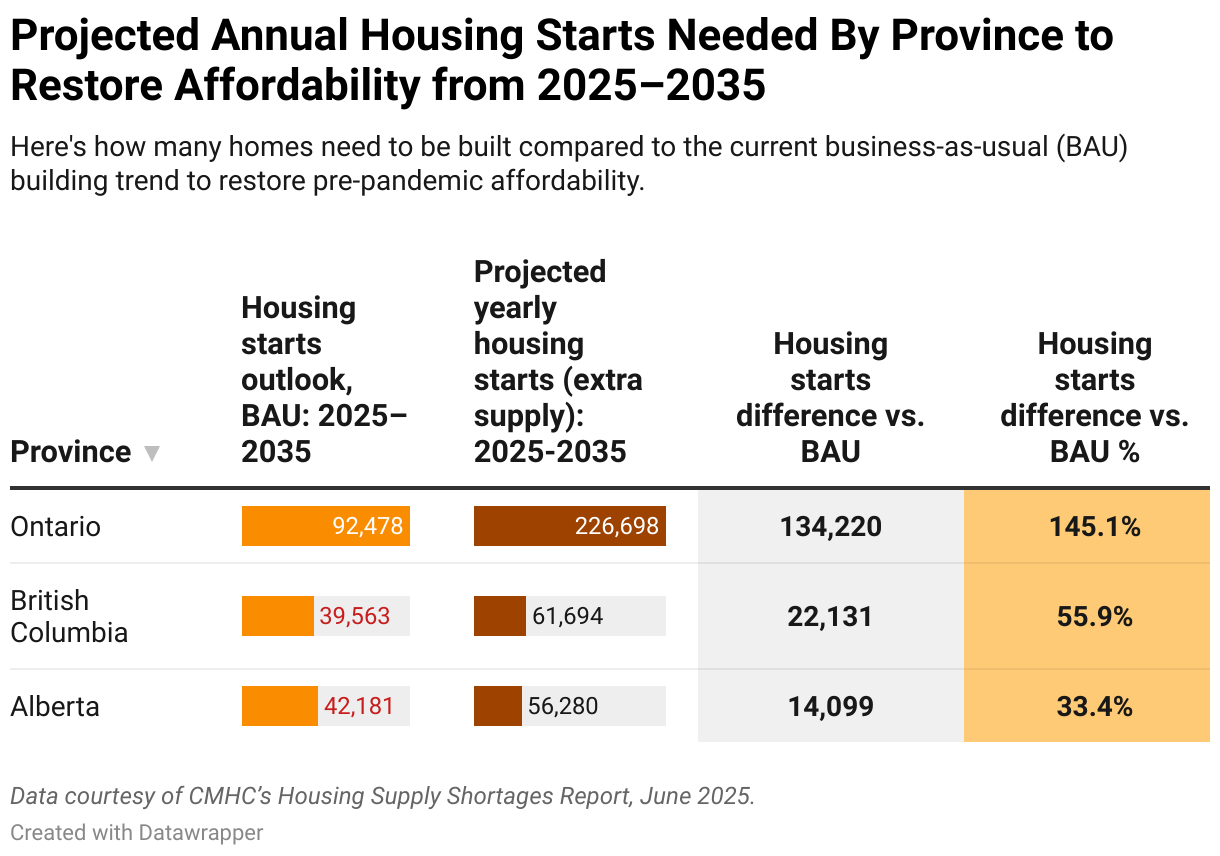
According to the Canada Mortgage and Housing Corporation (CMHC)’s latest report, Canada must significantly increase the pace of home construction to return to the affordability levels of the early 2000s by 2035. This means scaling annual housing starts from roughly 250,000 units to between 430,000 and 480,000. The challenge isn’t equally distributed: Ontario would need to increase housing starts by an overwhelming 145.1%, and British Columbia by nearly 56%. By comparison, Alberta’s required increase sits at 33.4%—still ambitious but substantially more manageable.
Edmonton and Calgary’s Success Story
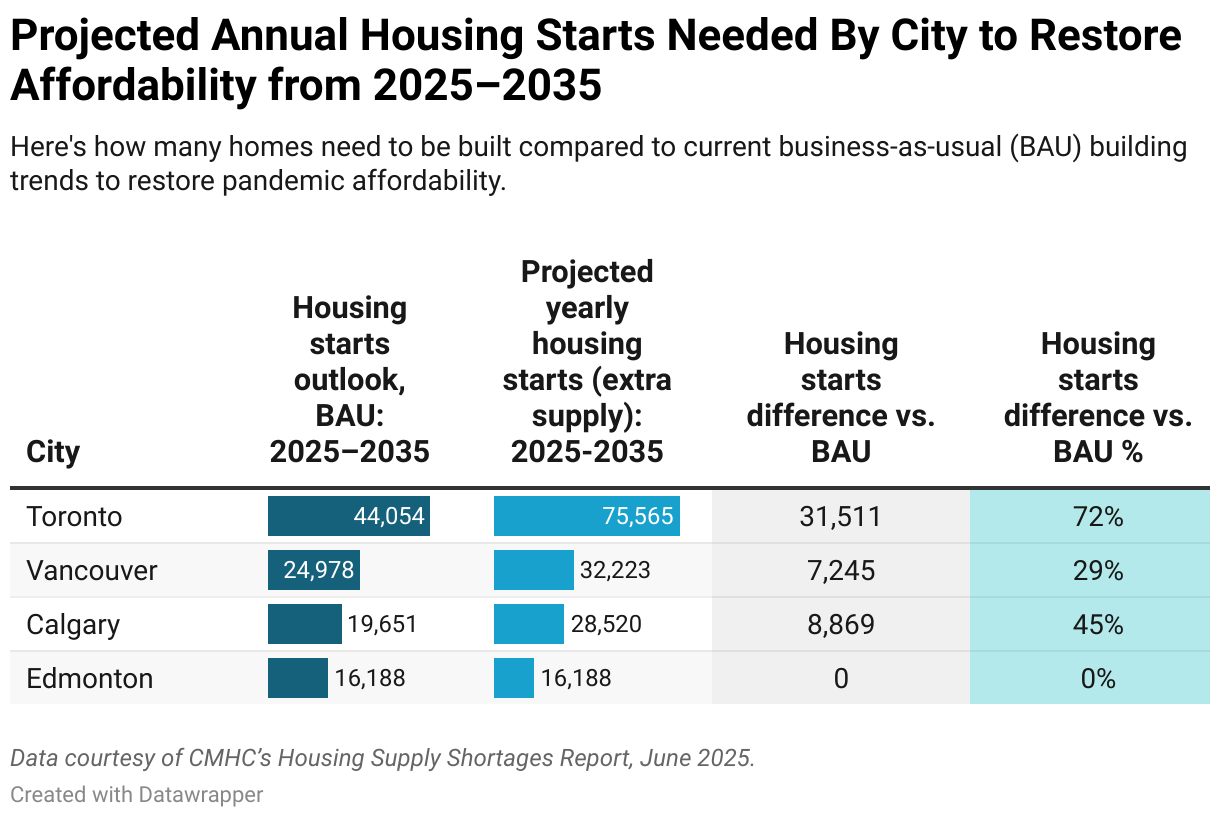
Within Alberta, Calgary is projected to require a 45.1% increase in housing starts, from its current annual average of 19,651 units to 28,520 units. Calgary’s affordability ratio (the percentage of income needed to purchase a home) has risen from 27% before the pandemic to 38% today. Even if the city meets its construction target, home prices are still expected to rise 7.3% by 2035. However, Calgary is already showing progress.
Through its “Home is Here” building strategy, the city has implemented or initiated 88% of its 98 housing-related actions. In 2024 alone, it approved 22,500 market homes and 893 non-market homes. In the first quarter of 2025, Calgary delivered 2.5 times more housing starts than Vancouver and five times more than Toronto, highlighting the city’s proactive stance on housing development.
Edmonton is even further ahead. It is the only major Canadian city where CMHC reports no need to accelerate current construction. With 16,188 homes built annually, Edmonton is already on track to meet future demand. Its affordability ratio has inched up modestly, from 26% pre-pandemic to 31% in 2024, with a target to return to 30%. Despite stable construction levels, Edmonton’s home prices are still projected to increase by 25.2% by 2035. The city isn’t resting on its laurels. Between 2023 and 2025, it committed to delivering 2,922 affordable housing units, exceeding its initial goal of 2,700. Since 2019, Edmonton has invested over $256 million in affordable housing, unlocking more than $1 billion in combined federal and provincial funding and developing nearly 5,600 units in total.
One of Alberta’s most significant advantages lies in its development conditions. Compared to Ontario and British Columbia, it’s easier and more cost-effective to build homes in Calgary and Edmonton. These cities benefit from greater land availability, lower land costs, more flexible zoning rules, and fewer regulatory roadblocks. Edmonton has led efforts to increase residential density, simplifying the development of diverse housing types. In contrast, growth in Toronto and Vancouver is hindered by land constraints, high costs, restrictive zoning, and sluggish permitting processes. A 2024 report by BILD GTA found that Ontario is now building fewer homes per new resident than at any time since 1972. The cost of government-imposed fees compounds the challenge. In Ontario, municipal housing-related taxes can make up more than 25% of a new home’s price. When including land transfer tax, GST, and HST, these charges can exceed $250,000 per home.

The Meaning of “Affordable Housing”
When discussing the construction of affordable housing, it’s essential to clarify what “affordable” actually means. According to the CMHC, housing is considered affordable if it costs less than 30% of a household’s pre-tax income. That definition puts Alberta in a relatively strong position—thanks to the province’s higher average salaries compared to Ontario and British Columbia, Albertans can stretch their housing budgets further.
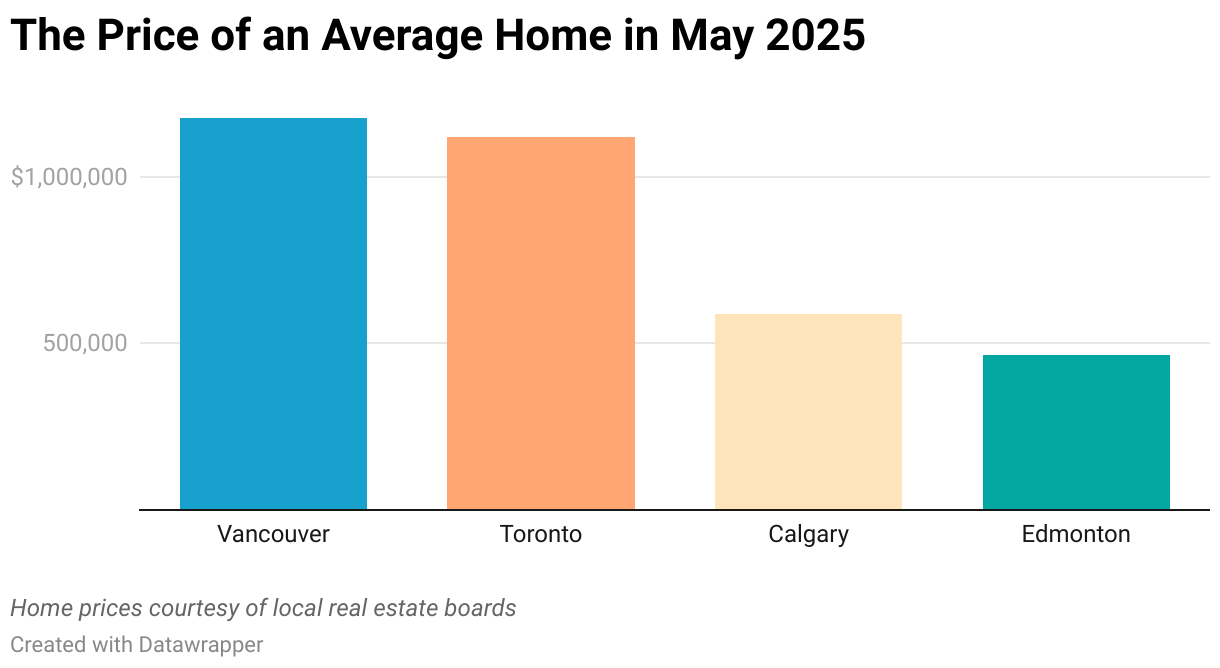
This financial advantage is especially significant when paired with Alberta’s lower average home prices. While average home prices in Toronto and Vancouver soar past $1.1 million, they sit at approximately $589,900 in Calgary and $464,277 in Edmonton. The gap also reflects the growing nature of cities. Land constraints and high demand in cities like Toronto and Vancouver mean new developments are mostly limited to dense condo towers. In contrast, Calgary and Edmonton still have room to grow outwards, allowing developers to offer a wider mix of housing types (from condos to detached homes and townhouses), which makes it easier to build more homes and also more inexpensively.
The Ripple Effect of Interprovincial Migration
The housing pressures in Ontario and British Columbia are now spilling over into other provinces. As more residents from these high-cost regions relocate to places like Alberta and Nova Scotia, demand (and by extension, home prices) are increasing in previously more affordable markets. Cities like Calgary and Halifax experienced noticeable declines in affordability as well as increased interprovincial migration since the 2020 pandemic.

Kelowna’s Innovation in Action
Despite the growing strain, some cities are taking the lead with forward-thinking initiatives. Kelowna, British Columbia, has become a national leader in permitting innovation by using AI-powered chatbots to streamline the application process. Where permits used to take between one and six weeks, straightforward applications are now being approved in minutes. Most are processed within two to twenty business days. In 2023 alone, Kelowna issued a record $1.75 billion in building permits. Of those permits, 84% were for apartments.
According to the BC Check-Up: Invest 2024 report, housing starts in the Thompson-Okanagan region rose by 21.4%, primarily driven by a 39.5% increase in multi-unit construction in Kelowna.
This growth was supported by the improved efficiency of an AI chatbot, which eased staff workloads and set a new benchmark for municipalities nationwide.
Calgary’s Downtown Office Conversion Strategy
Calgary is also pioneering bold strategies by converting underused downtown office space into residential units. According to its municipal government, the program aims to remove six million square feet of office space from the downtown area by 2031. As of mid-2025, Calgary had approved 21 office conversion projects, which translated to 2.68 million square feet, resulting in 2,628 new homes, a 226-room hotel, and a hostel. The latest wave of approvals added more than 1,100 new homes, expected to house approximately 2,000 people. The city’s first completed conversion project, The Cornerstone, transformed an empty office building into 112 two- and three-bedroom apartments, 40% of which are designated as affordable, meaning they were priced 20% below market value.
Toronto Can’t Follow Suit in Office Conversions
Toronto, by contrast, faces significantly more complex barriers to converting offices into residential units. According to an analysis by Gladki Planning Associates and Parcel for the City of Toronto, financial feasibility is a significant challenge. High construction costs, low expected returns, and rising interest rates make these projects unattractive to developers.
Compounding the issue are rigid zoning policies, heritage protections, and a slow approvals process. Additionally, the city’s policy to protect existing office space, particularly near transit corridors, further restricts what can be converted. When it comes to the construction of Toronto office buildings (especially those constructed after 1960), many have structural limitations, such as large floor plates and outdated infrastructure, that make residential retrofits difficult and expensive. Without a cohesive strategy or clear incentives, Toronto’s path toward meaningful office conversion remains uncertain and cost-prohibitive.

Ontario’s Housing Slowdown and Push to Build Smarter
According to the Financial Accountability Office of Ontario, the province started just 12,700 homes in Q1 2025, a 20.2% drop from the previous quarter and the lowest since 2009. Of these, 80% were multi-unit buildings, such as condos, while 20% were single-family homes. High construction costs and weak sales are slowing momentum.
To counter this, the Protect Ontario by Building Faster and Smarter Act, 2025, aims to accelerate housing and infrastructure by:
- Standardizing development charges across regions
- Removing barriers to the use of innovative building materials
- Fast-tracking approvals for transit-related projects
The province is also investing an additional $400M, raising total infrastructure funding to $2.3B. Leaders across municipalities and real estate sectors have welcomed the plan.
“For too long, high development charges, excessive red tape, and sluggish approval processes have prevented the construction of homes our communities need. Today’s legislation introduces more than 25 key policy initiatives to speed up housing development,” says Elechia Barry-Sproule, the president of TRREB.
Building Responsibly and the Need for Bird-Safe Design
While building more homes faster is a top priority, it’s also important to ensure that new developments are safe for both people and wildlife. FLAP Canada states that most new buildings lack bird-safe designs, despite the availability of affordable, proven solutions. While cities like Toronto have adopted guidelines, FLAP calls for province-wide standards to protect migratory birds.
Thinking about your next real estate move? Start your search today!