

Denver has undergone a remarkable transformation over the past few decades. Today, it ranks among the top walkable metropolitan areas in the United States. As demand grows for neighborhoods where residents can live without relying heavily on cars, interest in Denver’s most walkable neighborhoods continues to rise.
How Walkability Is Measured in Denver
Urban walkability is typically measured using the Walk Score system, which rates neighborhoods on a scale from 0 to 100 based on their proximity to amenities such as grocery stores, parks, restaurants, schools, and transit.
Recent data shows that:
- About 32% of Denver residents live in areas with a Walk Score of 70 or higher
- 62% live in neighborhoods with a score above 50
- Only 5% remain in strictly car-dependent areas
Not only does walkability influence convenience, but it also affects property values. Research suggests that every single point increase in Walk Score may boost a property’s value by up to $3,000.
Top Walkable Neighborhoods in Denver
Denver’s most pedestrian-friendly communities combine dense housing, local retail, transit connections, and bike infrastructure. Here are some of the city’s standout walkable neighborhoods.
Capitol Hill
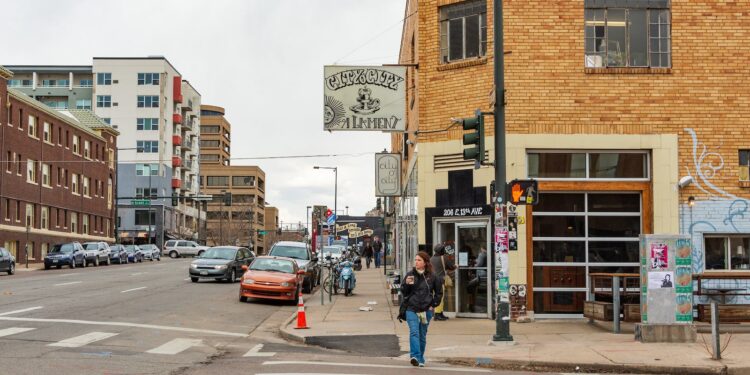
Capitol Hill is widely considered Denver’s premier pedestrian neighborhood with a Walk Score of 94. Built largely in the early 20th century, the area’s historic development patterns—smaller blocks, mixed-use buildings, and dense housing—naturally support walkability.
Today, residents can stroll through the neighborhood to find independent cafes, late-night bars, and eclectic shops occupying historic houses and early-20th-century apartments. The neighborhood is also within walking distance of cultural landmarks like the Denver Art Museum, the Molly Brown House Museum, and Civic Center Park.
The walkability of Capitol Hill is further amplified by its proximity to the “Golden Triangle” and “Uptown.” However, the neighborhood’s high Walk Score is offset by its relatively modest Transit Score of 60, suggesting that while most errands can be completed on foot, public transit options are less robust than in the central business district.
LoDo & Downtown
Lower Downtown (LoDo) and the surrounding Downtown core sit at the center of Denver’s transportation network, where multiple transit options connect. LoDo has a Walk Score of 91, but its most notable feature is its Transit Score of 88. This is largely due to Denver Union Station, which serves as the region’s main hub for commuter rail, light rail, and bus services.
Pedestrian activity in LoDo is anchored by the 16th Street Mall, a transit corridor served by the Free Mall Ride shuttle. The city has also invested in protected bike lanes on 15th, Lawrence, and Arapahoe streets, as well as a redesigned 14th Street streetscape. With some areas exceeding 30,000 residents per square mile, LoDo’s high population density supports a wide range of restaurants, galleries, and sports venues such as Coors Field.
RiNo & Five Points

The River North Art District (RiNo) and Five Points show how repurposing former industrial buildings and preserving historic structures can create lively, walkable neighborhoods.
RiNo has been transformed into a hub for creatives and young professionals, featuring warehouse-to-loft conversions, breweries, and galleries. The neighborhood’s walkability is supported by pedestrian bridges at 35th and 38th streets, helping connect residential areas with nearby transit stops and commercial districts.
Five Points, historically known as the “Harlem of the West,” maintains a Walk Score of 90 and is a “Biker’s Paradise” with a score of 98. The neighborhood’s walkability centers around the Welton Street corridor, which is served by the L Line light rail and provides direct access to downtown.
The Highlands (LoHi)
The Highlands, particularly Lower Highland (LoHi), is one of the most desirable neighborhoods for young professionals looking to live just a short distance from downtown. LoHi connects to the central business district via the Highland Bridge, a well-known pedestrian bridge that enables easy car-free commutes.
The Highlands’ culinary scene is a major driver of its walkability, with spots like Avanti Food & Beverage and numerous rooftop patios providing a “social anchor” for the community.
Cherry Creek
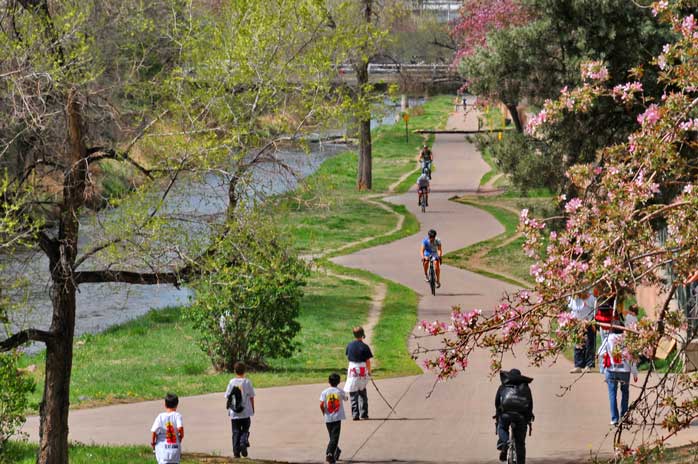
Cherry Creek is Denver’s premier example of “polished” walkability. The neighborhood is divided into Cherry Creek North—a 16-block commercial core with over 500 galleries, boutiques, and cafes—and the surrounding residential streets.
With a Walk Score of 81 to 90 depending on the specific block, Cherry Creek is consistently ranked among the top most walkable areas.
A major amenity contributing to its walkability is the Cherry Creek Trail, a 42-mile off-road path that allows for uninterrupted pedestrian and cyclist movement from the neighborhood into the heart of downtown.
Washington Park
Washington Park (Wash Park) represents a “hybrid” model of walkability, where pedestrian utility is centered around a massive public green space rather than a dense commercial core.
The park spans 165 acres and features two lakes and a 2.6-mile loop frequently used by runners and cyclists. Nearby residential streets are leafy and quiet, while the South Pearl Street and Old South Gaylord shopping districts provide restaurants, cafés, and other daily amenities within walking distance.
Infrastructure Challenges and Future Plans
Despite improvements, Denver still faces significant gaps in pedestrian infrastructure.
City reports show that:
- 40% of sidewalks are missing or too narrow
- Only 5% of sidewalks meet modern design standards
- Signalized crossings on major roads average over 1,200 feet apart
To address these issues, the city launched the Denver Moves: Pedestrians & Trails initiative, a long-term plan aimed at improving sidewalks, crossings, and bike routes.
The Future of Walkable Living in Denver
Denver’s transition from an auto-centric city to a pedestrian-friendly urban environment is still underway. From historic districts like Capitol Hill to revitalized areas like RiNo, the most walkable neighborhoods in Denver highlight how urban design and community amenities can work together to support vibrant city living.
Ready to live in one of the most walkable neighborhoods in Denver? Explore available homes with Zoocasa and start your search today.