

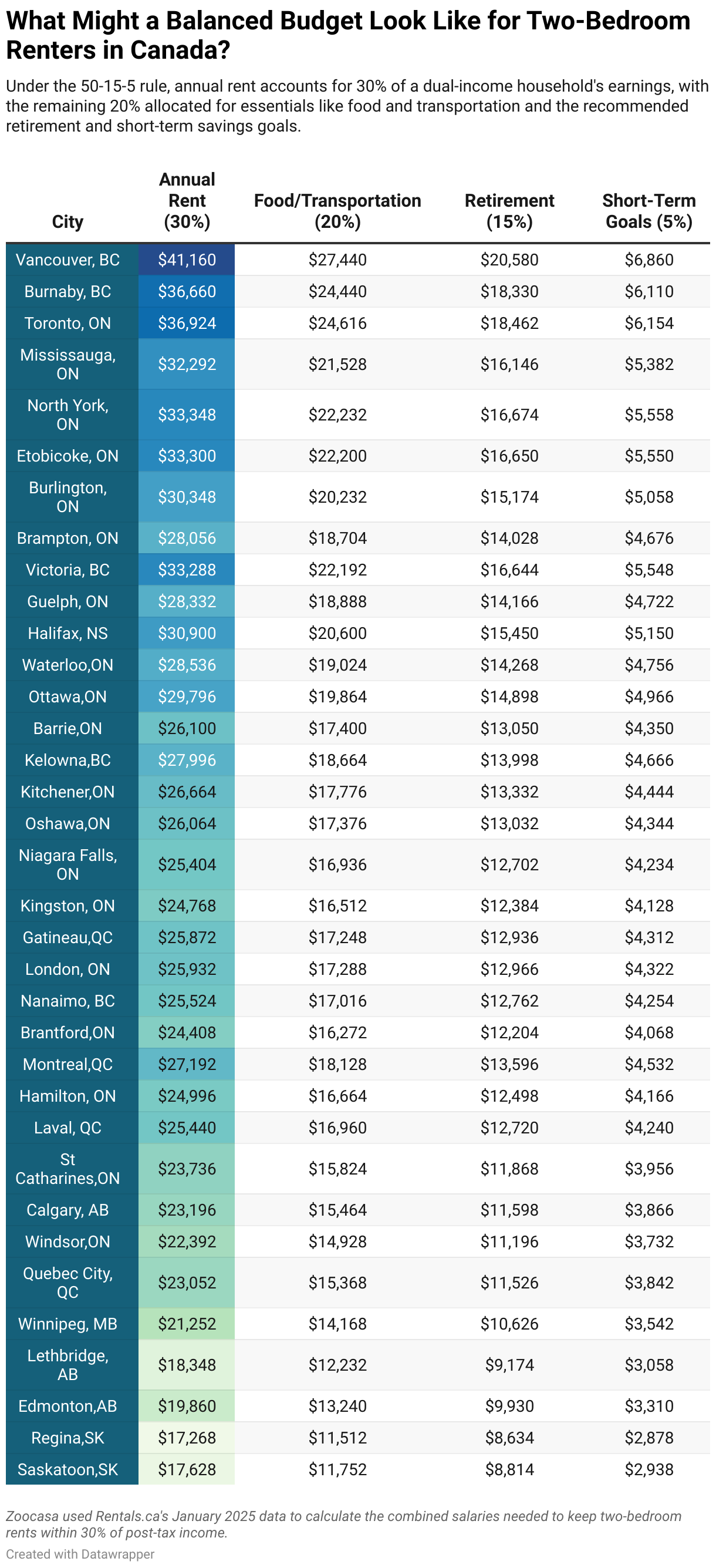
Rising costs for essentials like groceries and childcare and a growing number of Canadians renting their homes have made the once-reliable 30% rule for housing expenses a challenging goal. To add perspective, Fidelity, an Investment Canada firm, emphasizes a financial stability guideline that allocates 50% of income to necessities, 15% to retirement savings, and 5% to short-term goals—creating a framework for managing today’s financial pressures.
However, if you and your significant other aim to spend 30% of your income on renting a two-bedroom apartment, what should your salary look like to make that work? And more importantly, can you balance the rest of your budget—retirement savings, short-term goals, and food—while staying financially sound?
Zoocasa explored how close Canadians come to hitting these financial targets, breaking down affordability city by city. The result: A clearer picture of where the 30% rule is possible and which cities it might just be wishful thinking.
Methodology:
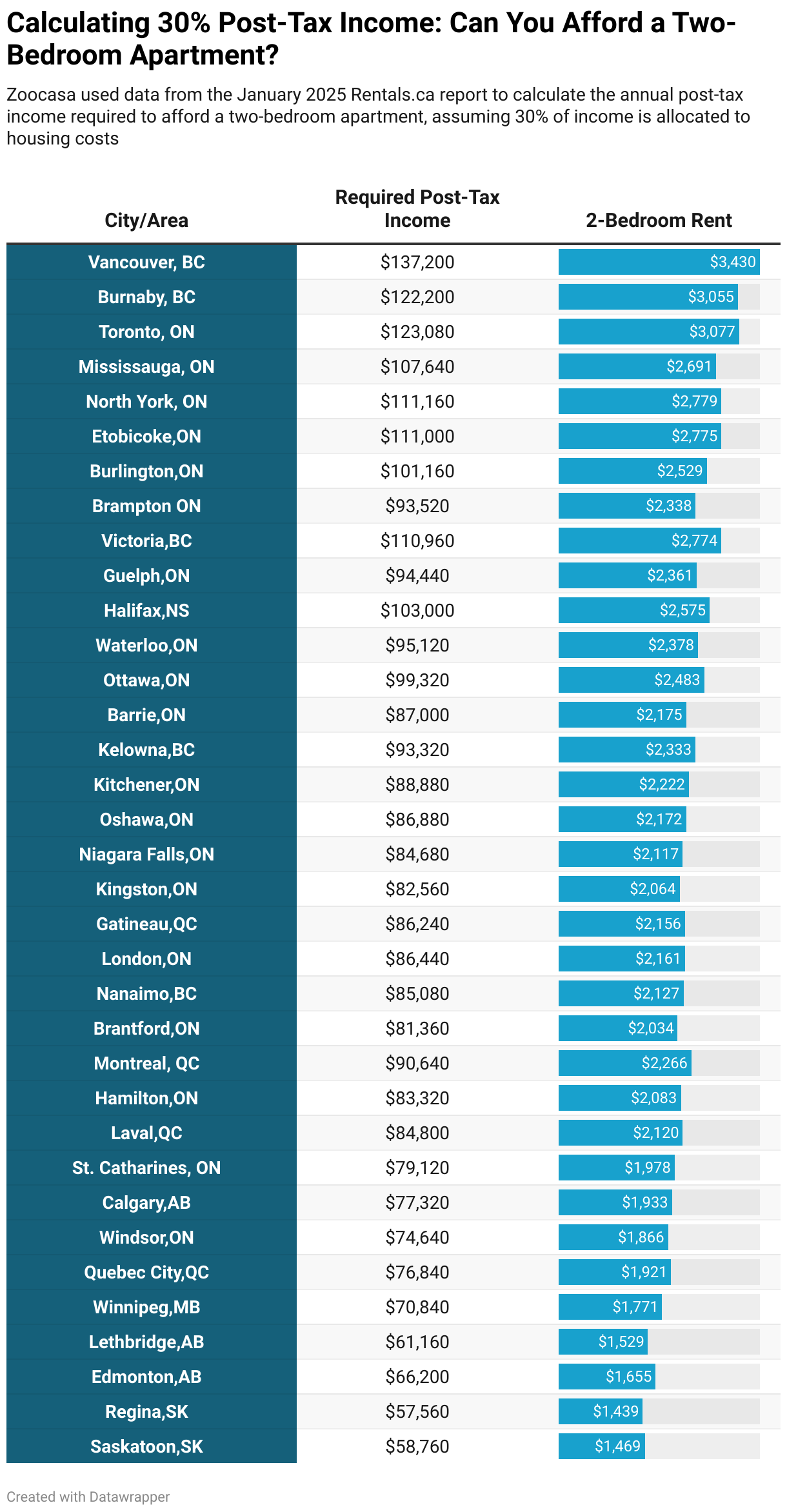
Zoocasa analyzed housing affordability by calculating the combined salaries of two individuals needing to keep two-bedroom rental costs within the recommended portion of post-tax income. These figures were then compared to data from the Rentals.ca January 2025 report. Using data from Statistics Canada’s Income Explorer, which tracks median earnings by age, geography, and family structure, the analysis compares 2019 and 2020 incomes against the income needed to meet this recommended threshold. This report focuses on dual-income households, so the average income was doubled to reflect the combined earnings of a couple/two people.
Where Dual Incomes Stretch Further: Western Canada’s Affordable Cities
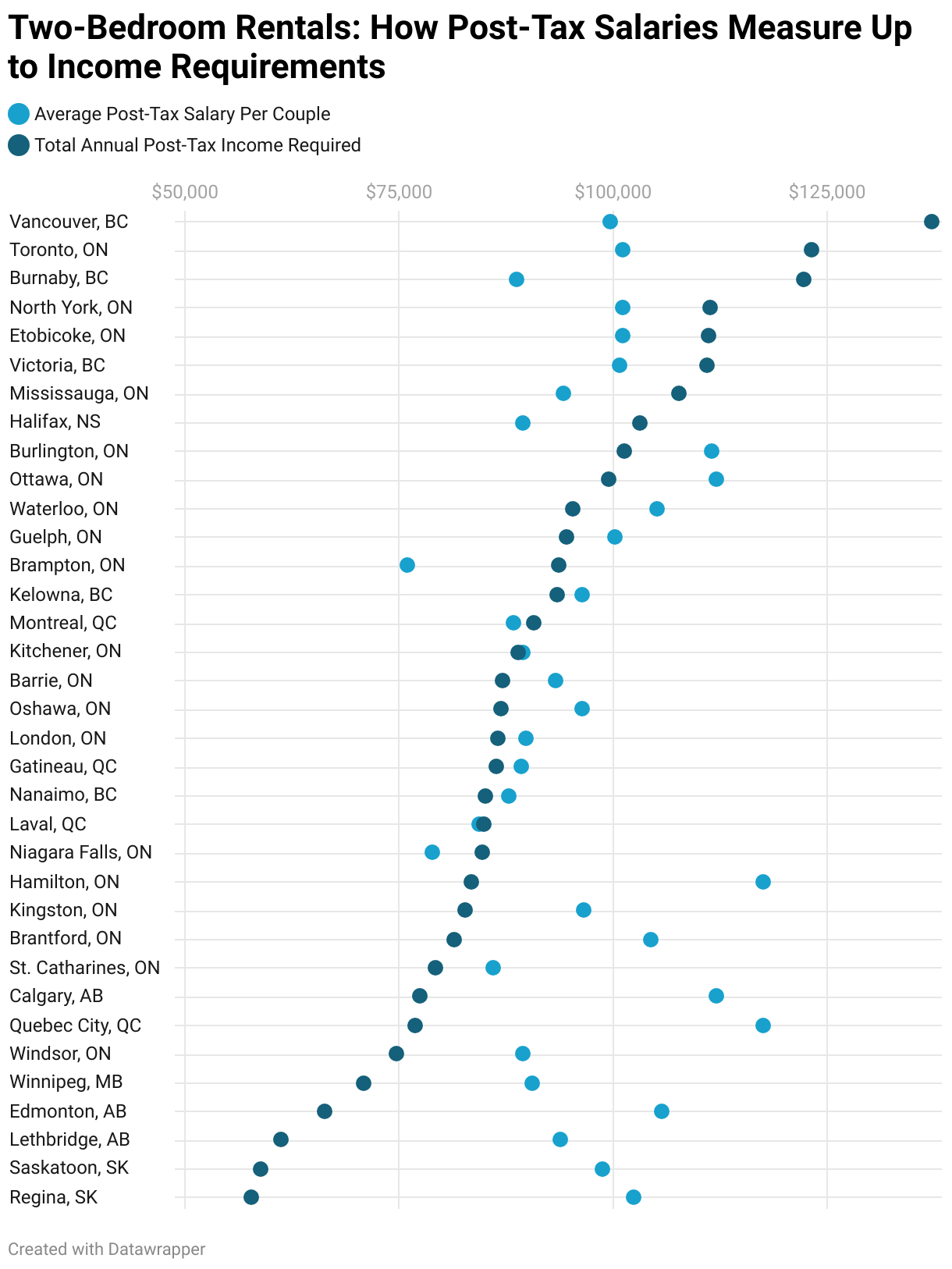
For those aiming to keep rent at 30% of their income while affording a two-bedroom apartment, several Canadian cities stand out for their affordability. Regina’s required annual income to stay within this threshold is $57,560. With an average income of $102,240, a dual-income household earns $44,680 more than needed—a surplus of 78%. Similarly, Saskatoon offers notable financial flexibility, where the average dual income of $98,720 surpasses the $58,760 required by $39,960, a difference of 68%.
In Alberta, Edmonton offers the most substantial affordability for renters, with an average dual income of $105,600 exceeding the $66,200 required to stay within the 30% rent threshold by $39,400—a surplus of nearly 60%. Lethbridge follows closely, where a dual-income household earning $93,680 makes $32,520 more than the $61,160 needed, a difference of 53%. Calgary also stands out, with an average post-tax income of $112,000, surpassing the $77,320 required by $34,680, offering 45% more than necessary for housing costs. These cities collectively showcase Alberta’s favorable conditions for affordable living while leaving room for financial flexibility.
Rent Gaps and Buffers: Ontario’s Balancing Act
Toronto is particularly unaffordable, requiring $123,080 annually to keep rent within the 30% income threshold, yet average dual incomes of $101,040 leave a 21.8% gap. Mississauga follows with a slightly more manageable shortfall, where the $118,400 required surpasses average dual incomes by 14.3%. North York and Etobicoke offer more stable financial landscapes, with gaps of 10% and 9.9%, respectively, reflecting greater consistency within the Greater Toronto Area (GTA). However, Brampton faces the tightest margins, with an average dual income of $75,920 falling 23.2% short of the $93,520 needed, highlighting significant financial strain.
On the other hand, cities like Burlington and Hamilton exemplify affordability in Ontario. Burlington’s required income of $101,160 is comfortably surpassed by an average dual income of $111,400, creating a 9.2% surplus and providing residents with a financial buffer. Hamilton residents fare even better, earning $117,400 annually—40.9% above the $83,320 required for rent. Ottawa also demonstrates strength, with average dual incomes of $112,000 exceeding the $99,320 threshold by 12.8%.
Where Average Dual-Incomes Can’t Keep Up With Rent Costs
Renting a two-bedroom apartment while adhering to the 30% income guideline is increasingly challenging in some Canadian cities, where housing costs significantly outpace average incomes. Vancouver and Burnaby face identical percentage gaps, with residents needing to earn 27.5% more to meet the 30% rule. In Burnaby, residents require an income of $122,200, while the average dual income of $88,560 leaves a shortfall of $33,640. Similarly, Vancouver presents the highest income requirement at $137,200, but with an average dual income of $99,520, residents face a significant gap of $37,680.
Outside of British Columbia and Ontario, Halifax, the capital city of Nova Scotia, requires an income of $103,000, leaving a $13,720 gap for residents earning an average dual income of $89,280—a 13.3% deficit.
In contrast, cities like Laval, QC, and Kitchener, ON, demonstrate a closer alignment between income and housing costs, offering rare affordability. In Laval, the $84,800 required for rent is just 0.6% higher than the average dual income of $84,320, showcasing an almost perfect balance. Similarly, Kitchener’s average dual income of $89,440 exceeds the $88,880 required by 0.6%, reflecting another well-balanced market. These cities stand out as examples of financial equilibrium, where housing costs and incomes align, providing residents with more significant financial security and growth opportunities.
However, with such narrow margins, even small changes in income or rent could tip the balance, making it essential for residents to regularly review their budgets to maintain financial stability and long-term growth.