

After two years of steep borrowing costs and growing inventory, Canada’s condo market cooled in 2025. Prices have dipped in nearly every major region, but the extent of those declines depends on where you look. Urban cores largely held their ground, while suburban and vacation-focused markets faced sharper corrections. Zoocasa analyzed condo price trends in Toronto, Vancouver, and Calgary to identify areas with the most significant price corrections and those demonstrating market resilience.
Toronto’s Outer Suburbs Take the Hardest Hit
Across all Toronto regions, the average condo price decreased by 4% year-over-year, falling from $682,543 to $655,231, a difference of approximately $27,000. For buyers, that kind of change can translate into tens of thousands of dollars saved on the purchase price alone, lowering both upfront costs and long-term borrowing amounts.
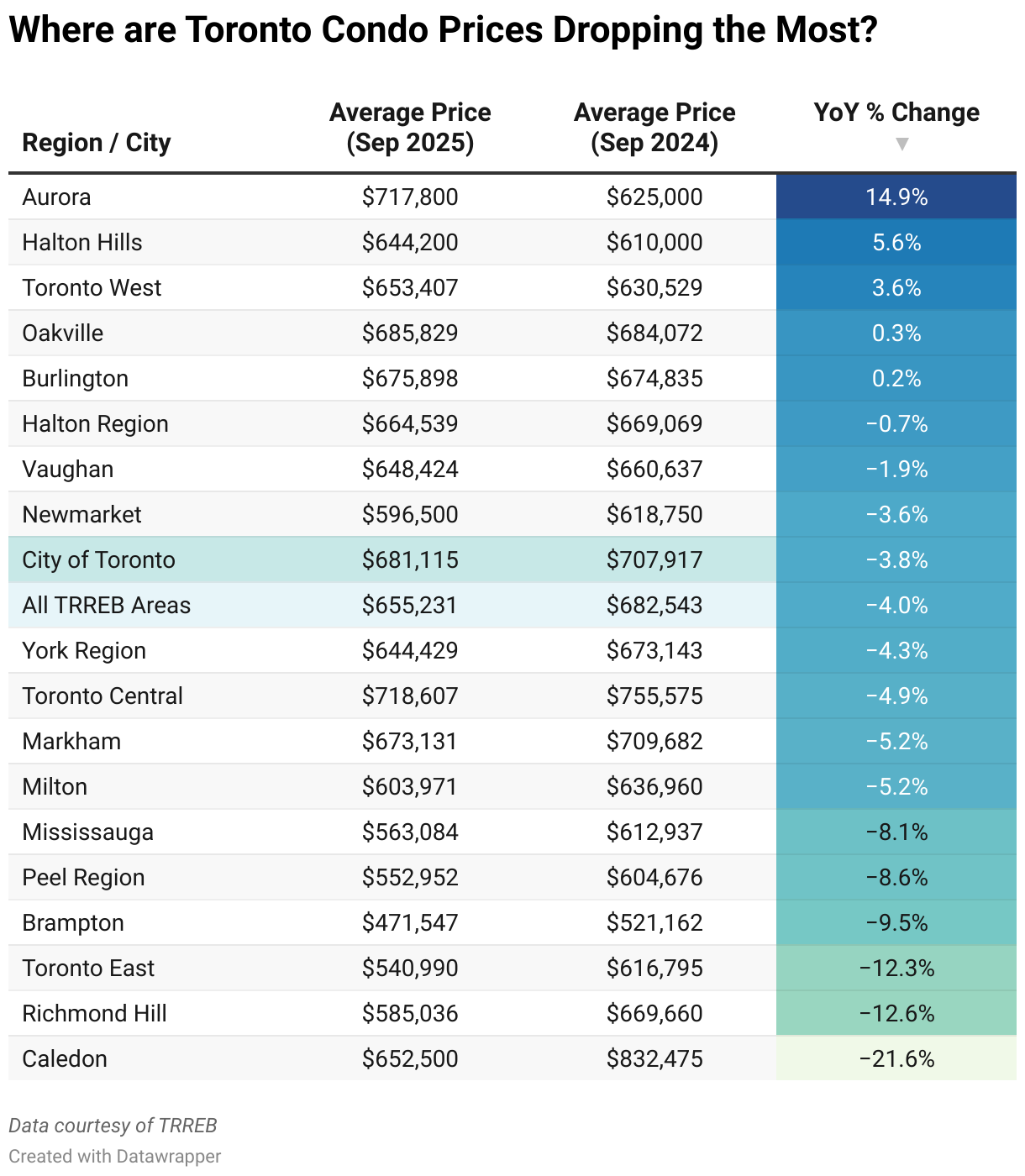
The City of Toronto saw a modest -3.8% decrease, but further outside the core, the story was very different. In nearby regions such as Caledon, Brampton, and Richmond Hill, prices dropped anywhere from $50,000 to over $180,000 year-over-year, illustrating how outer markets absorbed much deeper corrections than the 416.
These price drops reversed much of the rapid appreciation seen during the pandemic, particularly in outer suburbs, where affordability had once drawn first-time buyers.
Aurora and Halton Hills Defy the Downturn
Not every part of the GTA followed the same trend. Aurora (+14.9%) was one of the year’s strongest performers, with average condo prices climbing from $625,000 to $717,800, a gain of nearly $93,000. Halton Hills (+5.6%) also saw prices rise, while Oakville and Burlington remained flat.
These mid-sized, well-connected towns demonstrate how local factors—such as limited inventory and commuter convenience—helped insulate certain markets from broader price declines.
Vancouver’s Market Cools, Especially in Vacation Destinations
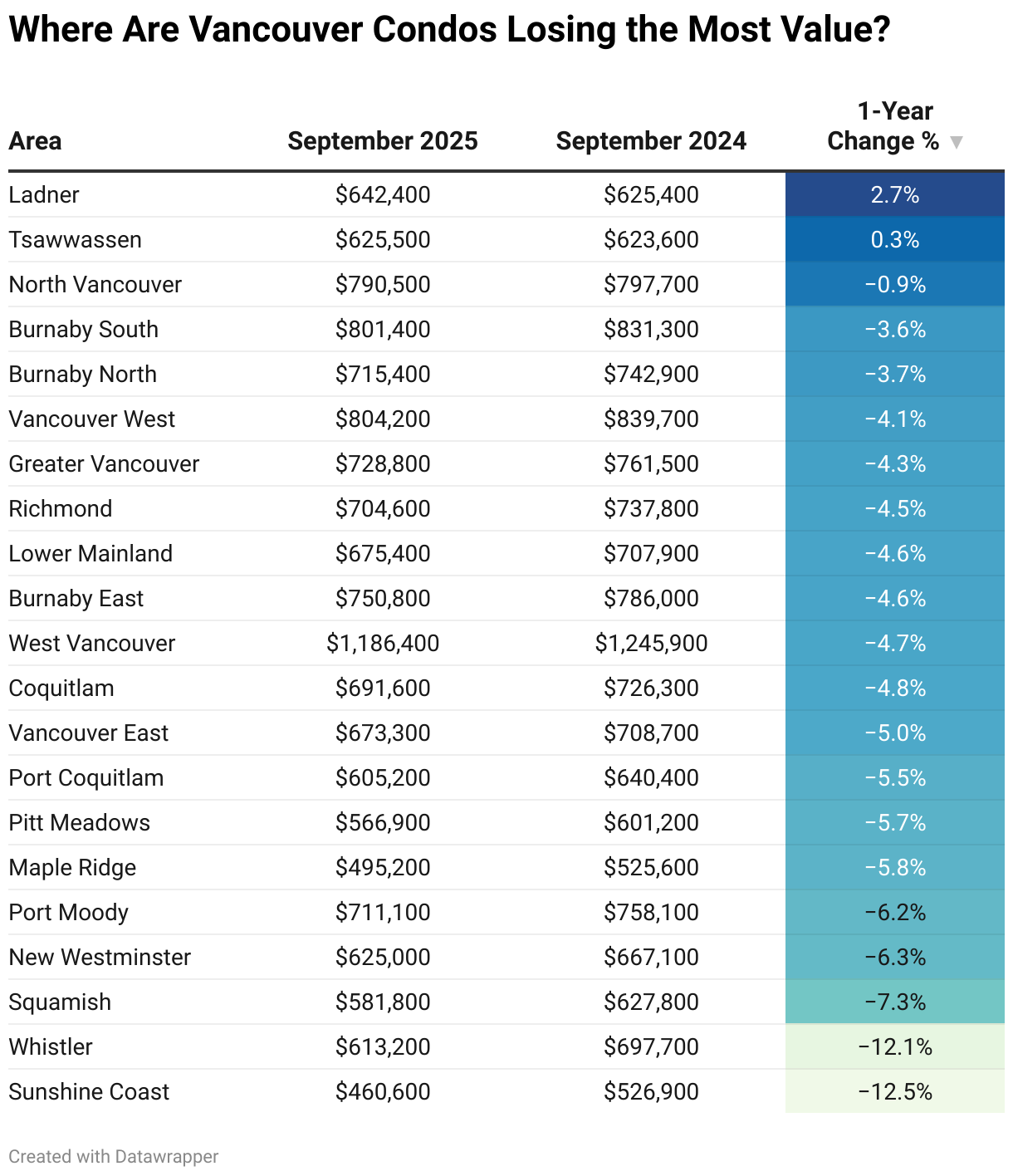
On the West Coast, Vancouver and the Lower Mainland saw more gradual declines. The Lower Mainland’s benchmark condo price fell 4.6%, while Greater Vancouver declined 4.3% compared to September 2024.
City centres were relatively stable. Vancouver East (-5.0%) and Vancouver West (-4.1%) moved roughly in line with the regional average, while nearby Burnaby, Coquitlam, and Richmond experienced similar drops, ranging from 3% to 5%.
The bigger losses came from recreational and secondary-home markets. Whistler (-12.1%), Sunshine Coast (-12.5%), and Squamish (-7.3%) saw the steepest declines, signalling a broader cooling in vacation-focused areas that surged during the pandemic.
Calgary Remains Canada’s Most Consistent Market
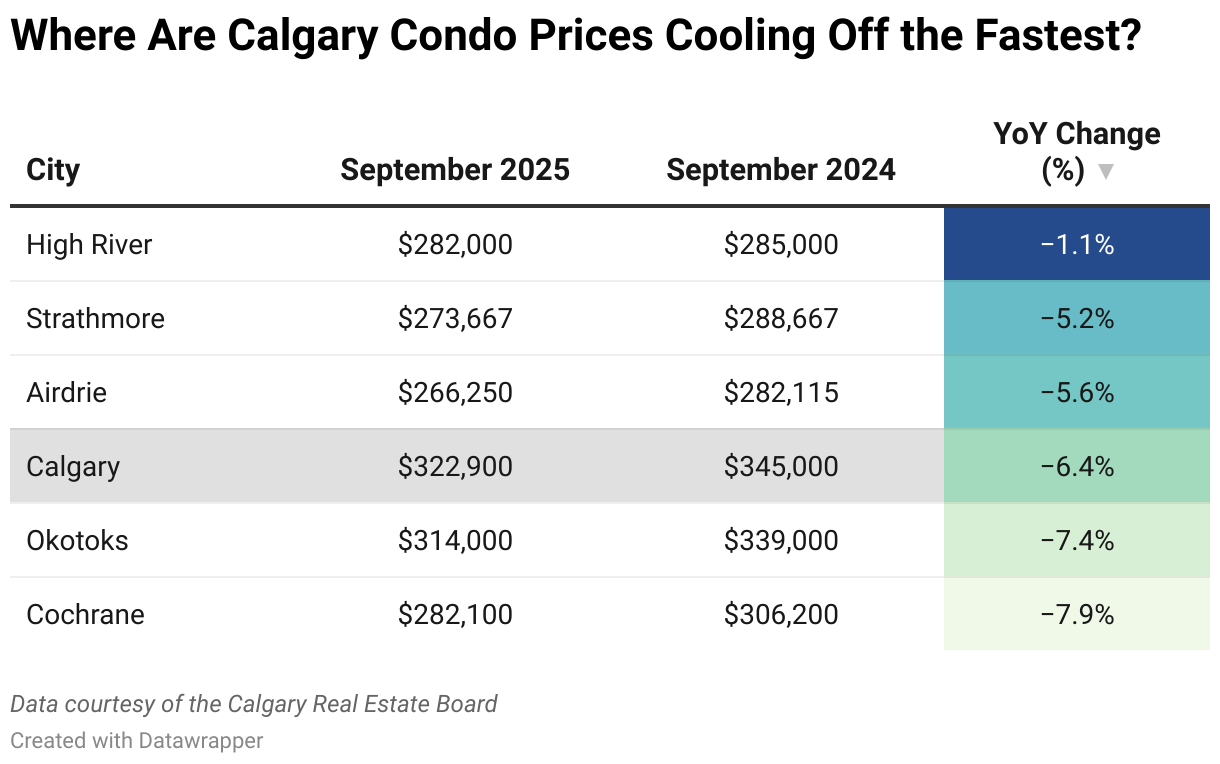
While other regions saw wider swings, Calgary’s condo market remained relatively steady in 2025. The City of Calgary recorded a 6.4% drop, from $345,000 to $322,900, while surrounding communities experienced a similar decline.
Related: How Many Months of Rent You’d Need to Save for a Home in Edmonton and Calgary
Airdrie (-5.6%), Strathmore (-5.2%), and Okotoks (-7.4%) posted modest declines, while Cochrane (-7.9%) saw the largest adjustment in the region. High River (-1.1%) remained nearly unchanged.
Compared to the volatility in Ontario and British Columbia, Calgary’s market stood out for its consistency, a reminder that slower, steadier adjustments often create more predictable outcomes for both buyers and sellers.
A Year of Rebalancing Across the Country
Across all three metropolitan regions, 2025 represented a year of correction and recalibration. Condo prices eased in most areas, but the easing was uneven: Calgary remained stable, Toronto showed sharp contrasts between the core and suburbs, and Vancouver cooled gradually, with sharper dips in lifestyle-driven markets.
Rather than a full-scale correction, these shifts reflect a return to balance after several years of aggressive growth. Prices have been adjusted, but few markets have experienced the kind of deep volatility seen earlier in the decade.
What This Means for Buyers
For buyers, 2025 created space to move more deliberately. Even small percentage drops translated into significant dollar savings. In Brampton, a 9.5% decline is equivalent to approximately $50,000 less on a $520,000 condo compared to a year ago. In Airdrie, a 5% drop on a $400,000 unit equalled $20,000 in savings. In Coquitlam, a 4.8% decrease in the benchmark lowered the price by more than $34,000, making ownership more attainable for first-time buyers.
These adjustments have reopened doors for buyers who were previously priced out, especially in suburban and secondary markets. However, demand in stronger-performing regions, such as Aurora and Halton Hills, remained competitive, with annual increases adding between $30,000 and $90,000 to average prices.
What This Means for Sellers
For sellers, 2025 required recalibration. Within higher-priced markets, those same small percentage changes carried even greater weight. In Burnaby South, for example, a 5% adjustment on an $800,000 condo represented a difference of about $40,000—nearly the cost of a 10% down payment on a mid-range unit in the same area.
Still, not all sellers faced the same pressures. Those in steady or growing markets, like Calgary or Aurora, continued to see healthy activity, buoyed by consistent demand and a tighter supply. The key takeaway? Even modest percentage shifts can have significant financial implications, shaping how homeowners approach timing and pricing in the months ahead.
While many of 2025’s changes appear modest on paper, their real-world financial impact is substantial. A few percentage points can mean tens of thousands of dollars in either opportunity or loss, reshaping how Canadians buy, sell, and plan their next move in a more measured, financially grounded market.
In these cities, pricing strategy, market timing, and teaming up with a reputable real estate agent become even more crucial. If you’re interested in buying or selling before 2026, give us a call ! Our agents will help you find the perfect home.