

For first-time homebuyers, entering the real estate market can feel daunting—but choosing a location with favorable conditions can make all the difference. As we enter the last quarter of the year, Canada’s real estate landscape is marked by sharp contrasts: major cities are becoming more buyer-friendly, while smaller, more affordable regions are heating up for sellers.
Zoocasa analyzed which markets provide the best prospects based on the latest sales-to-new listings ratios, according to the respective local real estate boards’ August 2025 data. This ratio, a key indicator of market conditions, reflects the balance between supply and demand: a higher ratio signals a seller’s market, while a lower one suggests a buyer’s market.
- Below 40% → Buyer’s market: listings outpace sales, giving buyers more choice.
- 40–60% → Balanced market: demand and supply are aligned.
- Above 60% → Seller’s market: sales exceed listings, giving sellers the advantage.
Listings Outpace Demand in Toronto, Giving Buyers an Edge
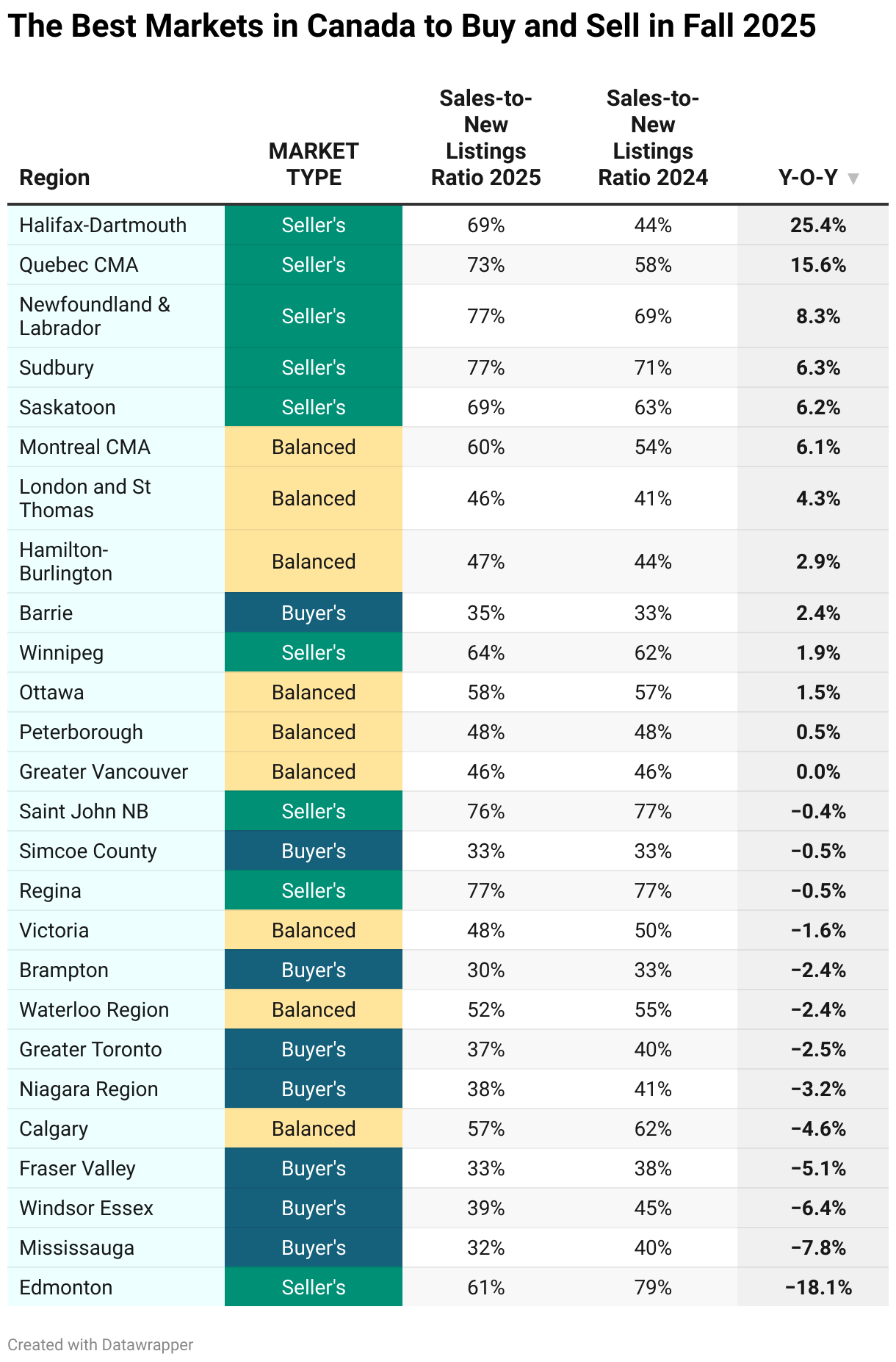
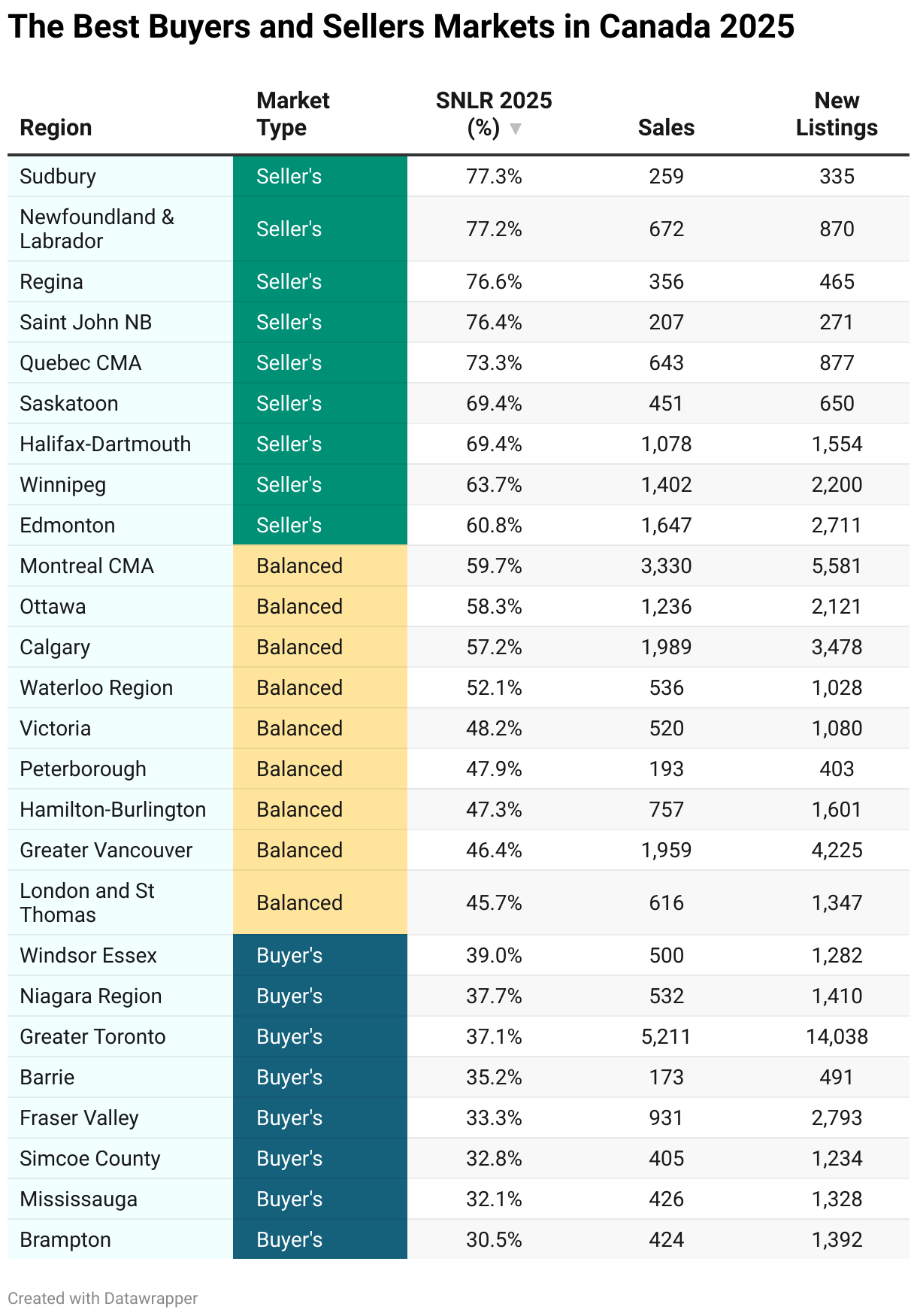
The Greater Toronto Area (GTA) is now one of Canada’s clearest buyer-friendly markets. Its ratio fell from 40% in August 2024 to 37% this year, firmly keeping it in buyer territory. With over 14,000 listings—the largest pool in years—buyers have room to negotiate, rather than being swept into bidding wars.
Other Ontario markets are following a similar trend. Niagara (38%) and Windsor-Essex (39%) both shifted from balanced to buyer’s territory this year, while Mississauga (32%), Brampton (30%), and Barrie (35%) all reinforced their buyer-friendly conditions. For Ontarians, the late-summer market of 2025 is delivering more breathing room than in years past.
Stability Returns to B.C.’s Housing Market
British Columbia’s housing market is showing signs of settling into a steadier rhythm this fall. The Fraser Valley continues to favor buyers with a sales-to-new listings ratio of 33%, giving those searching in suburban communities more inventory and less urgency than in recent years. Meanwhile, Greater Vancouver (46%) and Victoria (48%) remain firmly balanced, offering a middle ground where buyers can explore options without the pressure of bidding wars, and sellers can still expect consistent interest. Compared to the volatility of past years, this stability is a welcome change, making B.C. one of the few regions where market conditions are predictable, balanced, and easier to navigate as we head into winter.
Ontario Sees Buyers’ Market Majority
Ontario continues to dominate Canada’s buyers’ market landscape in 2025, but a few regions stand out for their notable year-over-year changes.
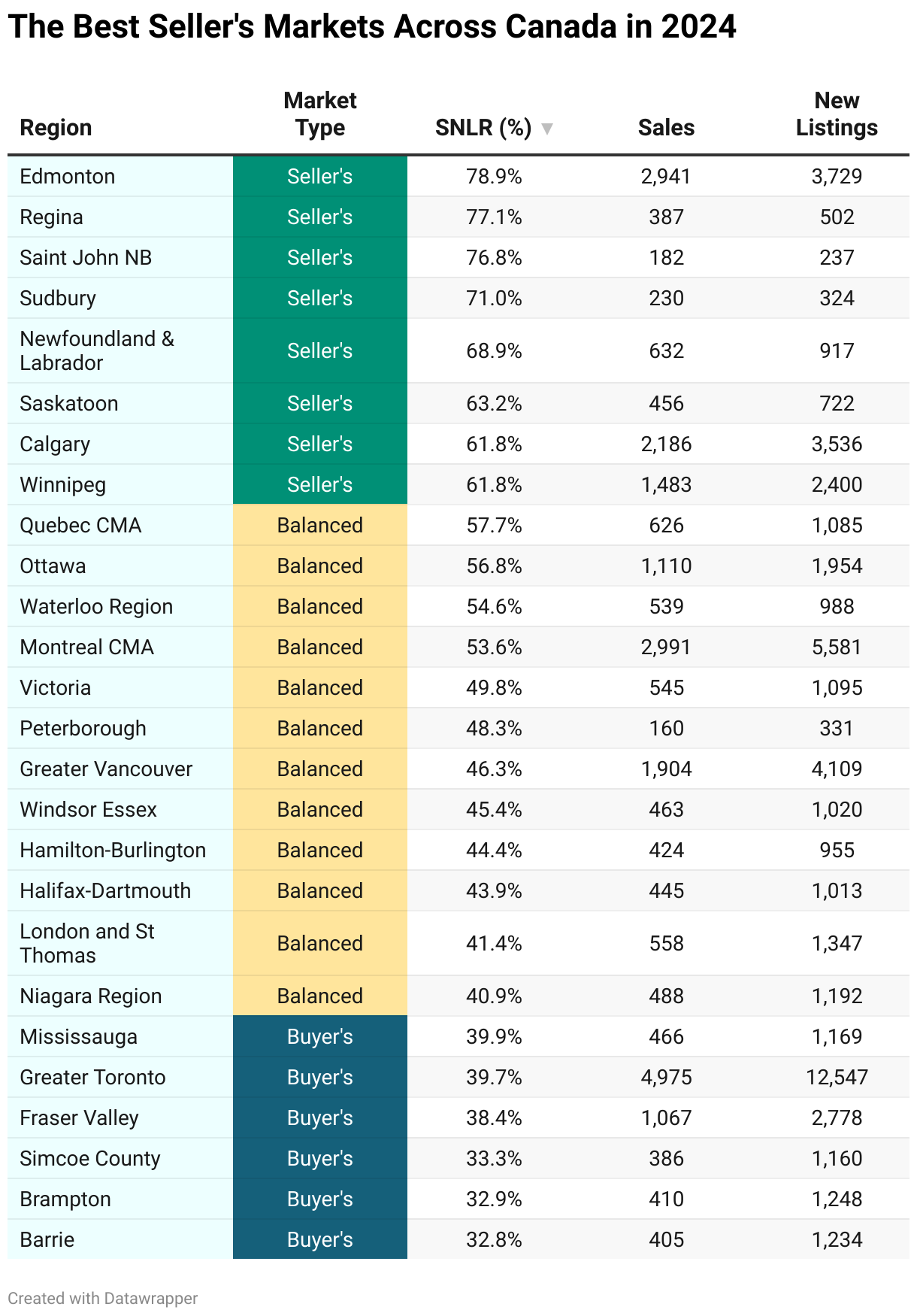
Mississauga experienced one of the sharpest declines, with its ratio falling from 40 percent in 2024 to 32 percent in 2025. The combination of fewer sales and more listings reinforced buyers’ control, making conditions notably less competitive than last year. Windsor-Essex also shifted into buyers’ territory, as its ratio slipped from 45 percent to 39 percent, pulling the region out of balance.
Overall, Ontario’s buyers’ markets highlight two clear trends: large urban centres, such as the GTA, are becoming increasingly favourable to buyers as listings accumulate, while smaller markets, like the Niagara region, highlight how quickly local dynamics can shift when inventory becomes tight.
Hot Sellers’ Markets This Fall
Another nine regions remain firmly in sellers’ territory, where demand is absorbing new listings at a rapid pace. Sudbury, for example, increased from 7 percent year-over-year, reinforcing Northern Ontario’s status as one of the country’s most competitive markets. Saskatoon has quickly become one of the country’s top three hottest housing markets. In 2025, its sales-to-new listings ratio rose to 69.38%, up from 63.16% in 2024 — a solid 6.22-point jump year over year. This means that a larger share of homes hitting the market are being sold quickly, showing just how strong buyer demand is. With buyers snapping up listings faster, the city is proving to be one of the most competitive real estate markets right now
Quebec CMA (73 percent), Saint John (76 percent), and Newfoundland & Labrador (77%) further illustrate how affordability relative to national averages continues to attract buyers and tighten supply conditions.
Halifax-Dartmouth experienced a whopping 25.44% year-over-year increase, transitioning from a balanced to a seller’s market. In the Prairies, Edmonton dropped 18.12% but remained in sellers’ territory. Nationally, Quebec CMA (+15.62%) also saw some of the largest gains.
Balanced Markets in Autumn 2025
The remaining eight regions demonstrate balanced conditions, where sales and new listings are more closely aligned, including Greater Vancouver, Victoria, Hamilton-Burlington, Waterloo, London & St. Thomas, Ottawa, Montreal CMA, and Calgary.
Balanced markets create an environment of relative stability, where neither buyers nor sellers have a decisive advantage. In these cities, pricing strategy, market timing, and teaming up with a reputable real estate agent become even more crucial. If you’re interested in buying or selling before 2026, give us a call ! Our agents will help you find the perfect home.