

Consumers are more aware than ever of their impact on the environment, but in order to achieve lasting change, you have to look beyond products and into patterns. Where you live, how you get to work and what you eat all play into the amount of waste you generate. In sustainable cities, having reliable public transit in a walkable area that prioritizes green energy can make a world of difference in your journey to a more sustainable lifestyle.
With that in mind, Zoocasa analyzed data from 15 of America’s most sustainable cities to determine how much it would cost to live there. Although most come in well above the national average for housing costs, a handful offer sustainable living at a more accessible entry point.
The West Coast Wins on Sustainability
A 2025 WalletHub study evaluated the largest 100 United States cities on 28 “green” indicators, from greenhouse gas emissions per capita to the amount of greenspace, renewable energy sources and more.
Each city was scored on environment, transportation, energy sources and lifestyle categories, with the highest-ranked city crowned as the most sustainable. The final verdict? The West Coast reigns supreme, claiming over half of the most sustainable cities in America.
Living sustainably in these areas comes at a cost, however–and in most cases, a rather steep one. Four of the five most sustainable cities are in California, known for its high living costs and lack of affordability.
In first place, San Jose’s cost of living, or CoL, is about 84% higher than the national average overall, with housing costs 230% higher–larger than any city on the list.
In second place is Washington, DC. While its living costs are only 39% above the national average, its housing costs still come out to 148% higher.
Meanwhile, Oakland offers one of the more affordable sustainable California cities at just 33% higher than the national average. In Oakland, housing is only 57% higher than the national average–several times lower than in San Jose.
Minneapolis, Minnesota, is the eighth-highest on the list, and boasts the lowest cost of living at $48,117, about 8% below the national average. Housing costs are about 19% lower than the national average, beat out only by Saint Paul, Minnesota, at 20% below. Collectively, the Twin Cities offer sustainability at the most affordable entry point for residents.
For people looking to live sustainably, this means high rankings can’t be the only consideration. What is environmentally sustainable may not always be financially sustainable, so prospective residents must look closely at their finances to see which areas are right for them.
Confronting California’s Cost Problem
The single-largest contributor to the CoL is housing. Rent or a mortgage payment is the highest fixed cost facing most households, meaning if you can’t make the payment, you should probably find somewhere better suited to your budget.
Based on Apartments.com data, Boston, Massachusetts, actually tops the list for rental costs at $3,636, followed by San Francisco, California, at $3,533.
When it comes to home ownership, a different picture emerges. The San Jose area brings the highest median home cost at $1.65 million, trailed by Oakland, San Francisco and Fremont at $1.45 million.
Lower-income earners who have fallen in love with California aren’t without options, however. The Sacramento area’s average rent is below the national average at $1,576, making it the most affordable entry point for California residents looking to live sustainably. The median home also costs about $507,750, which falls well below prices seen in other areas of the state.
A West Coast standout for affordability is Portland, Oregon. With the average rent at $1,528 and median home sale prices around $575,000, Portland has the lowest housing costs for sustainable cities along the West Coast.
Naturally, high earners have more options on where to live if they want to lead more sustainable lives. They can afford to foot the cost of housing while unlocking the benefits of green-focused jobs, walkable cities and more. Even so, lower-income earners have a few options they can explore as well.
Midwest Offers an Affordable Entry Point for Sustainable Living
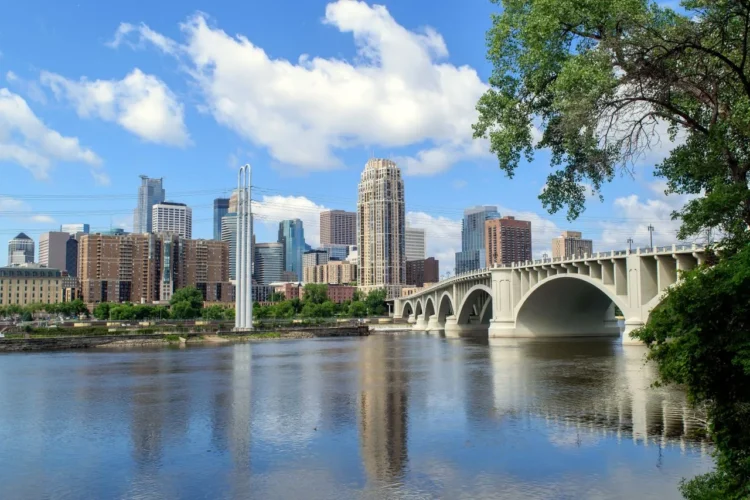
There are two clear winners in the Midwestern United States offering high sustainability ratings alongside more accessible costs.
Saint Paul offers the lowest average rent costs on this list, as well as the lowest median home price. At $1,296, the city is more than $300 below the national average for rent, and $140,000 below the national median sales price in June.
Just west, Minneapolis brings the second-lowest rent and median sales cost. The average rent in Minneapolis is $1,427, while the median home costs $362,495. Both of these figures still come in under rates at the national level
Although Colorado isn’t considered part of the Midwest, its proximity to the region still lends itself to lower housing costs. The average rent in Denver, Colorado, is $1,633, while the median home costs $615,000.
What this means: Although high earners have more options to live sustainably, low earners aren’t without them. It comes down to what you can afford to pay for housing and what cities fit best into that budget.
Representing both sides of the price spectrum, it would cost you about three times more to rent an apartment in Boston compared to Saint Paul. Long story short, your money goes a lot farther in the Midwest compared to the East or West coasts.
Defining Affordability for Sustainable Living
To determine local homebuying affordability, we compiled median household income data compared to how much income a family would need to make to qualify for a mortgage on a median-priced home.
Data from the U.S. Census Bureau shows that in 13 of 15 cities, families would need to make at least double the median household income to qualify for a mortgage on a median-priced home. Purchasing a home is the most challenging in Irvine because the median income is about 3.5 times lower than what is needed to afford a home.
The threshold is lower in other California cities, but not by much. San Jose, San Diego, San Francisco, Oakland and Fremont would each require households to earn over 200% more than the median household income to qualify for a mortgage on a median-priced home.
Only two cities on the list have incomes above what would be needed to buy a home, and it’s consistent with other measures on this list–Minneapolis and Saint Paul. In the Twin Cities, you’d need about $92,000 in household income to qualify for a mortgage–about a quarter of what you’d need for a San Jose home.
Washington, DC is the next-lowest on the list, with the average household needing to make 119% of the median income to qualify for a mortgage.
Why this matters: For areas where the percent difference is higher, buying a home is likely out of reach for the average resident. But there are areas where buyers face below-national costs, and ultimately where their purchasing power is a lot stronger, giving them more options.
Sustainability vs. Survivability: Tough Choices for Eco-Friendly Lifestyles
Data from 15 of America’s most sustainable cities reveals a clear trend that the sustainability of an area is often tied to its cost of living. Several of the top-ranked United States cities have living costs that are considerably higher than national averages, with home ownership seemingly far out of reach for everyday people.
But the data also shows opportunities for lower-income earners to settle down in areas of the Midwest or even northern West Coast, with housing costs reasonable compared to national levels.
Looking to make your next move? Zoocasa has agents that can help. Reach out today.