

For the most part, living in Canada feels the same as the U.S., just with a slightly different flavor. For instance, spelling flavor as “flavour”. But if you’re only visiting for a short time, you probably won’t feel much of a difference.
Most of the same chain restaurants exist, tipping culture is just as prevalent, and small talk is everywhere. Of course, there are some obvious differences. Grocery packaging includes English and French logos, healthcare is universal, the “washroom” means bathroom, and there’s a friendly “eh” tacked onto the end of sentences.
By the time I moved to Canada, I’d already lived in France, Thailand, and South Korea, so I didn’t think much could surprise me. And being from Upstate New York—where I probably differ more from a Texan than an Ontarian—Canada felt like a familiar cousin.
Still, a few things about life here surprised me when I moved four years ago. Here are a few of the quirks I’ve picked up on while living in Ontario.

Outdoor ice rinks are a lot more prevalent
My hometown of Syracuse is one of the snowiest cities in the country, so I’m used to winter living and everything that comes with it: snow tires, school closures, and skiing. But one aspect of winter in Canada surprised me.
Canadians like to ice skate outdoors. Before living in Ontario, I’d never seen so many outdoor ice rinks. My small city in Ontario has at least twenty. Toronto has more than fifty. (For comparison, Syracuse, a city of 140,000 people, only has one outdoor rink that I’m aware of.)
I’m not the only one noticing the craze for outdoor skating, either. The International Ice Hockey Federation estimates that Canada has 5,000 outdoor rinks, compared to just 500 in the United States. I guess Canadians can embrace the winter chill better than we Americans can.
A lot of Canadians have their own pair of ice skates
Speaking of skating, I was shocked the first time I went to a local rink and couldn’t rent a pair of ice skates. How was this possible? Where did everyone get theirs from? It turns out that skating is so common a sport that a lot of Canadians have their own pair of ice skates.
In fact, this winter pastime is such a big part of Canadian life that an RBC survey found that 92% of parents think every child should learn to skate. As a result, I’ve now invested in my own pair..
You go tobogganing, not sledding
As an American, I knew what the word toboggan meant. I could picture it clearly in my head: it’s a long, wooden holiday sled used for sledding down a snowy hill.
But in Canada, a toboggan isn’t just a noun; it’s a verb. Where I’d say “going sledding,” Canadians say “going tobogganing.” And to their ears, my version sounds strange.
Cottages are not only in fairytales
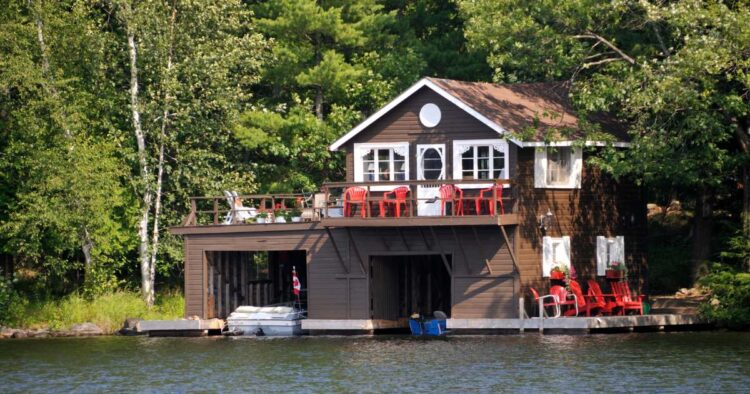
The American mind cannot comprehend a Canadian cottage. I originally pictured a storybook cabin in “Hansel and Gretel” or an old, quaint home in the English countryside. Could everyone here afford a second home straight out of a fairytale?
It was a while before I figured out that when Canadians talk about their cottages, they’re actually referring to their camp, cabin, or lakehouse. This could be something as simple as a one-bedroom log cabin or as fancy as a mansion that just so happens to be overlooking a lake.
In Northern Ontario, there’s even a region referred to as “cottage country”.
I told everyone I went to college. Was I wrong?
The word “university” can sound quite posh and elite in America. Instead, we refer to higher education colloquially as college. Even if you attend Harvard University, you probably won’t say you went to university. You went to college.
I didn’t realize there was a real difference between a university and a college until I moved to Canada. Here, college usually means shorter diploma or certificate programs that focus on hands-on training for specific careers. University refers to degree-granting institutions with four-year programs that lead to a bachelor’s degree, as well as graduate studies.
I try to use the appropriate word now in conversation, but sometimes I still slip up and refer back to my college days.
It’s grade 9, not 9th grade
When Canadians talk about school, they refer to grades by grade 9, grade 10, etc. They don’t use 9th grade the way Americans do. This took time for my ears to adapt to.
Similarly, Americans often refer to the first, second, third, or fourth year of high school or college as their freshman, sophomore, junior, or senior year. I’ve had to adjust my vocabulary because those words don’t resonate with Canadians (or frankly, anyone who is not American).
Postal codes have letters in them!
My grandpa called me the other day to double-check my address. “This can’t be right—there’s a P in your zip code. P as in Peter,” he emphasized to me over the phone. I had to assure him that yes, Canadian zip codes include letters, unlike in America, where zip codes only contain numbers.
No Venmo, but the superior e-transfer exists
You practically cannot exist as a modern American without Venmo, the payment service that transfers money from one bank account to another.
In Canada, there is no Venmo because there is something better: e-Transfer. Interact e-transfer lets you send money directly from your bank account to someone else’s using only their email. And you don’t need a special app to do it, it’s built right into your banking app.
At the farmer’s market and forgot your wallet? No problem. Just e-Transfer the money. The deposit is instant, unlike Venmo, which can take a few days or charge extra to arrive faster.

Contactless payment readers are the norm
Whenever I visit the U.S., I slip back into the rhythm of things right away, except for one detail: the waiter running off with my credit card.
In Canada, and in much of the rest of the world, the server brings a contactless payment reader right to your table. It still feels strange when I go home and have to hand over my card to a stranger to pay.
Work-life balance feels better here
Canada offers some of the fewest days of paid vacation in the world at just 10—on par with Japan. Mexico guarantees a minimum of 12 days, Brazilians get 22, and the U.K. offers at least 28.
Compared to the U.S., though, Canada feels generous. American workers are entitled to 0 federally mandated paid vacation days. Companies do offer time off, but it isn’t required by law, and many Americans don’t even take all the days they’re given. An Expedia report found that as many as 53% of Americans leave vacation time unused.

King Charles is the head of state
I was surprised to see Queen Elizabeth on so many coins and bills. She even has a freeway named after her. But what did she have to do with Canada? Then I learned that Canada is part of the British Commonwealth, and it all clicked. It also explained why so many Canadian words follow British spelling, like neighbourhood, centre, and labour.
And now, with King Charles on the throne, he’s Canada’s Head of State and will appear on newly printed currency. Who knew Canada was so connected to royalty?
Your favorite movie or TV show was probably filmed in Toronto
When you think about movies, you probably think of Hollywood. And if not there, then maybe New York. But would you ever think of Toronto as a filming hub?
I was surprised to learn just how many movies and TV shows were filmed in Toronto. So many shows and movies set in New York are actually filmed there, like Suits, The Boys, and American Psycho.
You’d think a movie called Chicago would at least be safe from Toronto’s influence, but no, the movie musical was actually filmed there, too. So was Hairspray, despite famously taking place in Baltimore. The long list of movies shot in Toronto includes Good Will Hunting, X-Men, My Big Fat Greek Wedding, and even Guillermo Del Toro’s newest Frankenstein movie.
The Biggest Surprise of All?
The longer you live somewhere, the more you start to blend in with your surroundings. You adapt to the new culture until eventually, you are part of it. There are probably dozens of more differences I could’ve mentioned in this roundup. But after four years of living in Canada, the differences have started to blur.
I haven’t exactly become Canadian myself, but I’ve definitely picked up some Canadian mannerisms. For one, I can’t convert Celsius to Fahrenheit anymore. Celsius is all I know. I also know how to pronounce Saskatchewan, Newfoundland, and Mississauga correctly. I can even point them all out on a map!
Sometimes I can’t even remember exactly how things are done in the States or if it’s really all that different. Oh, that’s right. Americans don’t refer to their country as the States, do they? I guess that’s another Canadian habit I’ve picked up.
Considering a move soon? Whether you’re in the United States or Canada, Zoocasa has thousands of up-to-date listings near you. Start your search today!