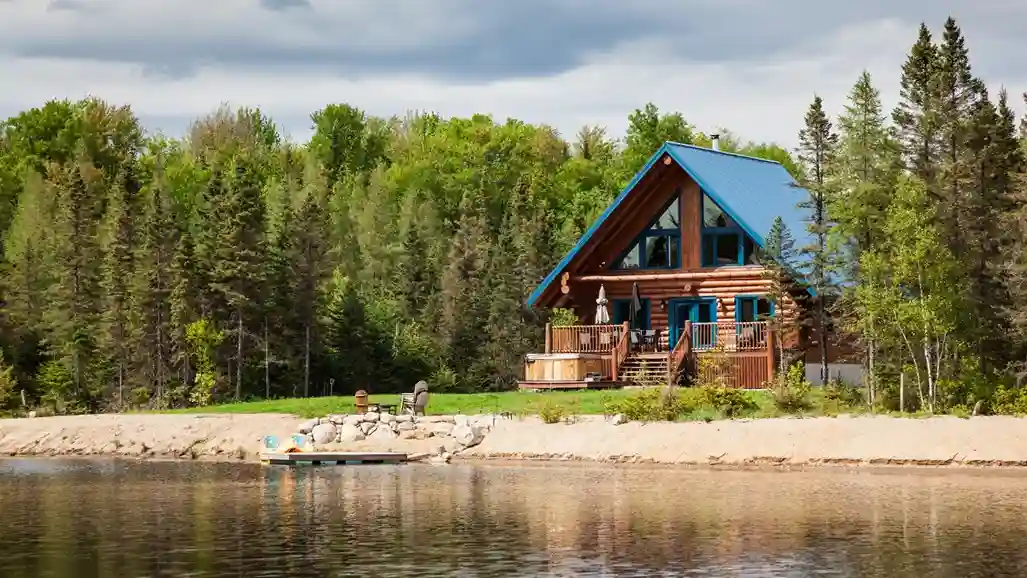
A log home in Ontario can offer everything from rustic charm to waterfront luxury, but buying one requires more research than a typical resale home. These properties often have different financing requirements and insurance considerations than standard wood-frame houses.
Knowing what to expect before you buy a log home in Ontario can help you avoid costly surprises and decide whether it’s the right fit for your lifestyle. Here’s what to actually check before you fall for the timber and the view.
Ontario’s Building Code Treats Log Walls Differently
Unlike a standard wood-frame wall filled with insulation, a solid log wall provides less thermal resistance on its own. An 8-inch log wall typically has an insulation value between R-8 and R-12, which is lower than the energy efficiency standards set out in Ontario’s Supplementary Standard SB-12 for conventional homes.
SB-12 separates the province into two climate zones based on heating degree days: Zone 1 covers most of Southern Ontario, while Zone 2 includes Northern Ontario and parts of Eastern Ontario. Depending on the compliance path, exterior walls typically need an effective insulation value between R-22 and R-29. Since solid log walls alone do not reach that level, builders often rely on additional energy-efficient construction methods to comply with the code.
The Performance Pathway
A Registered Energy Advisor can model the home’s overall energy performance using software such as HOT2000. Instead of focusing only on the log walls, the assessment looks at the entire building, allowing lower wall insulation values to be balanced with upgrades like high-performance windows, extra attic insulation, or a more efficient heating system.
Verified Airtightness
Another option is to improve the home’s overall airtightness. Under SB-12’s performance path, detached homes that score 2.5 ACH50 or better on a blower-door test, and attached homes that reach 3.0 ACH50 or better, can earn energy performance credits. Those credits may reduce the need for higher insulation levels in other parts of the home.
What to ask for
Ask for the home’s original SB-12 compliance documents. If the home qualified through energy modelling, request the HOT2000 report or any ENERGY STAR or R-2000 certification.
If the seller or listing agent cannot provide this information, raise the issue with your home inspector before waiving any conditions.
Getting a Mortgage on a Log Home Is Its Own Process

The Appraisal Gap
Appraisals can be more complicated for log homes because there are often very few comparable sales nearby. Appraisers may have to rely on older transactions or compare the home with conventional properties and adjust for its unique construction. That can lead to an appraised value that falls below the purchase price. Since most lenders finance based on the lower appraised value, buyers may need to bring additional cash to closing.
Down Payment and Default Insurance Rules
These rules apply no matter what type of home you’re buying, but they can make a bigger difference when there’s an appraisal gap. If your down payment is less than 20%, you’ll need mortgage default insurance through the Canada Mortgage and Housing Corporation (CMHC), Sagen, or Canada Guaranty.
This insurance is only available on homes priced below $1.5 million. Above that price, a minimum 20% down payment is required. For insured mortgages, buyers must provide at least 5% of the first $500,000 of the purchase price and 10% of the amount above $500,000.
If you’re building rather than buying resale:
Buyers should expect a construction-to-permanent mortgage with staged draws. Instead of receiving the full loan amount upfront, funds are released in phases after an inspector confirms key milestones, such as the foundation, log shell, weather-tight stage, and interior finishing.
What to do about it:
Ask your mortgage broker to flag the property as unconventional construction early, and consider commissioning your own appraisal pre-screening before you’re locked into a firm offer.
Insurance Depends on Fire Protection Distance
Ontario insurers often use the Fire Underwriters Survey’s Dwelling Protection Grade (DPG) system to evaluate community fire protection. The system ranks communities on a scale from 1 to 5, with lower scores generally indicating stronger fire protection resources. In simple terms:
- Protected: Within roughly 8 km by road of a fire station with hydrant access or accredited water supply.
- Semi-protected: Within 8 km, but relying on a volunteer department and tanker shuttle rather than hydrants.
- Unprotected: Beyond the 8 km response distance that Fire Underwriters Survey uses as its maximum recognized range for personal-lines coverage.
A property with a strong DPG rating could see premiums reduced by as much as 60% to 70% compared with a home without recognized fire protection. Homes in areas with partial protection usually fall somewhere in between. In cottage regions like Muskoka and Parry Sound, properties that are far from a fire station or located on seasonal roads may have a harder time finding coverage.
Rural log home insurance policies often come with additional endorsements to address risks that are less common in urban properties. These may include coverage for:
- Extra replacement cost coverage in case rebuilding costs exceed expectations.
- Wildfire-related coverage for properties surrounded by forests or located in high-risk areas. Some insurers may also require homeowners to maintain defensible space around the home.
- Rental coverage if the property will be used as a short-term rental. A regular home insurance policy usually will not cover business activity.
What to ask for
Don’t wait until after you waive your financing conditions to check insurance details. Ask your broker to confirm the municipality’s DPG rating and the property’s distance from the responding fire station before moving forward.
Wood-Burning Appliances Need a WETT Inspection
Many Ontario insurers require a current Wood Energy Technology Transfer (WETT) inspection before providing coverage for homes with wood-burning appliances. The inspection confirms that wood stoves, masonry fireplaces, and wood cookstoves meet safety standards under CSA B365, the Installation Code for Solid-Fuel-Burning Appliances and Equipment.
What to ask for
Buyers should request a current WETT inspection report rather than relying on a seller’s verbal confirmation. They should also confirm that the appliance has a clear certification label showing it meets required safety standards.
Log Homes Settle, Which Affects Everything Else
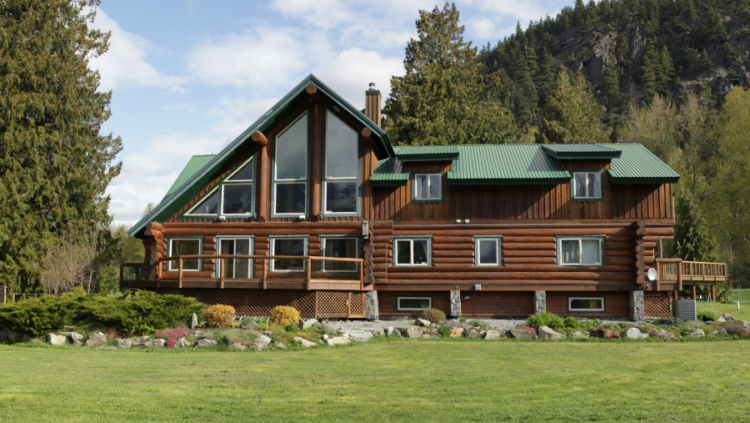
One of the biggest differences between a new log home and a conventional house is that the structure continues to move after construction. As logs dry during the first two to three years, they shrink and settle, which can cause an 8-foot wall to drop by several inches.
That movement is normal, but it requires specialized building techniques. Proper construction includes settling spaces above windows and doors, flexible utility connections, and elastomeric sealants that allow log courses to move without compromising the building envelope.
For a resale purchase, ask when the home was built and whether it’s past its primary settling window. A log home built within the last two to three years is still actively moving, which is worth flagging to your home inspector.
Long-Term Maintenance Costs Add Up
Exterior maintenance is one of the largest long-term costs associated with owning a log home. For an average 1,500 to 2,500 square foot log home in Ontario, homeowners should budget around $20,000 to $30,000 plus HST for a cleaning and re-staining project. A full media blast and re-staining process can cost closer to $27,500 to $50,000 or more. Chinking repairs are usually an additional cost.
The key is staying ahead of the problem. Walls that face south or west often need attention sooner because they receive more sunlight. If maintenance is ignored for too long, moisture damage can turn a simple refinishing project into a much more expensive log replacement repair.
Log Homes, Long-Term
A log home in Ontario is not automatically harder to own than a regular house. It simply comes with different responsibilities. Maintenance, insurance, and financing all work a little differently, and buyers who understand that before they purchase a log home in Ontario are usually much happier with their decision years later.
Ready to find a log home that fits your budget? Browse Ontario listings on Zoocasa and start your search today.