
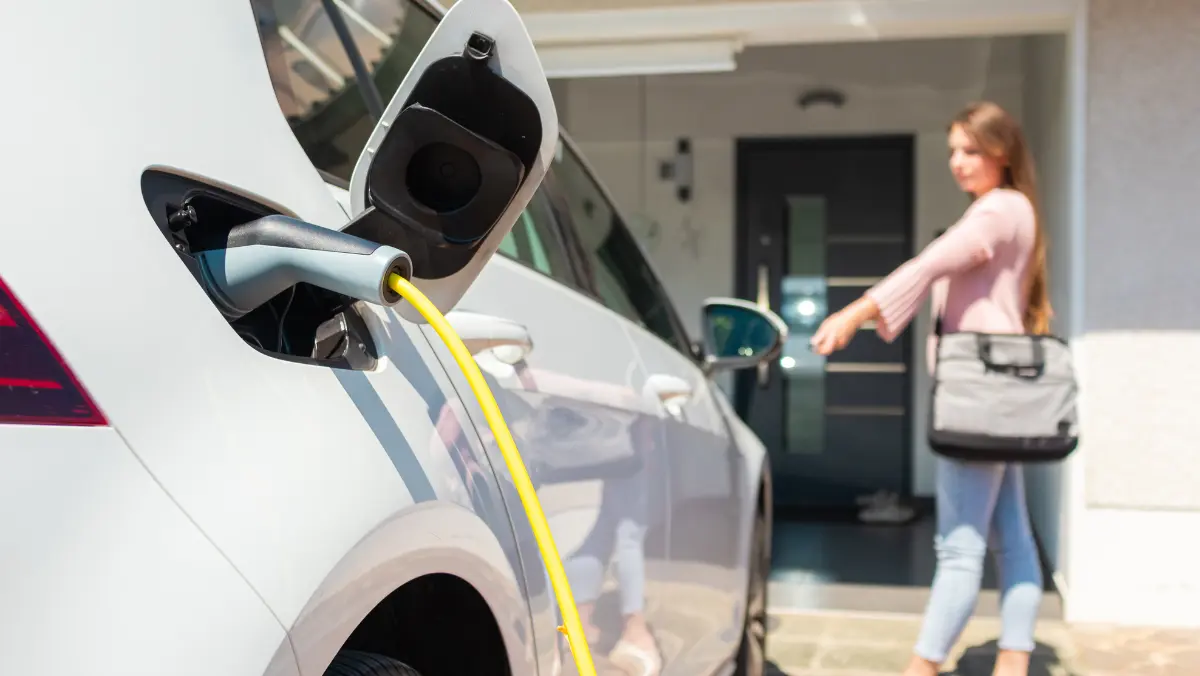
If you’ve bought an electric vehicle (EV) in the last year, or you’re considering a home with one in mind, you’ve probably wondered what it takes to install a home EV charging station in your own driveway. This is what the numbers say about cost, what Ontario’s electrical code actually requires, and how to time your charging so it doesn’t wreck your hydro bill.
Here’s what to know about installation costs, Ontario’s electrical code requirements, and when to charge your EV to keep electricity costs under control.
Level 1, Level 2 or Level 3?
Not all “EV chargers” are created equal, and the level you need depends entirely on how many kilometres you drive in a typical week.

Level 1 charging uses a standard household outlet, so there is no dedicated installation required. But at roughly 5 to 8 km per hour, it is best suited to plug-in hybrids or drivers with very low daily mileage.
Level 2 is what most homeowners mean by a “home EV charging station.” It’s the standard choice for most residential EV charging stations.
Level 3, or DC fast charging, requires much higher electrical capacity and is generally designed for commercial and public charging sites rather than residential garages.
What It Costs to Install One in Canada
For a typical single-family home, installing a Level 2 charger costs around $1,100 to $2,500+ CAD all-in. The price can climb quickly if the charger is far from the electrical panel or your home needs an electrical upgrade. Here’s what you’re paying for.

What The Hardware Costs in 2026
Prices vary by retailer, connector type, and current promotions, so use these figures as ballpark estimates rather than exact quotes.

For homes where winter performance is a major concern, the Grizzl-E line stands out for its cold-weather flexibility. Independent testing referenced by EnergySage has evaluated its performance in low temperatures. Tesla’s Wall Connector can be a cost-effective 48-amp hardwired option for homeowners already in the Tesla or NACS ecosystem.
Is Your Panel Ready For This?
Unlike an appliance that runs for a short period, a Level 2 charger can draw its full rated current continuously for several hours. That is why the electrical code classifies EV charging as a continuous load, requiring additional capacity and safety measures.
- 60-amp service (common in pre-1960s homes): Not adequate for Level 2 charging without a full service upgrade.
- 100-amp service (mid-to-late 20th-century construction): Workable, but tight. Adding an 11.5 kW charger on top of an electric range, dryer, and central air can push you past what the panel can safely support.
- 200-amp service (today’s standard): Generally has enough headroom for a 40A or 50A dedicated EVSE circuit without any service upgrade.
If your panel comes up short, you have two options besides a costly service upgrade: an Electric Vehicle Energy Management System (EVEMS) or picking a lower-amperage charger.
Permits and Licensing
Under Ontario Regulation 164/99, an EV charger installation legally requires a Notification of Work filed with the Electrical Safety Authority (ESA) before any wiring starts, and the work itself must be performed by a Licensed Electrical Contractor (LEC). Once the installation is complete, an ESA inspector verifies the wiring, breaker sizing, and grounding, then issues a Certificate of Acceptance.
Keep that Certificate of Acceptance with your other home documents. It’s the kind of thing a buyer’s lawyer will ask about if they notice a 240V charger in the garage during a showing.
Building a New Home? The Panel Prep Is Now the Law
For buyers of applicable new homes in Ontario, the electrical groundwork for future EV charging is largely built into the construction. Under the EV-Ready Homes Act (Bill 199) and related Building Code requirements, builders must provide a minimum 200-amp panelboard, a 27 mm conduit run from the panel to the garage or driveway, and a standardized junction box.
These requirements are designed to allow a future EV charger to be installed without major renovations. While the charger itself is not included, having the infrastructure in place can substantially reduce future installation costs.
Rebates in 2026

If you’re budgeting for an installation in Ontario, the electricity rate plan you choose ends up mattering more than any one-time rebate.
Charge Overnight and The Math Changes Completely
For homeowners, one of the biggest ways to control EV charging costs is to choose the right Ontario Energy Board (OEB) electricity rate plan.

A full 75 kWh charge costs about $7.35 on standard off-peak Time-of-Use pricing, compared with just $2.93 under Ultra-Low Overnight (ULO). The catch is ULO’s steep 39.1¢/kWh on-peak rate from 4 to 9 p.m. on weekdays, so the plan works best if your household can avoid running major appliances during those hours. A smart charger can make this easier by automatically starting the charge at 11 p.m.
Ontario is also moving toward managed EV charging, where software automatically adjusts charging times based on electricity demand and local grid conditions. Enova Power, Oshawa Power, Oakville Hydro, and Essex Powerlines have partnered with BluWave-ai on a province-wide initiative that allows participating EV owners to connect their vehicles to the platform to optimize charging based on grid needs.
It is an opt-in program, so check with your local utility before committing to a fixed overnight schedule. Your utility may already have a managed-charging option that can do the timing for you.
Ready to Plug In?
Installing a home EV charging station is a bigger project than most homeowners expect, but it isn’t out of reach with the right contractor and a bit of planning. A home charger can quickly pay for itself in convenience and, with the right charging schedule, lower overnight electricity costs.
Whether you’re upgrading your current home or shopping for one with EV-ready wiring already in place, Zoocasa can help. Start your home search today.