
Following a mid-year sales rally, Canada’s housing market slowed at the end of 2025, culminating in a subdued December. The Canadian Real Estate Association (CREA) reported a 2.7% month-over-month decline in national home sales. CREA’s Senior Economist, Shaun Cathcart, attributed the December decline to coinciding but apparently unrelated slowdowns in Vancouver, Calgary, Edmonton, and Montreal. Despite this, Cathcart expressed optimism for 2026, anticipating that sales will increase as spring approaches, continuing the upward trend observed earlier in the previous year.
Total home sales in 2025 were 1.9% lower than in 2024, but December’s activity was up 4.5% compared to the previous December. Even with fewer sales overall, the market remained balanced, with a sales-to-new-listings ratio of 52.3%. The national average sale price finished the year almost unchanged from last year at $673,335.
Smaller Markets Defy Seasonal Trends with Late-Year Surges
From November to December 2025, several regional hubs outperformed national trends, generating significant activity despite the typical late-year slowdown. Trois-Rivières CMA led national sales growth with a 22.1% month-over-month increase (seasonally adjusted), rising from 113 units in November to 138 in December. Halifax–Dartmouth recorded an 8.6% increase (up 37 units to 466), and Thunder Bay posted an 8.5% gain, increasing from 189 to 205 sales. These results underscore a shift toward more affordable regional centers with sustained buyer engagement. However, supply conditions varied considerably across these high-demand markets.
Saguenay CMA experienced a significant increase in inventory, with new listings rising by 28.1%. In contrast, other regions faced a tightening supply. Trois-Rivières, despite leading in sales growth, recorded the second-largest decrease in new listings (–26.5%), indicating heightened competition for available properties. Quebec CMA experienced the most pronounced inventory decline in December (–28.4%), while Regina saw listings decrease by 19%.
In December, larger markets continued to experience rising inventory levels. The Greater Toronto Area saw listings increase from 14,632 to 15,441. Fraser Valley listings rose to 2,884 (up from 2,734), and Windsor–Essex increased to 1,232 (up from 1,168). These trends indicate that inventory in major population centers is expanding relative to smaller, more constrained markets.
Sudbury and Thunder Bay Experience Price Increases Amid National Market Stability
Although the non-seasonally adjusted national average home price remained stable, several regional markets exhibited notable volatility in their seasonally-adjusted prices. Sudbury experienced the largest increase, with average prices rising 16.9% month-over-month to $590,968, driven by a decline in new listings and increased competition among buyers. Thunder Bay recorded a 9.0% increase to $394,165, driven by an 8.5% rise in sales activity that outpaced available inventory. Regina also posted gains, with prices increasing 8.9% to $383,111 despite contractions in both supply and demand.
In contrast, several markets experienced price declines at the end of the year. Trois-Rivières saw prices decrease by 4.6% to $417,336, despite a notable increase in sales, suggesting sellers may have adjusted their expectations to facilitate transactions. Gatineau prices fell by 3.2% to $491,061 amid reduced activity, while Hamilton–Burlington recorded a 2.5% decline, resulting in an average price of $793,141 as the market stabilized.
Inventory Spikes in Toronto and Vancouver
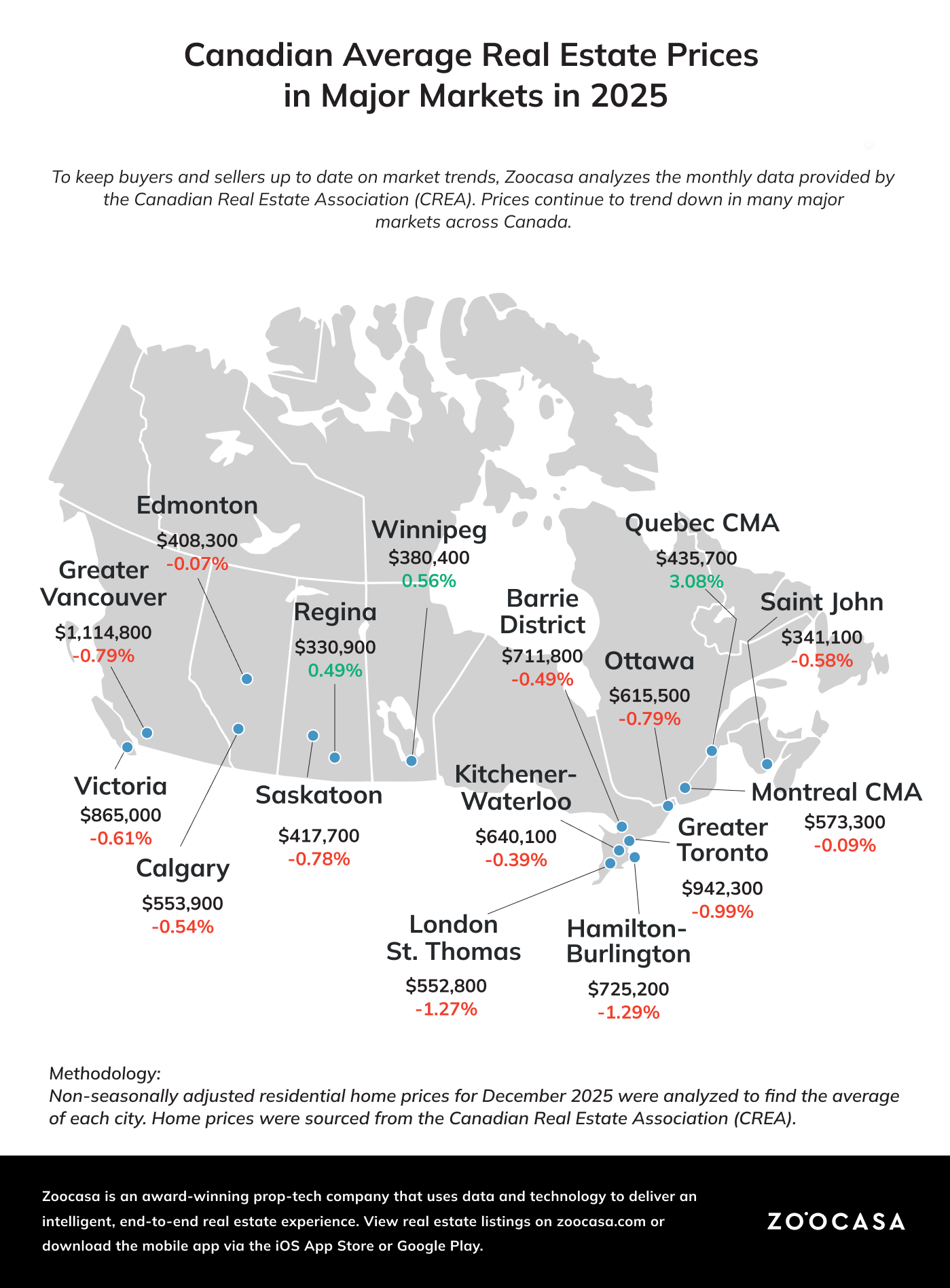
The two most expensive markets, Greater Vancouver and Greater Toronto, are diverging in price trends, but both experienced substantial increases in supply. Greater Vancouver underwent a market correction, with average prices declining by 1.1% to $1,232,038 and sales activity decreasing at twice the national rate. In contrast, Greater Toronto showed greater stability, with prices remaining virtually unchanged (a 0.3% increase) at $1,055,093 and sales remaining stable.
Notably, both markets recorded significant increases in new listings, contrary to the national trend of a 2.0% decline in supply. Greater Toronto posted the third-highest increase nationally, rising 5.5% to 15,441 units, the largest volume among all regions. Greater Vancouver’s inventory increased by 4.6% to 5,180 new listings. These developments suggest that while Vancouver is experiencing a cooling market, Toronto may face a saturation risk if supply continues to outpace demand.
Prices Rise in Alberta’s Biggest Cities Despite Lower Sales Activity
Meanwhile, Calgary and Edmonton diverged from the national cooling trend by recording price increases driven by a pronounced supply shortage. While the national average price declined by 1.2%, Edmonton’s average price rose by 2.2% to $462,810, and Calgary’s increased by 1.3% to $659,274. These gains were supported by significantly reduced inventory, with new listings falling by 7.1% in Edmonton and 6.5% in Calgary, both rates exceeding the national decline. Despite higher prices, buyer activity declined more rapidly than the national average, with sales dropping by 5.7% in Calgary and 4.8% in Edmonton.
Looking forward, CREA projects modest growth in 2026, with the national average price expected to rise by 2.8% to approximately $699,000. Even the most active provinces, such as Saskatchewan and Quebec, are anticipated to experience a significant slowdown in growth compared to 2025. Buyer activity is forecast to increase by 3.5%, primarily due to a recovery in British Columbia and Ontario. Overall, the national average price is projected to reach $715,000 in 2027, which would mark the seventh consecutive year that the national price remained near the $700,000 mark.
Regarding winter 2026, CREA Chair Valérie Paquin remains optimistic that the subdued market conditions will persist only briefly. She noted, “The spring market is now just around the corner, and it is expected to benefit from four years of pent-up demand and interest rates that at this point are about as good as they are going to get.”
Curious what this could mean for your plans to buy and sell? A local agent can walk you through your options. Start your search today.