

Buying and selling real estate is often a planned-out process. Whether you’re buying a primary residence, an investment property, or a recreational property, having a deeper understanding of the market can help inform critical decisions.
While inventory pile-ups are softening prices in major metros like Toronto and Vancouver, a distinct group of “hot spots” is defying the trend—offering sellers aggressive competition and leverage heading into the spring market. As the data confirms, the “easy sell” has moved away from the big city centres and into specific, high-demand regional hubs.
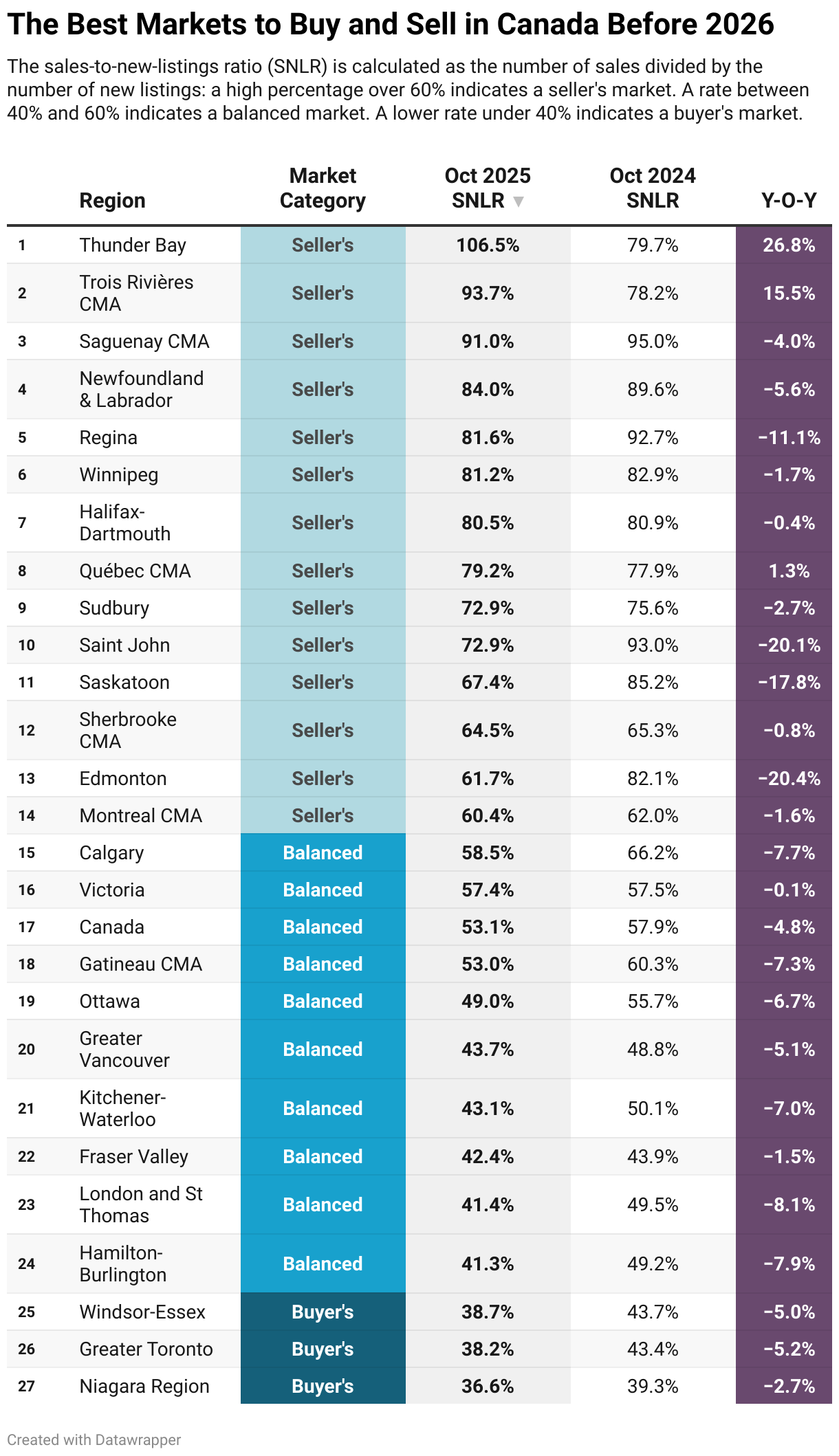
To identify these remaining strongholds, Zoocasa analyzed the latest sales-to-new-listings ratios (SNLR) based on October 2025 data from the Canadian Real Estate Association. This key metric reveals where the balance of power lies: a ratio above 60% signals a seller’s market, where demand outstrips supply, while anything below 40% marks a buyer’s territory.
- Below 40% → Buyer’s market: listings outpace sales, giving buyers more choice.
- 40–60% → Balanced market: demand and supply are aligned.
- Above 60% → Seller’s market: sales exceed listings, giving sellers the advantage.
Noteworthy Market Changes in 2025
If you want to predict the future, look at the past. In the past 12 months, several regions crossed the 40% or 60% threshold, fundamentally changing the dynamic for buyers and sellers.
Greater Toronto shifted from a balanced market to a buyer’s market, dropping from 43.4% (balanced) to 38.2% (buyer). This marks a significant shift for Canada’s largest market, moving from a stable environment to one where inventory is outpacing sales. As a result, buyers now have distinct leverage that they didn’t possess a year ago.
Windsor-Essex also transitioned from a balanced market to a buyer’s market, declining from 43.7% (balanced) to 38.7% (buyer). Similar to Toronto, Windsor has cooled off sufficiently to enter buyer territory, indicating a notable slowdown in sales relative to new listings.
Calgary, Alberta’s largest city, experienced a notable slowdown this past year. The market shifted from a seller’s market at 66.2% to a balanced market at 58.5%. Having been a hot seller’s market for some time, this decline below the 60% threshold marks a notable cooling period. Buyers are now gaining more negotiating power than they have had in recent years.
In Gatineau CMA, the market shifted from 60.3% (seller) to 53.0% (balanced). Last year, Gatineau was barely in seller territory, but it has now firmly settled into a balanced market, aligning more closely with its neighbor, Ottawa.
Quebec and Atlantic Canada Lead the Seller’s Charge
Ontario and British Columbia are experiencing more balanced market conditions, while Quebec and Atlantic Canada continue to strongly favour sellers. In Quebec, the Saguenay CMA has one of the tightest markets, boasting a Sales-to-New-Listings Ratio (SNLR) of 91.0%.
Both the Quebec CMA, with a 79.2% SNLR, and Saint John, at 72.9%, are also heavily tilted toward sellers. This means that well-priced homes are unlikely to remain on the market for long. Additionally, Newfoundland and Labrador are demonstrating remarkable resilience, with an SNLR of 84.0%. This indicates that the East Coast remains a hotbed of activity, where demand significantly surpasses the number of new listings.
Contrasts in Alberta’s Biggest Cities
Alberta’s two largest cities, Calgary and Edmonton, showcase contrasting market conditions. Traditionally a competitive hotspot, Calgary has cooled significantly into a balanced market, with its sales-to-new listings ratio dropping from 66.2% in 2024 to 58.5% in 2025. This provides a welcome reprieve for buyers who faced tight conditions last year. One primary reason is new inventory. “Supply levels have been sitting higher than typical levels for the past three months, mostly due to the gains occurring in the higher-density sectors of row and apartment style units,” said Calgary Real Estate Board’s Chief Economist Ann-Marie Lurie, in a December report.
Edmonton, on the other hand, remains a seller’s market with an SNLR of 61.7%, though it has cooled significantly from the 82.1% seen in October 2024. While both cities are seeing shifts, Calgary currently offers a more relaxed pace for buyers, while Edmonton retains a slight edge for sellers. A City of Edmonton economic update reports about 13,500 housing units under construction in 2025, with roughly 55–64% intended as purpose-built rental, indicating a very large pipeline of supply.
Thunder Bay and Trois-Rivières: The Hottest Markets in Canada
Thunder Bay and Trois-Rivières are currently the most competitive real estate markets in the country.
Thunder Bay has experienced an explosive surge in activity, with its Sales-to-New Listing Ratio (SNLR) skyrocketing to 106.5%. This is a significant increase from 79.7% just one year ago. A ratio over 100% indicates that for every new listing entering the market, more than one home is being sold, rapidly depleting older inventory. For sellers in this area, this is an ideal situation that offers considerable leverage. Buyers, on the other hand, will need to think and act quickly, often needing to submit offers that are highly appealing to sellers, such as a strong price above asking or waiving typical conditions like a home inspection.
Trois-Rivières is not far behind, boasting an impressive 93.7% ratio, up significantly from 78.2% in October 2024. This data shows that, despite broader economic changes, buyers in these regions are absorbing almost every home that becomes available on the market, often resulting in multiple offer scenarios and quick sales.
A Buyer’s Market in the Golden Horseshoe
Three key regions in Ontario’s Golden Horseshoe are experiencing buyer’s markets: Niagara, the Greater Toronto Area (GTA), and Windsor-Essex. This change gives buyers more options and stronger negotiating power.
In the Greater Toronto Area (GTA, the sales-to-listings ratio (SNLR) is 38.2%. This means buyers have more control in a typically competitive market. Homes are staying on the market longer, allowing buyers to take their time. There are many condos available, which lets buyers choose carefully and negotiate better prices and terms.
Meanwhile, in the Niagara region, the most buyer-friendly market we analyzed, had an SNLR of 36.6%. This area is ideal for people moving from the city to find more space. Sellers are eager to attract buyers, so it’s often possible to buy homes for less than the asking price or negotiate favourable terms, like home inspection options.
With an SNLR of 38.7%, Windsor-Essex is another good choice for affordability. The leaning shift to a buyer’s market indicates that the post-pandemic real estate rush has slowed. This allows local buyers and investors to enter the market without the intense competition seen in 2022-2023.
For anyone planning a move in early 2026, success hinges on tailoring your strategy to the hyper-local market dynamics. Thinking of buying and selling? Start your search today! You might just find the home you’ve been dreaming of.