

Expensive housing options are significantly influencing Canadians’ decisions about where to live. A 2025 Zoocasa survey reveals that buyers are increasingly willing to explore options outside major metropolitan areas. More than half of current homeowners (53.8%) believe there are no neighbourhoods in their city that still feel reasonably priced, and one in four people (26.3%) said they were seriously considering moving to a smaller secondary city.
In fact, the demand for living in smaller urban hubs is already well underway. Using RentCafe.com’s Q3 Renter Interest Report, Zumper’s rental data, and local real estate board average home prices, Zoocasa analyzed which Canadian cities are drawing the most renter attention and how that demand is influencing both rent levels and home prices.
Related: Santa Can Help…But Not That Much: How Long Holiday Savings Take to Reach a Down Payment
New Brunswick City Sees Rapid Rental Growth Amid 20% Rent Decrease
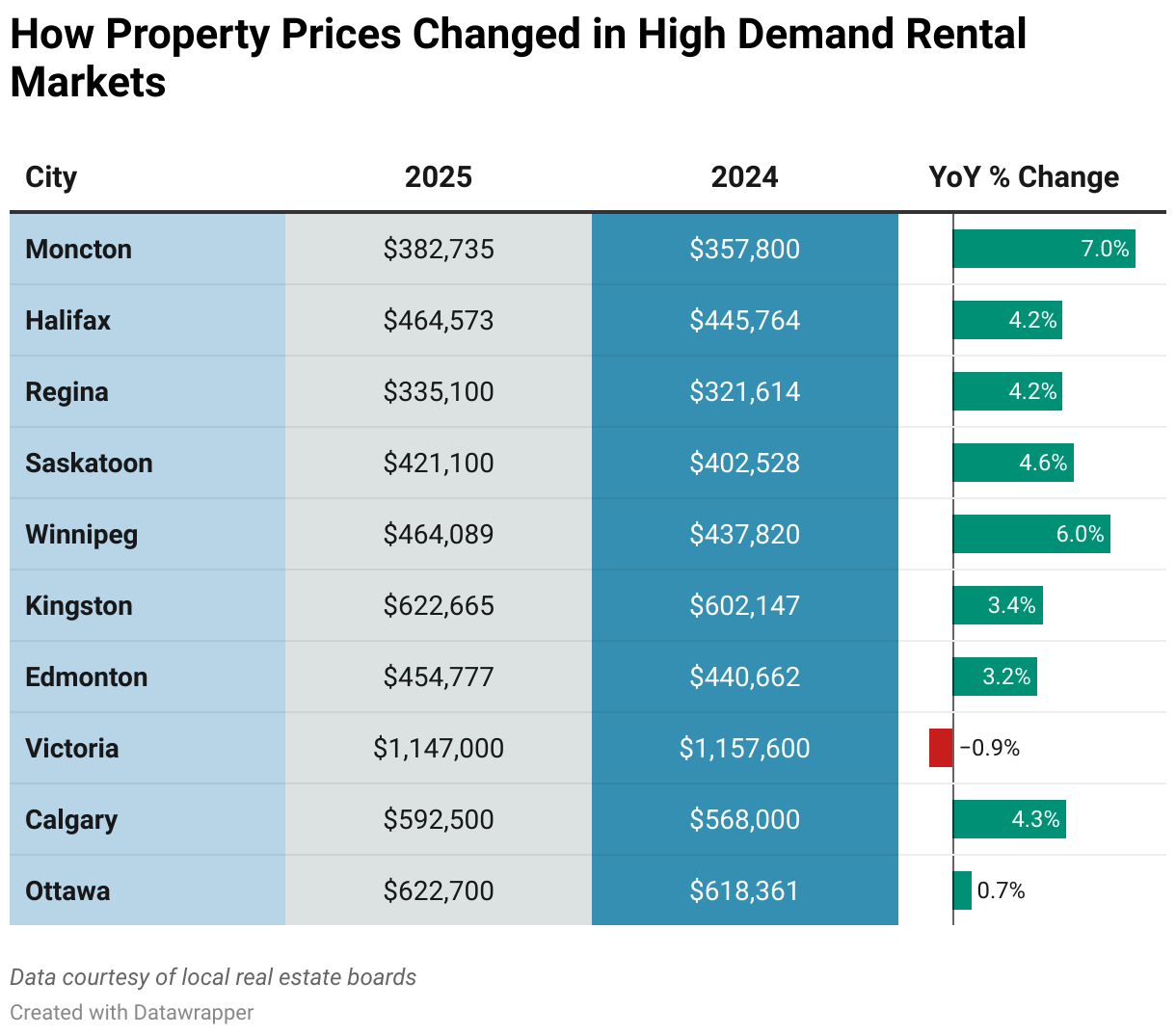
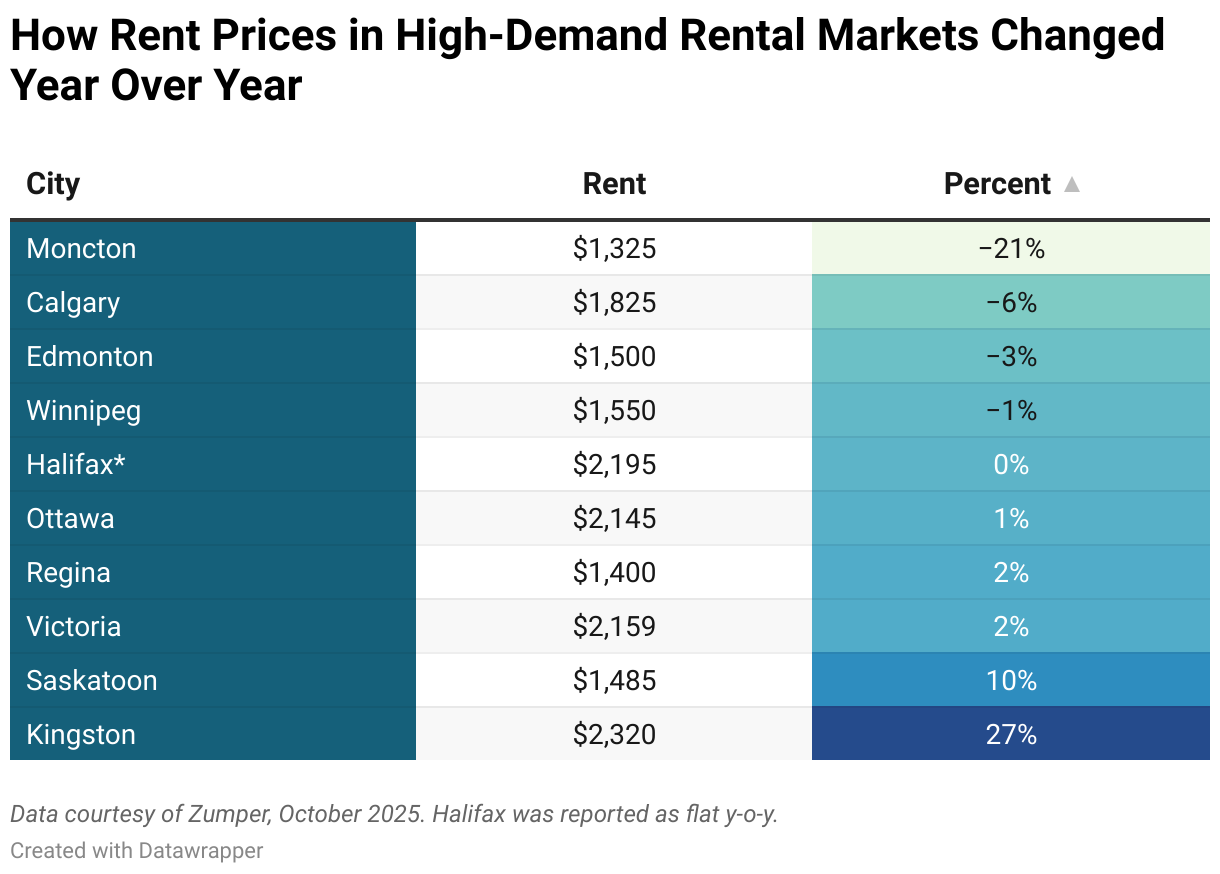
As reported by RentCafe, Moncton is now Canada’s most in-demand rental market, outpacing large metros as it continues its transformation into a nationally competitive hub. The average rent sits at just $1,325, down 21% year-over-year, the steepest decrease among top-ranked cities. Meanwhile, the average home price rose to $382,735, a 7% year-over-year increase. However, homes in Moncton are priced roughly 44% below the national average of $690,195.
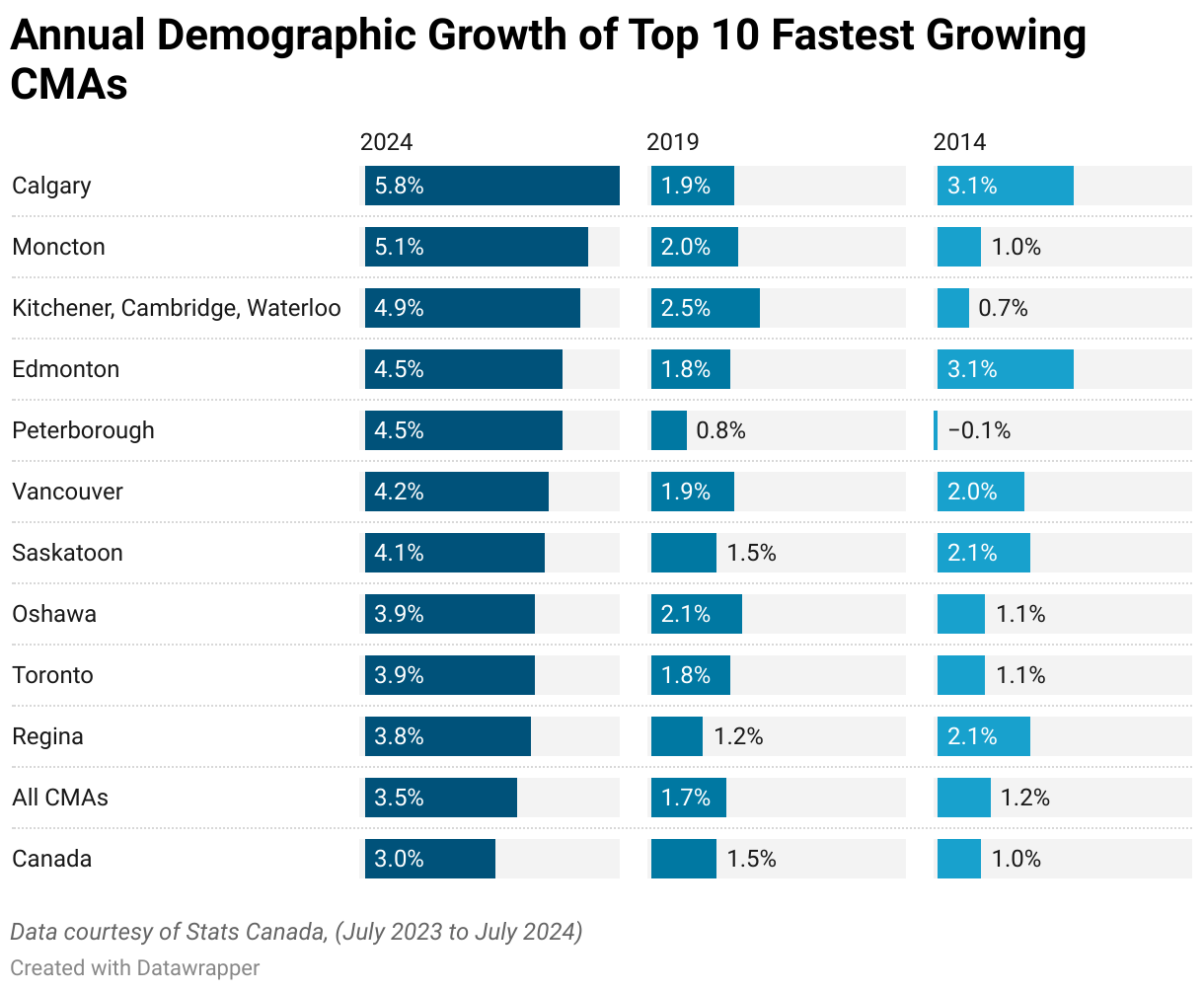
Immigration is the main factor behind this population growth, with Moncton recording one of the highest rates of inward migration in Canada in 2024. The population of the Moncton Census Metropolitan Area rose from approximately 178,600 to 188,000 between July 2023 and July 2024, making it one of Canada’s fastest‑growing metropolitan areas.
Related: Two of Canada’s Happiest Major Cities Have Vastly Different Home Prices
Growing Demand for Rentals in Kingston’s Housing Market
In contrast, Kingston is facing a rapidly intensifying rental market, where demand exceeds the number of available units. According to Zumper, rental prices have surged 27% year-over-year, averaging $2,320 across all property types. Meanwhile, average home price growth rose 3.4% to $622,665.
A unique feature of Kingston’s rental market is the impact of two high-demand groups: young renters and retirees. Home to Queen’s University, St. Lawrence College, and the Royal Military College of Canada, the city experiences a steady influx of students, while seniors comprise approximately 20–30% of the local population.
According to Statistics Canada, over the last decade, Kingston’s CMA population has grown by 8% to 11%, making it one of Ontario’s fastest-growing mid-sized regions. Its waterfront neighbourhoods, heritage downtown, and cultural density have vaulted it beyond “student town” status; it is now a competitive rental city in its own right, and prices reflect that shift.
Western Canada Sees Rising Rental Interest Among Residents
Compared to the tightening conditions in Eastern and Central Canada, the rental landscape in Western Canada has greater opportunities for renters. Renters in Winnipeg and Edmonton have similar average rental prices at $1,550 and $1,500, respectively, with average home prices in both cities falling within the $455,000 to $465,000 range, making it easy to still save a down payment while renting.
Calgary continues to experience quick population growth, currently at 5.8%. However, Zumper reports a 6% year-over-year drop in rent prices, now averaging $1,825. Simultaneously, home values are on the rise, reaching $592,500, which is still nearly $100,000 below the national home price average.
These markets not only provide outstanding rental opportunities but also affirm that Western Canada is the premier destination for maximizing your investment without sacrificing living space or future homeownership potential.
Related: Here’s How Many Months of Rent You’d Need to Save for a Home in Calgary and Edmonton in 2025
Rapid population growth is also putting upward pressure on rental demand. As reported by Statistics Canada, 15 of Canada’s 41 Census Metropolitan Areas (CMAs) recorded their fastest population growth in more than 20 years. Seven of these exceeded an annual growth rate of 4%—including Moncton, Calgary, Edmonton, and Saskatoon.
For context, this growth rate is nearly unprecedented on a national scale, with Red Deer, Alberta, being the only CMA to experience an expansion rate of that level from 2001 to 2021.