
Canada’s housing market remained steady in March 2026, with little change in activity as fluctuating interest rates slowed early-spring activity. The Canadian Real Estate Association (CREA) reported that home sales were essentially flat, down 0.1% month over month. The national average sale price was $673,084, a slight 0.8% drop from $678,668 in March 2025. New residential listings also decreased, falling 4.9% year-over-year from 88,722 to 84,345.
Behind the steady national numbers, regional gaps are widening. Ontario and B.C. had the sharpest price declines, while Quebec, Saskatchewan, and Atlantic Canada continued to gain ground. A mid-month jump in fixed mortgage rates, driven by new inflation data, didn’t help, pausing buyers just as they were gearing up to return to the market.
Shaun Cathcart, CREA’s Senior Economist, described the month as a pause caused by uncertainty about interest rates, not a drop in demand. “Home sales activity remained at lower levels in March, as rising global economic uncertainty, along with a mid-month jump in fixed mortgage rates tied to incoming higher inflation, piled on to an already shaky economic start to the year,” he said.
“2026 is still expected to see a modest amount of upward momentum in sales and a stabilization in prices as some pent-up first-time buyer demand enters the market, but the forecast for the year has had to be revised downward. The timing of higher mortgage rates, along with the perception they may be temporary, could keep would-be buyers away at the most active time of year (April, May, and June) as they wait for rates to come back down.”
A Balanced Market Waiting for Change
Canada’s market remains in balanced territory. The national sales-to-new listings ratio held at 47.8%, below the long-term average of 54.8% but comfortably within the 45% to 65% range that typically signals balanced conditions. Inventory told a similar story: 167,524 properties were listed for sale at the end of March, up 1% year-over-year but still 10.6% below the long-term average, with months of inventory steady at five for the third month in a row.
CREA Chair, Garry Bhaura, pointed to a potential silver lining for flexible buyers. “While the interest rate situation has recently changed, what could be a challenge for a buyer looking for a fixed rate mortgage may also be seen as more choice and less competition for those choosing a variable rate,” he said.
Bhaura also adds that spring still tends to bring more activity to the market, even if the pace is cooler than expected a few months ago. For buyers who aren’t feeling the pinch of higher rates, he recommends connecting with a local real estate agent now.
Ontario and B.C. Continue to Lead Price Declines
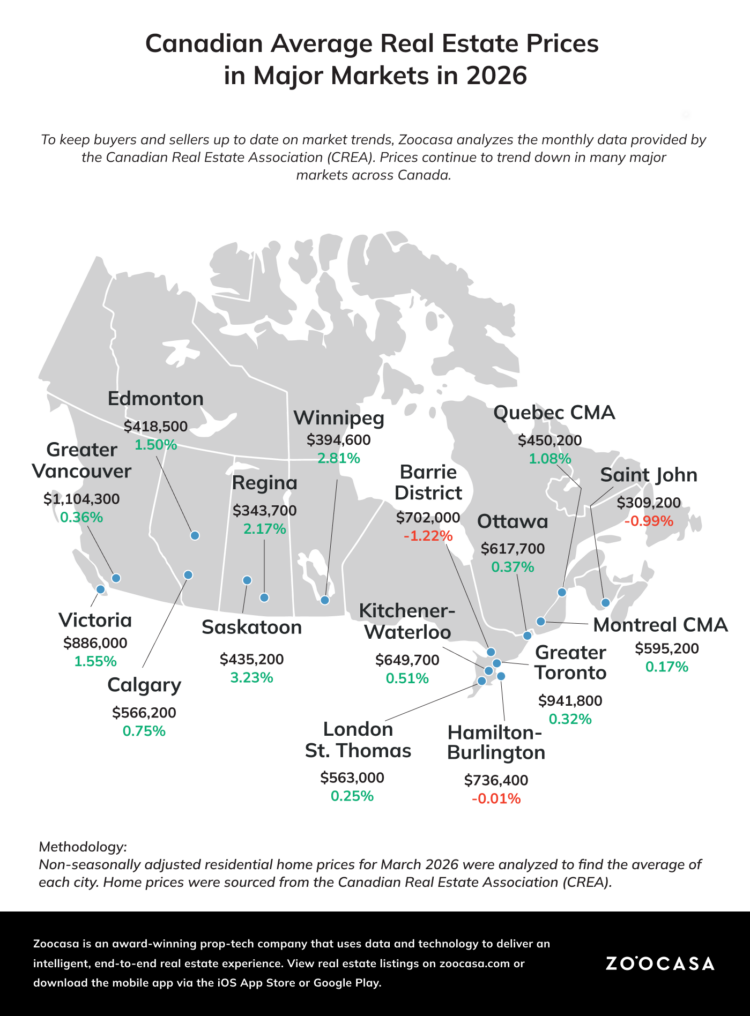
Southern Ontario and parts of B.C. are still seeing the biggest price drops. Greater Toronto’s average price fell 6.7% to $1,017,796, Niagara Region dropped 8.1% to $621,944, and Hamilton-Burlington was down 6.2% to $818,114. Kitchener-Waterloo fell 4.7% to $734,690, London and St. Thomas dropped 3.2% to $624,194, and Windsor-Essex was down 6.8% to $532,208.
Meanwhile in B.C., the Fraser Valley had a 6.3% drop to $967,114, and Greater Vancouver fell 3.0% to $1,201,522. Victoria was an exception, rising 4.0% to $1,027,854.
New listings in these areas also dropped sharply. Greater Toronto had 16.7% fewer new residential listings than last year, Fraser Valley was down 16.2%, and Greater Vancouver fell 12.8%. This suggests that many potential sellers are choosing to wait until the market is more certain.
Alberta’s Housing Market Remains Steady
Alberta continues to offer something increasingly rare in Canadian real estate: stability. In Calgary, the average price barely moved, inching up 0.3% to $656,109, while new listings dipped 11.2% to 4,521, a hint that sellers are in no rush to test the waters. Edmonton, meanwhile, continues to quietly make its case as one of the country’s best-value big cities. Prices rose a modest 2.2% to $465,237, with new listings essentially flat at 4,188.
Sitting roughly $208,000 below the national average, Edmonton remains an attractive option for buyers seeking more space, shorter commutes, and a foothold in a major market, especially those rethinking life in pricier corners of Toronto or Vancouver.
Buyers Still Active in More Affordable Markets
Quebec had another strong month across the board. New listings jumped sharply in nearly every major market, led by Saguenay (+29.3%), Gatineau (+22.1%), and Quebec CMA (+22.0%), with Trois-Rivières, Sherbrooke, and Montreal not far behind. Prices kept climbing too, with Quebec CMA up 9.1% to $486,768, Saguenay up 8.8% to $403,184, and Montreal up 4.7% to $665,120, proof that affordability and steady demand continue to drive the province forward.
Saskatoon and Trois-Rivières Lead in Price Growth
Smaller and mid-sized markets again saw the biggest price increases. Saskatoon led the country with a 13.8% rise to $460,867, followed closely by Trois-Rivières CMA, up 14.3% to $449,128, and Thunder Bay, up 11.5% to $378,030. All three remain well below the national average of $673,084, indicating that buyers are moving to more affordable regions.
CREA Lowers Its 2026 and 2027 Forecasts
Alongside the March data, CREA released a downgraded outlook for the rest of 2026 and into 2027, pointing to a recent oil-driven inflation spike, higher bond yields and mortgage rates, and a softer-than-expected start to the year. Instead of fuelling the spring rebound many had anticipated, higher rates and the perception that they may be temporary are expected to keep some buyers on the sidelines into the summer.
National home sales are now forecast to reach 474,972 units in 2026, a 1% gain over 2025, with most of that growth driven by recovery in British Columbia and Ontario. Other provinces, where record population growth had previously boosted demand, are expected to see only modest increases or slight declines. Similarly, the national average home price is forecast to climb 1.5% to $688,955 in 2026, with little to no growth in B.C., Alberta, and Ontario, and gains of 2% to 5% elsewhere.
Looking ahead to 2027, national sales are projected to rise another 2.1% to 485,071 units, a figure that could be revised above 500,000 if further rate hikes prove unnecessary, while the national average price is expected to edge up just 0.9% to $695,094. That would mark the sixth and seventh consecutive years in which the national average has hovered near $700,000.
What’s Next for the Market
March’s numbers show a market that was ready to pick up, but rate changes slowed things down. With five months of inventory and balanced conditions, buyers in Ontario and B.C. have time and choices, while sellers in Quebec, Saskatchewan, and Atlantic Canada are in a stronger position. The next few months will reveal whether lower rates bring more buyers back or delay the recovery.
Curious about your local market? Talk to a local agent who understands your area’s inventory, prices, and competition.