

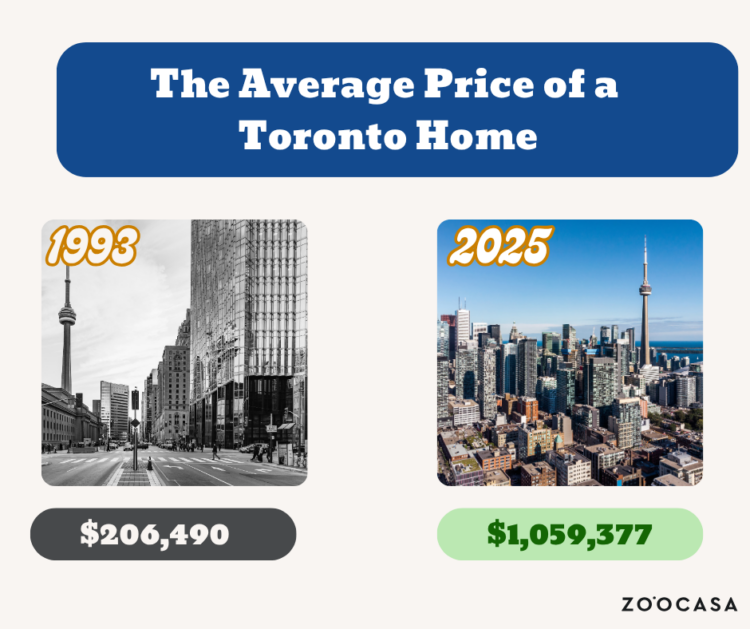
The last time the Toronto Blue Jays won the World Series in 1993, the average home in the city sold for $206,490. Adjusted for inflation, that’s roughly $397,319 in 2025 dollars. So, home prices are up about 167% in real (inflation-adjusted) terms.
Fast forward to today, and the numbers tell a very different story. According to the Toronto Regional Real Estate Board (TRREB), the average home price in September 2025 is $1,059,377. To buy a home at that price, a 20% down payment would total roughly $211,875.
That’s a 413% jump in average home prices since the Jays’ last World Series championship — a rise almost as dramatic as the team’s latest comeback
With the Blue Jays back in the World Series spotlight, Zoocasa took a closer look at how Toronto’s real estate market has evolved since the last time the team was crowned champions.
Toronto in 1993: When the Jays Were on Top and Homes Were Affordable
Thirty-two years ago, Toronto was riding high on back-to-back World Series wins, sealed by Joe Carter’s legendary walk-off home run. Moviegoers packed theatres for Jurassic Park and Mrs. Doubtfire, while Whitney Houston’s “I Will Always Love You” echoed from every radio.
Just as the way we watch movies and listen to music has completely changed, so too has the cost of living in the city. According to the Canadian Mortgage and Housing Corporation in October 1993, a one-bedroom rental apartment was $627 a month, which is the equivalent of $1,206 in today’s dollars. Now, according to Rentals.ca, a one-bedroom rental goes for roughly $2,295, a 266% increase over three decades.
How Toronto’s Housing Costs Stack Up Against MLB Paycheques
Even major-league salaries can’t keep up with Toronto’s housing market. In Rosedale–Moore Park, where detached homes average $5.52 million, even Blue Jays’ rookie pitcher Trey Yesavage, who famously struck out Shohei Ohtani in Game 2, would fall short. His $4.1 million signing bonus, alongside his reportedly $57,204 salary, still wouldn’t buy a single home outright in one of Toronto’s most expensive neighbourhoods.
Set to earn a whopping salary of $820,000 in 2026, Yesavage still wouldn’t be able to purchase a detached home outright even in some of Toronto’s most affordable neighborhoods, including Rexdale, Kipling, West Humber, and Claireville, where the average price is $939,318. His full salary would cover only about 87% of the cost of an average detached home, highlighting just how challenging Toronto’s housing market has become, even for the city’s most popular athletes.
Meanwhile, Vladimir Guerrero Jr., the Blue Jays’ highest-paid player, is set to earn $28.5 million in 2025, enough to buy a detached home in nearly any Toronto neighbourhood and still have plenty left over for box seats at the Rogers Centre.
From Steady Gains to Soaring Prices
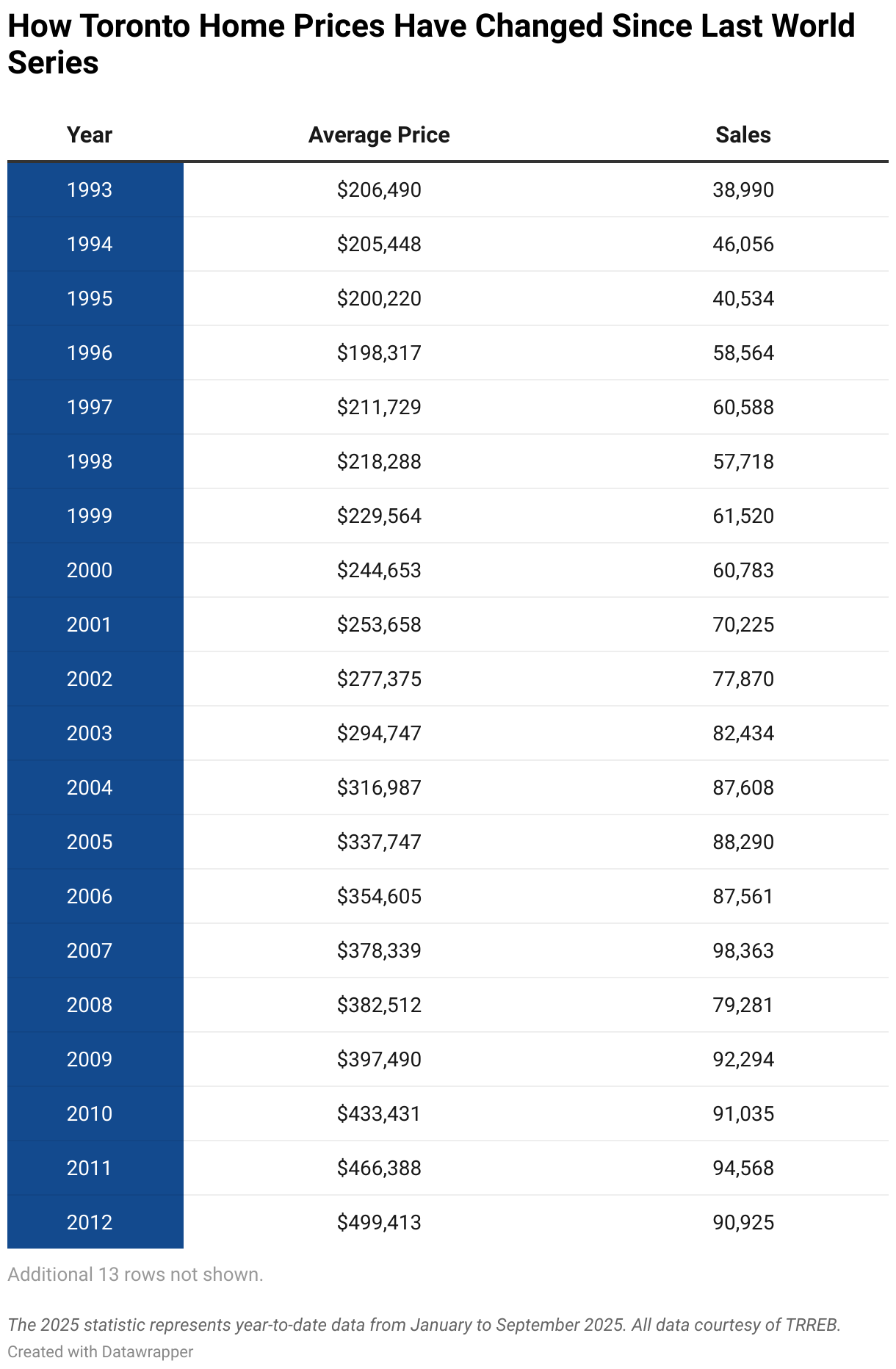
It’s worth noting just how much the city has changed since Canada was last in the World Series. Five years after the Jays’ 1993 win, Toronto’s average home price climbed modestly to $211,729, the start of a steady rise that would reshape the city’s housing market. In today’s dollars, that’s about $385,365.
By 2013, twenty years after the championship, the average price had nearly doubled again to $523,036, up 5.2% from the year before.
Fast-forward to 2025: even with a record number of listings, the average Toronto condo sold for $681,115 in September, roughly equal to the city’s average home price in 2015 ($623,529).
Toronto’s Market Never Stays Down for Long
Similarly, Toronto’s housing market has a history of bouncing back stronger after every cooldown.
Thirty-two years ago, the average home sold for $206,490 across 39,000 sales. By 2003, the average climbed to $294,747, and annual sales more than doubled to 82,434 as demand surged across the GTA.
A decade later, in 2013, prices hit $525,681 with 92,767 sales, showing steady growth through economic shifts. By 2015, Toronto broke new records again, with 107,429 sales and an average price of $623,529.
Then came the pandemic years. In 2021, Toronto saw 127,313 transactions, and the average home price surpassed the $1 million mark for the first time, reaching $1,098,087.
In September 2025, TRREB reported that 47,727 sales were recorded year-to-date, proof that, while the pace may have shifted, Toronto’s market remains one of the most active in the country.

Back in 1993, Statistics Canada recorded the Greater Toronto Area’s population at about 4.6 million. By 2024, that number had surged to 7.6 million, fueled by steady immigration, strong job growth, and the city’s enduring appeal.
This population boom has been a key driver behind Toronto’s soaring home prices. As more people move to the region in search of opportunity, housing demand continues to outpace supply, keeping competition fierce and prices climbing, even through shifting market cycles.
As reported by Sportsnet.ca, manager John Schneider recently reflected on what makes the Toronto Blue Jays stand out against other major league players: “Fanbase, obviously, in my mind, is second to none, when you have a whole country behind you. But more than anything, I’m proud of the fact that it’s pretty clear what we stand for and what we think is important on the field. I think we really showed that this entire season and this postseason.”
The Six Always Finds Its Way Back
Whether it’s the Blue Jays fighting their way back to the World Series or Toronto’s housing market defying every forecast, this city knows how to make a comeback.
Prices rise, markets shift, and new players step up, but Toronto always finds its rhythm again. Just like that bottom-of-the-seventh moment at the Rogers Centre, when George Springer’s three-run homer reignited the crowd and kept the World Series dream alive, Toronto proves time and again that it can rise when it matters most.
Curious about buying or selling in Toronto? Our expert agents are here to guide you every step of the way! Give us a call today to speak with an agent in your area and start planning your next real estate endeavor.