

Housing and employment are two of the clearest indicators of a community’s overall well-being. For many Canadians, the decision to settle in a city depends on a combination of stable job opportunities and affordable housing costs. Together, these factors shape where people live and how confidently they can plan for the future. When either begins to falter, population growth slows, housing demand shifts, and local economies inevitably feel the ripple effects. In a healthy economy, unemployment typically falls between 3.5% and 4.5%, rarely exceeding 5%.
Yet in 2025, both the housing and job markets have drifted out of balance. Unemployment rates in Canada are climbing, and many people are feeling the pinch. A recent Zoocasa survey of nearly 1,000 Canadians found that 15.1% have less than $5,000 in savings for a down payment, suggesting many will remain long-term renters as homeownership is still years out of reach.
Zoocasa analyzed rental prices and unemployment rates from January to September 2025 across Canadian cities to examine how shifting job markets are affecting rental trends.
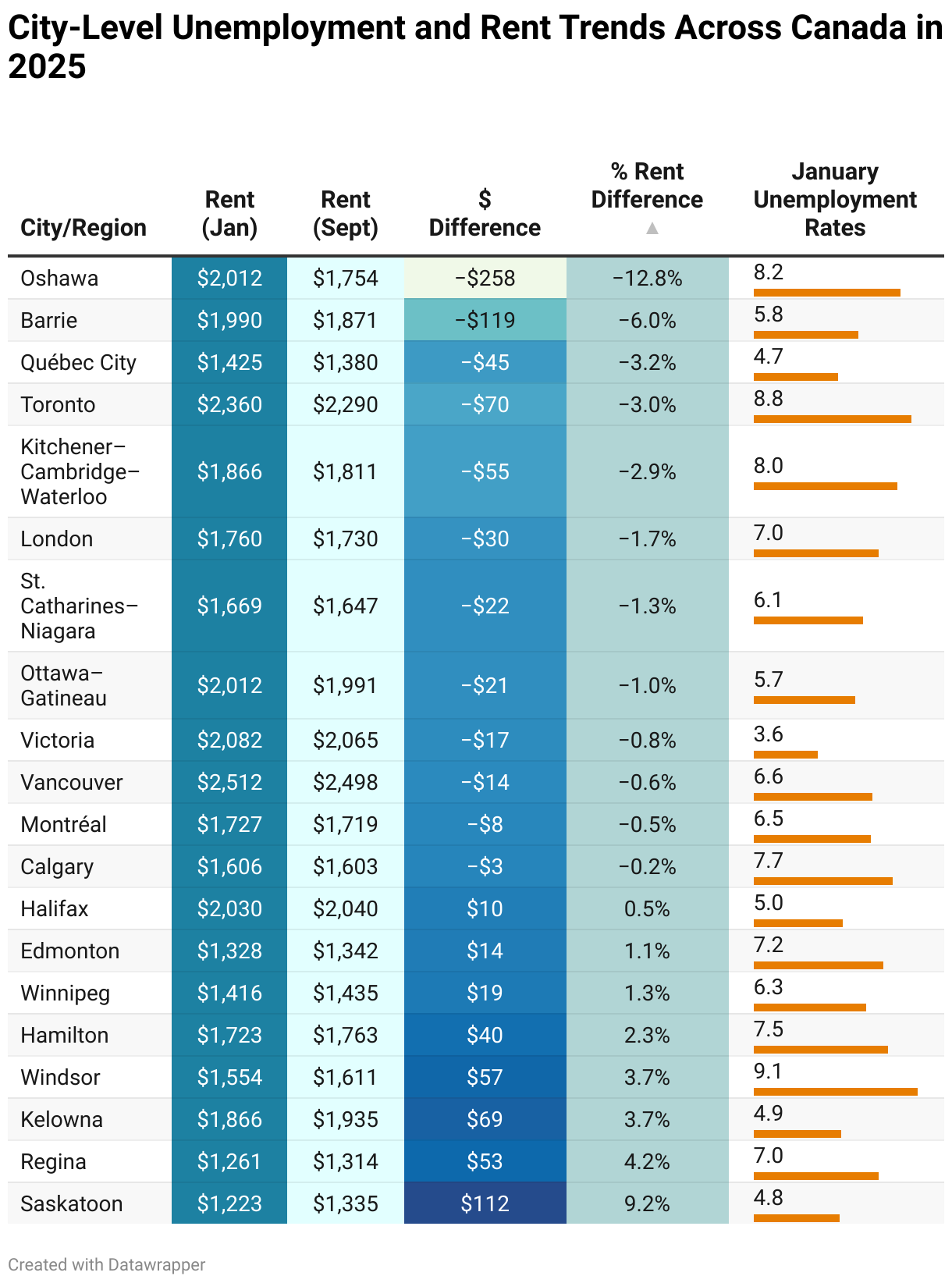
Rents Rise in Weakened Job Markets
Across Canada, rents continue to rise despite increasing unemployment. Saskatoon saw the sharpest increase, with rents up 9.2% (+$112) to $1,335, even as unemployment rose from 4.8% to 5.3%. Regina followed, with rents climbing 4.2% (+$53) to $1,314, even as unemployment improved slightly from 7.0% to 6.5%. In September, Saskatchewan’s goods-producing sector experienced a notable decline. The construction sector lost about 1,000 jobs, while utilities shed around 700, as reported by the Government of Canada’s job bank.
In Kelowna, unemployment surged from 4.9% to 7.1%, the largest jump in any city, yet rents rose 3.7% (+$69) to $1,935. Windsor saw a similar pattern: rents increased 3.7% (+$57) to $1,611, while unemployment climbed from 9.1% to 10.4%.
“Windsor families are being left to carry the weight of U.S. tariffs, and a weak provincial government with no plan to protect jobs,” Windsor West NDP MPP Lisa Gretzky stated in an August press release about the city’s job crisis. In the second quarter of 2025, the province lost 38,000 jobs, including 56,000 full-time positions. Nearly 30,000 of those were in the manufacturing sector, a key pillar of Windsor’s economy.
Early Signs of Relief
Some regions are beginning to show tentative signs of balance. Oshawa stands out for the steepest rent drop nationwide, falling 12.8% (−$258) to $1,754 as unemployment rose from 8.2% to 8.8%
Barrie saw rents decline 6% (−$119) to $1,871, alongside a sharp rise in unemployment from 5.8% to 7.7%. In Toronto, rents decreased by 3% (−$70) to $2,290, with unemployment remaining steady at 8.9%. Kitchener–Cambridge–Waterloo also saw a 3% decrease (−$55), while unemployment improved from 8.0% to 7.1%, suggesting that affordability pressures may be easing slowly.
Large metropolitan areas remain stubbornly expensive despite minor fluctuations. Montréal and Vancouver experienced little movement, with unemployment rates remaining steady at 6.5% and 6.3%, respectively, and minimal rent changes. Ottawa–Gatineau, with unemployment rising from 5.7% to 7.0% saw rents decrease by just 1% (−$21) to $1,991, indicating that tight supply continues to buffer prices.
In coastal cities such as Halifax, Victoria, and Vancouver, affordability remains out of reach despite stability on paper. All three saw minor increases in unemployment, yet rents remained largely unchanged. In Halifax, rents rose by just $10 a month, while in Victoria, there was a minimal decrease of $17.
A few markets are showing genuine improvement in both job conditions and housing costs. Hamilton, London, and Vancouver each reported slight decreases in unemployment, but rent relief remains minimal, within a narrow range of $15 to $40. Kitchener–Cambridge–Waterloo and Regina show early signs of balance, with improving employment and slower rent growth.
The Cost of Stability
This disconnect between wages, rent, and availability is reshaping how Canadians live, work, and plan their futures. In fact, Canada’s birth rate has fallen to its lowest level in recorded history, reflecting the lasting impact that affordability challenges can have on future generations. An Ipsos survey for Global News found that 65% of Canadians are choosing smaller families due to financial pressures. Without rent control and stronger wage growth, Canada’s rental market will continue to operate on compromise, where stability comes at a cost and true affordability remains elusive.
The widening gap between wages, rent, and housing supply has become one of Canada’s defining economic challenges. As affordability pressures mount, stability itself is being redefined, shifting from a sense of security to a balancing act between income and essential costs.
Still, there’s room for optimism. With stronger job growth, fairer wages, and a renewed focus on expanding affordable housing, cities could begin to restore balance between earnings and expenses. Closing that gap won’t happen overnight, but these steps are essential to ensuring that stability and opportunity remain within reach for future generations.
Looking for a new home? Give us a call today to speak with an agent in your area and start planning your next real estate endeavor.