
In October 2025, five provinces (including Ontario, Nova Scotia, and Saskatchewan) raised their minimum wages to help workers keep pace with rising living costs. They joined British Columbia, Quebec, New Brunswick, and Newfoundland and Labrador, which had already made similar increases in early 2025.
But despite these efforts, one major expense continues to rise faster than incomes: rent. While rental prices have cooled slightly from the record highs of 2023, affordability remains out of reach for many Canadians, especially single earners trying to rent a one-bedroom apartment at the average price.
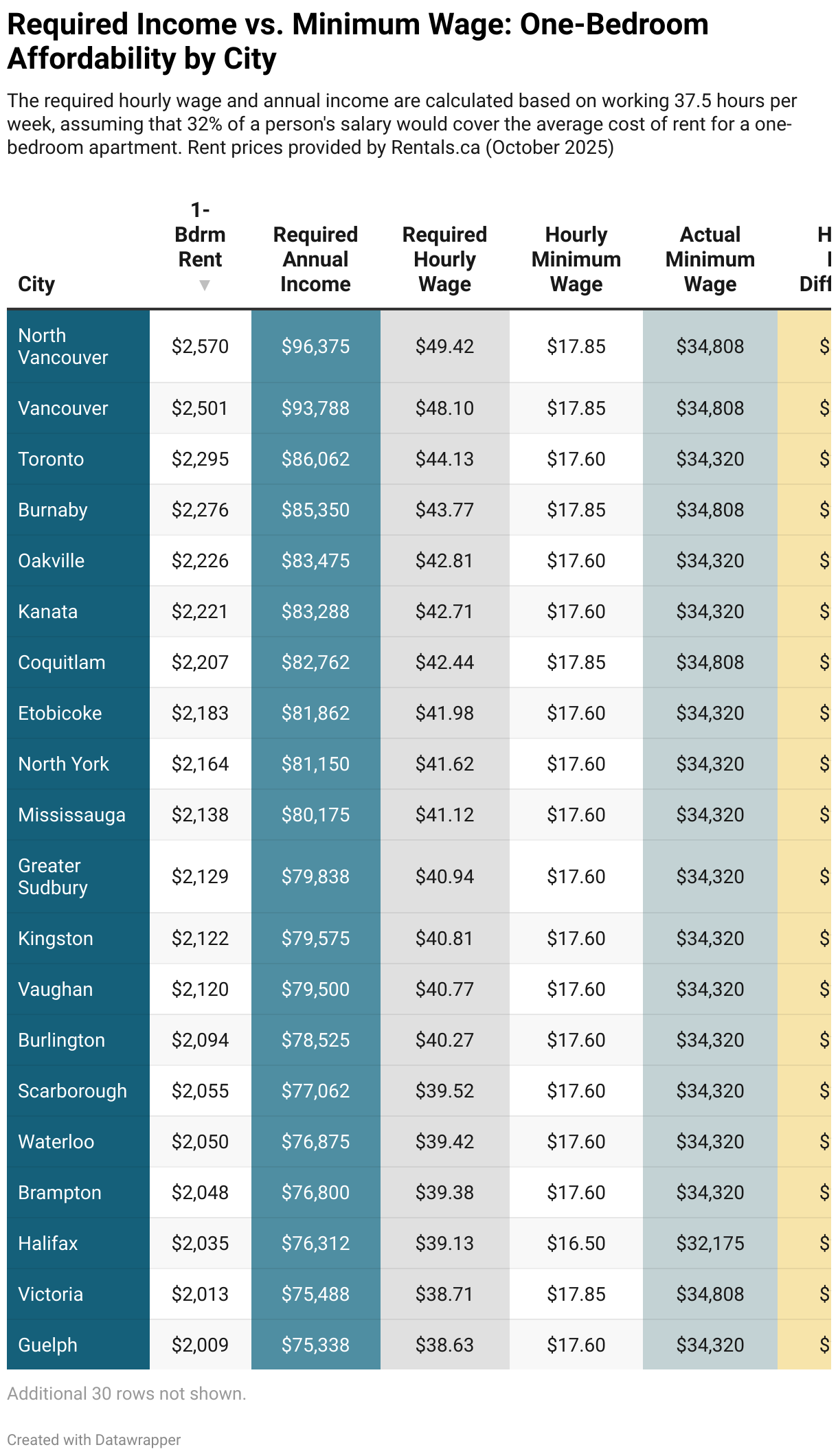
Using recent data from Rentals.ca, Zoocasa analyzed 51 Canadian cities to reveal the minimum income required to rent a one-bedroom apartment affordably under the 32% rule, highlighting the growing gap between what renters earn and what they need to keep housing costs manageable.
The 32 Percent Rule: A Reality Few Can Meet
Financial experts often point to a golden rule of budgeting: no more than 32 percent of your gross income should go toward housing. It’s a standard that’s supposed to leave room for food, transportation, savings, and a little breathing room for the unexpected. But for Canadians earning minimum wage, that target feels like an impossible dream. A full-time worker putting in 37.5 hours a week earns between $29,000 and $35,000 a year, depending on the province. According to that guideline, their rent should be around $775 to $930 per month.
The problem is that in most Canadian cities, even a basic one-bedroom apartment costs nearly double, or even triple, that amount. While minimum wages have climbed, rent has continued to rise faster, leaving workers locked in a cycle where a full-time job doesn’t guarantee affordable housing.
High Wages, Even Higher Rents in British Columbia
Nowhere is the disparity between income and rent more pronounced than in British Columbia. The province raised its minimum wage to $17.85 per hour, the highest in Canada, but it hasn’t been enough to keep pace with its extremely high housing costs. In North Vancouver, a one-bedroom apartment averages $2,570 per month, meaning a renter would need to earn nearly $96,400 per year (or about $46.42 per hour) to meet the 30 percent affordability rule. That’s a staggering 177 percent higher than the province’s minimum wage.
Vancouver, meanwhile, requires an hourly wage of $48.10 to afford the average rent of $2,501, while Burnaby and Coquitlam are only slightly behind at $43.77 and $42.44 per hour, respectively. Even cities that once offered a hint of relief, like Victoria or Kelowna, have now crossed the line of affordability, with one-bedroom apartments costing between $1,900 and $2,000 per month. In Nanaimo, where rents are a bit lower at $1,860, a worker would still need to earn twice the minimum wage to stay within budget.
Ontario’s Wage Increases Fail to Keep Pace with Soaring Rents
Ontario has also raised its minimum wage to $17.60 per hour in response to inflation and rising living costs. Nevertheless, rent prices across much of the province continue to rise faster than income. In Toronto, the average one-bedroom apartment rents for $2,295 per month, meaning a renter would need to earn $44.13 per hour, or roughly $86,000 per year, to adhere to the 32 percent rule. That figure is 151 percent higher than Ontario’s new minimum wage.
This pattern repeats across the Greater Toronto Area. In Mississauga, renters would need to earn $41.12 per hour to afford a one-bedroom apartment, while in Brampton, the figure is $39.38.
Meanwhile, in Waterloo, where a one-bedroom costs $2,050, the required wage is $39.42 per hour, and in London, it’s $32.96. These figures represent wage gaps ranging from 87 to over 120 percent, illustrating that even mid-sized cities once seen as affordable alternatives are no longer accessible to minimum-wage earners.
Ontario’s housing costs continue to outpace wage growth at nearly every level, confirming that incremental wage adjustments are insufficient to bridge the affordability gap.
Alberta’s Minimum Wage Problem
Alberta has long been viewed as one of the more affordable provinces, thanks to its lower cost of living and absence of provincial sales tax. But its minimum wage has been frozen at $15.00 per hour since 2018, and that stagnant rate no longer aligns with modern rental prices. In fact, a single person earning the minimum wage and working full-time in Alberta still earns less than $30,000 a year.
This is especially noteworthy when you consider that in Calgary, where a one-bedroom apartment averages $1,675 a month, a renter would need to earn about $32.21 an hour to stay within the 32 percent rule—more than double the province’s minimum wage. Edmonton, with an average rent of $1,386, requires an hourly wage of $26.65, which is approximately 78 percent higher than the minimum wage. Smaller cities, like Lethbridge and Medicine Hat, tell a similar story.
Although rents there range between $1,200 and $1,300, the required hourly wage still exceeds $23 per hour, well above the provincial minimum wage.
Lower Prices and Persistent Gaps in the Prairies
The Prairie provinces are often held up as examples of affordability, but even here, the numbers don’t quite add up. Saskatchewan, with its minimum wage of $15.35 per hour, still falls short of what’s needed to keep rent under control. In Regina, where the average one-bedroom rent is $1,301, a person would need to earn $25.02 an hour to stay within budget. In Saskatoon, the math is nearly identical: $1,293 in rent translates to a required wage of $24.87 per hour.
Manitoba offers slightly better odds, with its $16.00 hourly minimum wage, but affordability remains elusive. In Winnipeg, a one-bedroom apartment costs about $1,443 a month, which means renters would need to earn $27.75 an hour—73 percent more than the provincial minimum wage. Even in cities where rent seems modest compared to national averages, workers are still falling short by $9 to $11 an hour.
The Truth About Renting in Atlantic Canada
In Halifax, Nova Scotia, a person earning the provincial minimum wage of $16.50 per hour faces an average rent of $2,035 for a one-bedroom apartment. That means they’d need to make $39.13 an hour (137 percent higher) to comfortably afford it.
Meanwhile, Newfoundland and Labrador continue to offer some of the most accessible rental opportunities in Canada. In St. John’s, the average one-bedroom costs $1,015, meaning a renter would need to earn $19.52 an hour to stay within the 32 percent affordability guideline. With the province’s minimum wage at $16, the gap, while still present, has narrowed to 22 percent.
A Raise Without Relief
Canada’s minimum wage hikes were well-intentioned, but they’ve fallen short of addressing the country’s real affordability challenges. The cost of housing continues to rise faster than earnings, leaving a single income earner paying well over a third of their income (sometimes more than half) in order to rent a one-bedroom apartment.
The path forward requires more than modest annual raises. It demands that income standards be tied directly to real-world housing costs, ensuring that minimum wage truly reflects what it takes to live, not just survive.
Until then, Canada’s wage increases will continue to look good on paper but offer little relief in reality. A raise that helps pay for a latte or two is still insufficient to cover essentials like food, clothing, shelter, transportation, childcare, and saving for the future.
Are you reviewing your finances and thinking about buying or selling a home in the near future? Zoocasa has thousands of up-to-date listings near you. Start your search today!