
After years of affordability challenges and steep housing costs, happiness has become a growing part of the conversation around livability. While smaller towns and rural regions often score high on well-being, Zoocasa focused on Canada’s ten largest cities to uncover where big-city residents feel happiest, and how much that happiness costs.
According to Leger’s Happy Cities 2025 report, Canadians rate their overall happiness at an average of 68.7 out of 100. Respondents were categorized as very happy (scores of 9–10), happy (7–8), or unhappy (1–6). The report also tracks changes in happiness over time, revealing that nearly half of Canadians reported their happiness remained the same over the past year, while 28% experienced a decline and 23% noted an improvement. Based on responses from more than 39,800 adults nationwide, the report found that only two of Canada’s largest cities scored above that national benchmark.
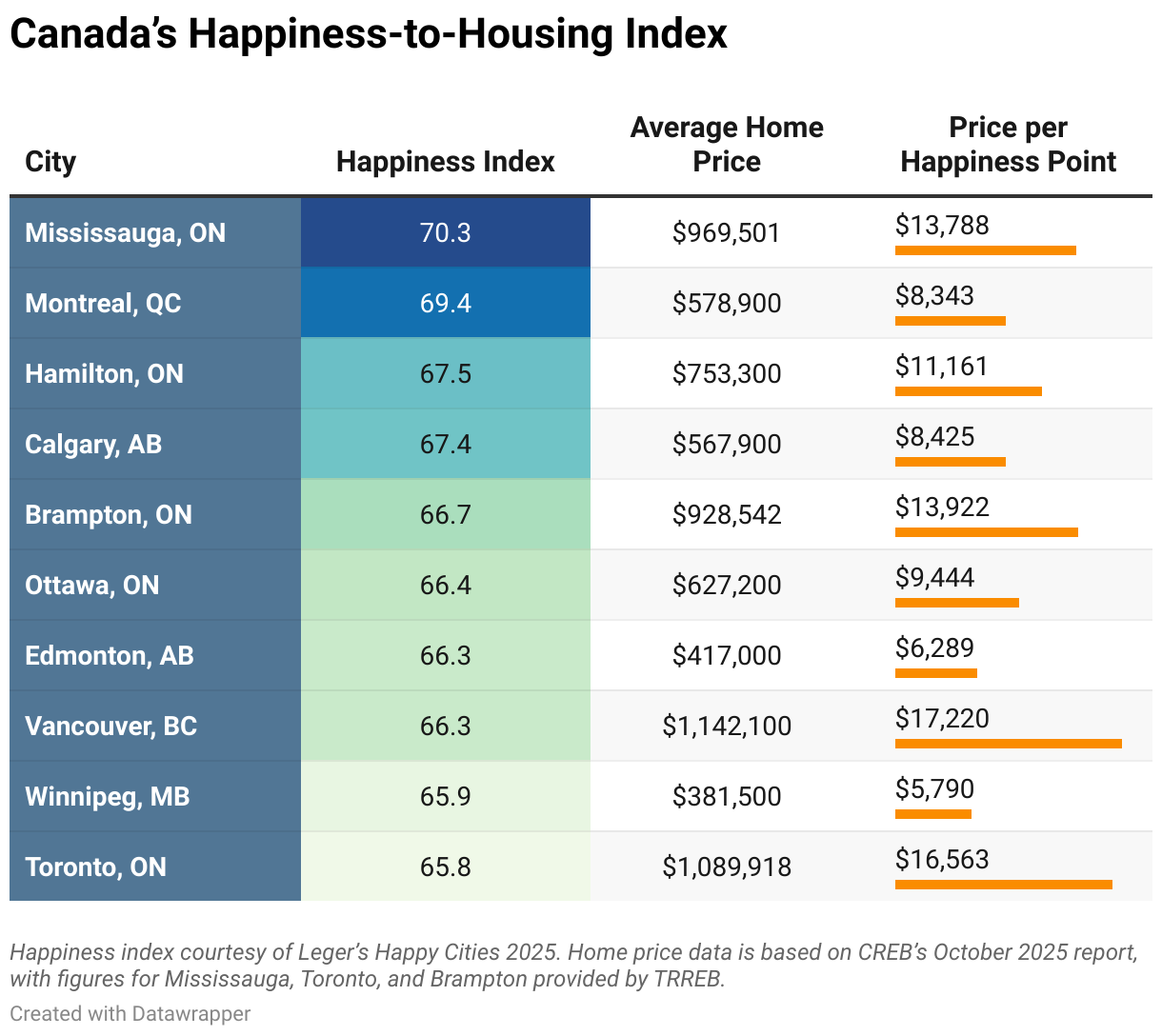
To explore how happiness intersects with housing, Zoocasa compared Leger’s data with average home prices from CREA and TRREB and calculated a unique “price per happiness point.” The “price per happiness point” represents the average home price divided by a city’s happiness score, showing how much housing costs for each “unit” of happiness reported. A higher price per happiness point indicates that residents pay more for their happiness, while a lower one suggests a better balance between housing costs and well-being. In essence, this metric shows how much people in Canada’s largest cities are willing to pay for the quality of life they enjoy, and where affordability and happiness are best balanced.
Happiness Comes at a Price, And It’s Steep in Some Cities
Among Canada’s ten largest cities, only Mississauga and Montreal report happiness scores above the national average. But the cost of that happiness differs dramatically between the two. In Mississauga, where the average home costs $969,501, residents are effectively paying about $13,788 for every “point” of happiness, almost twice the cost of Montreal’s $8,343 per point, based on an average home price of $578,900.
The eight other largest cities by population fall below it, even with their abundance of amenities, job opportunities, and urban conveniences. When home prices are factored in, the difference becomes even more pronounced. The “price per happiness point” ranges from $5,790 in Winnipeg to $17,220 in Vancouver, showing that the cost of big-city happiness can be as much as three times higher depending on where you live.
Western Canada Offers the Best Value for Happiness
Cities out West stand out for delivering strong happiness scores at much lower housing costs. Edmonton ($6,289 per point), Calgary ($8,425), and Winnipeg ($5,790) all rank as the most affordable markets on the list, yet their happiness levels are nearly equal to those in higher-priced regions. This suggests that Western Canadians enjoy one of the best “happiness returns” on their housing investment, with affordability playing a key role in overall satisfaction.
Smaller Big Cities Deliver Greater Happiness Value
Cities like Winnipeg and Edmonton, while still among Canada’s largest urban centres, demonstrate that happiness and affordability don’t have to be mutually exclusive. These cities offer the lowest cost per happiness point among all cities analyzed, showing that residents in more affordable major markets may be enjoying a higher return on quality of life than those in pricier provinces.
Montreal and Calgary Strike a Balance
On the other hand, Montreal and Calgary exemplify a balance between emotional satisfaction and financial accessibility. Both report happiness scores near the top of the list while maintaining mid-range home prices. At roughly $8,000 per happiness point, these markets show that livability and affordability can coexist, offering residents a sense of well-being without the financial strain found in Canada’s most expensive metropolitan areas.
Vancouver and Toronto: High Costs, Lower Returns
Despite their global appeal and strong economies, Vancouver and Toronto deliver some of the lowest happiness scores, yet they carry the highest housing costs. With home prices exceeding $1M in both markets, residents are paying upwards of $16,000 per happiness point. The data suggests that even as these cities offer vibrant job markets and cultural opportunities, affordability pressures continue to weigh on overall life satisfaction.
Home Affordability Shapes Canadian’s Happiness
To better understand how Canadians are feeling about today’s housing landscape, Zoocasa surveyed nearly 1,000 readers in June 2025 about their future housing plans, real estate preferences, and overall outlook. The results align closely with the findings from Leger’s Happy Cities report — affordability remains at the heart of Canadians’ sense of happiness and stability.
More than half of respondents (52.6%) said that affordable and stable housing options have the greatest impact on their overall quality of life. This was followed by community safety and security (22.4%) and proximity to work, school, or essential services (11.7%), reinforcing that the foundations of happiness are built as much on practical needs as on emotional ones.
However, optimism around affordability remains low. A majority of homeowners (53.8%) agree that there are no longer any neighbourhoods in their city that feel reasonably priced: a sentiment that may be driving many to consider new regions altogether. In fact, more than one in four Canadians (26.3%) reported that they are actively considering moving to a smaller or secondary city, such as London or Fredericton, to reduce their housing costs. Another 13.5% said they were open to the idea but would need to explore it further.
The findings suggest that while Canada’s happiest big cities offer a glimpse of balance between price and quality of life, many Canadians are looking beyond the major metro areas in search of the same. As affordability continues to influence both financial decisions and emotional well-being, the path to happiness in housing may increasingly lead through smaller, more attainable markets.
Ultimately, the data shows that for many Canadians, happiness starts with an affordable home. Happiness looks different for everyone, and so does the perfect home. Our agents can help you find the place that fits your lifestyle and brings a little more joy to your everyday life. Thinking about moving before 2026? Let’s make it happen!