

Homeownership has always carried financial strain, but the scale of difficulty today is fundamentally different from the past. For couples in their 30s — the median age when most Canadians purchase their first home — the burden of borrowing has grown heavier despite falling interest rates and rising incomes. By comparing borrowing costs across decades, one conclusion becomes unavoidable: today’s buyers face the steepest and most prolonged path to homeownership
In 1990, a Canadian family needed just over $41,000 for a down payment on a $207,756 home, a sum that could be saved in about 10 years. By 2025, the required down payment has tripled to more than $134,000 on a $672,784 home, and it now takes 22 years to save at the same rate. Monthly mortgage payments have grown from $1,952 in 1990 (41% of income) to $3,263 in 2025 (47% of income).
Methodology
Zoocasa analyzed borrowing costs for median age buyers across decades using a consistent framework. Calculations are based on a five-year mortgage term, a 20-year amortization period, and the interest rate provided for each year in the dataset. For each scenario, the mortgage amount reflects the purchase price minus a 20 percent down payment. Monthly mortgage payments and the remaining balance after five years were then determined, allowing for direct comparisons across time. Note: This analysis reflects average after-tax family incomes.
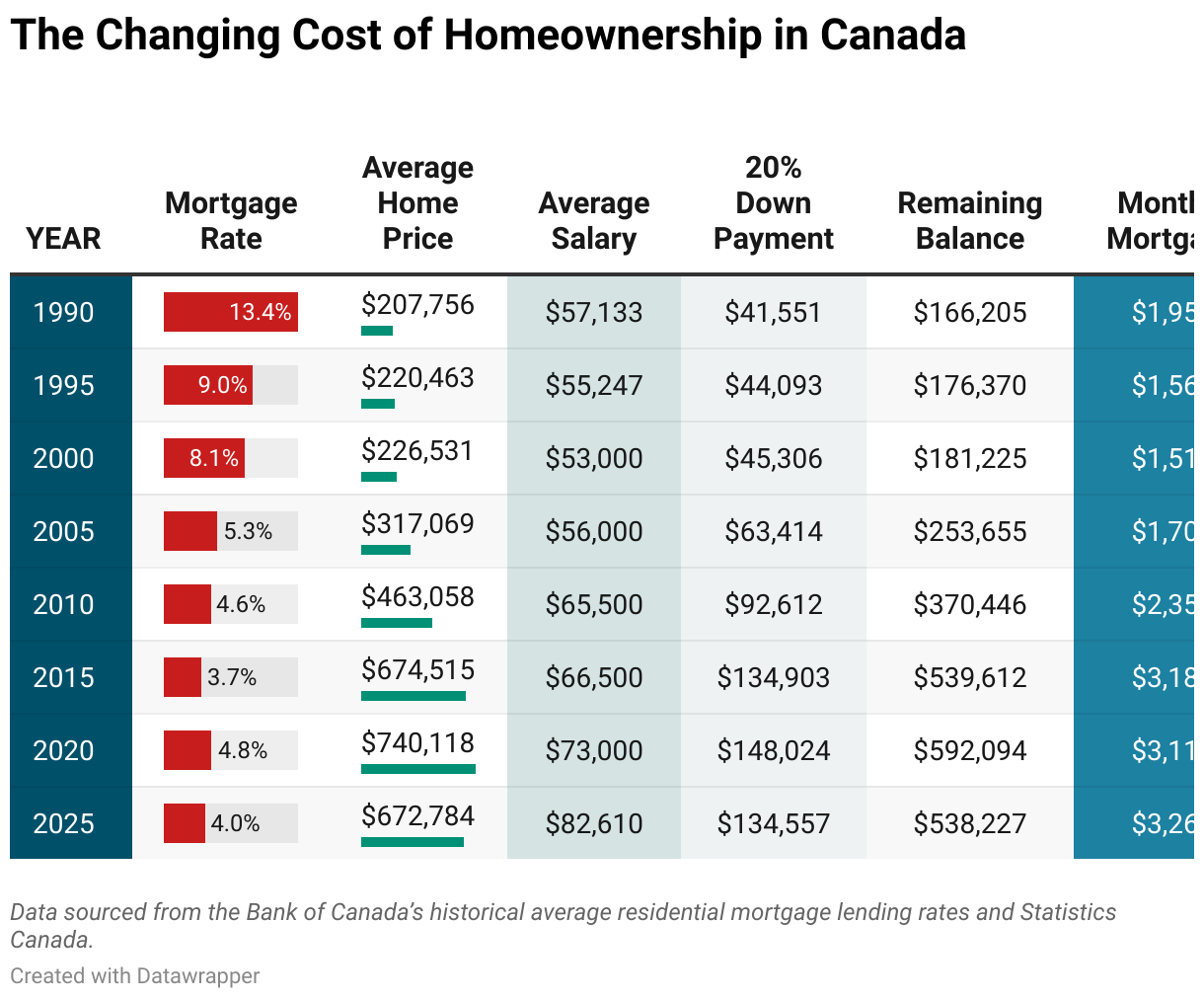
Borrowing Costs Then and Now
In 1990, the average Canadian home cost $207,756. A 20 percent down payment of $41,551 left a mortgage of $166,205. With interest rates at 13.4 percent, monthly payments reached $1,952, consuming 41 percent of a family’s $57,133 after-tax income. It was costly, but the debt burden was relatively modest.
By 2025, the picture is starkly different. The average home costs $672,784, requiring a down payment of $134,557 and a mortgage of $538,227. Even at a much lower interest rate of 4.04 percent, monthly payments have risen to $3,263. For a family earning $82,610, that amounts to 47 percent of income. In effect, couples today carry mortgages three times larger than those of 1990 while dedicating a larger share of their paycheques to service them. The conclusion is clear: income growth has not kept pace with home prices, and affordability has deteriorated despite lower interest rates.

The Interest Rate Paradox
Historically, falling interest rates made homeownership more attainable. By 1995, rates had dropped to 8.95 percent, and buyers could purchase a $220,463 home with payments of $1,563, or just 34 percent of income. By 2005, rates fell further to 5.3 percent, yet payments remained manageable at 37 percent of income despite rising prices.
The turning point came in the 2010s. Rates fell to historic lows ( just 3.71 percent in 2015), but the relief was entirely offset by skyrocketing home prices. Meanwhile, a $674,515 home in 2015 required a mortgage of $539,612, pushing monthly payments to $3,180, nearly 48 percent of income.
Lower borrowing costs, once a pathway to affordability, became the very driver of price escalation. Millennials and Gen Z are not enjoying the benefits of low rates, they are paying the price for them through historically large debt loads, as the cost of living increases substantially post-pandemic.
- Related: Canada’s Hottest Condo Market of the Last Decade Might Surprise You (It’s Not Toronto or Vancouver)
Debt That Lingers Longer
Another critical measure is how much principal remains after five years of payments. In 1990, buyers still owed $153,953 after five years. By 2000, the number had risen modestly to $158,500. By 2010, the remaining balance had climbed to $306,679.
Now in 2025, couples will still owe $440,989 after five years, nearly triple the balance of 1990 buyers. This shows that while Boomers and Gen X could build equity relatively quickly, today’s buyers remain heavily indebted well into midlife. The pace of equity accumulation, once a cornerstone of financial stability, has slowed dramatically, leaving households more exposed to market downturns and less able to leverage their homes for wealth-building.
The Down Payment Divide
For first-time buyers, the greatest obstacle is no longer the monthly mortgage payment but the ability to save for a down payment. In 1990, families needed $41,551 upfront, a sum that could be saved in about 10 years at a 7.2 percent household savings rate.
By 2025, the required down payment is over $134,000. Despite higher incomes, it now takes 22 years to save the same relative share. This shift is profound: where Boomers and Gen X could realistically purchase by their mid-30s, Millennials were forced to delay, and Gen Z faces the prospect of waiting until their 40s without external assistance.
Generational Comparisons at Mid-30s
Boomers in the late 1980s and early 1990s battled sky-high interest rates but bought inexpensive homes, building equity quickly once rates fell. Gen X, entering their 30s between the late 1990s and early 2010s, benefited from falling rates that balanced rising prices. Millennials in the 2010s faced record-high prices despite low borrowing costs, delaying ownership with steep down payment hurdles. Gen Z, heading into their 30s in the 2030s and 2040s, faces the steepest climb yet: saving timelines over two decades, mortgage balances near half a million dollars, and slower equity growth.
This data highlights how boomers were able to save for retirement and build wealth through more affordable purchases, which is now evident in the sizable inheritances being passed down to the next generation.
Homeownership Rates Declining Across Canada
Declining homeownership rates further illustrate how the challenges faced by today’s buyers differ from those of previous generations. Nationally, the homeownership rate fell from 69 percent in 2011 to 66.5 percent in 2021, a loss of 2.5 percentage points in just a decade, as reported by Statistics Canada. In Ontario, the decline was even more pronounced, dropping from 71.4 percent to 68.4 percent over the same period, while British Columbia experienced a similar fall from 70.0 percent to 66.8 percent. Even Alberta, long considered one of the most affordable provinces for ownership, saw its rate slip from 73.6 percent in 2011 to 70.9 percent in 2021.
These downward shifts are significant because they capture how younger generations, particularly Millennials and Gen Z, are struggling to gain a foothold in the market. Where Boomers and Gen X were able to enter ownership despite interest rate or price challenges, today’s buyers are increasingly locked out altogether.
When Housing Costs Steal Derail Future Plans
The implications go well beyond the housing market. Delayed ownership means delayed wealth building, postponed retirement, and diminished ability to transfer wealth to the next generation. It also impacts broader life decisions. A 2025 BMO survey found that 70 percent of Gen Z Canadians want children but fear financial insecurity, while 86 percent say the high cost of childcare prevents them from saving for major goals such as homeownership and education.
Taken together, these pressures reveal that today’s younger buyers are being forced to delay or reconsider the very milestones that traditionally define financial stability and family life in Canada.
Considering buying or selling? The right real estate agent will help you navigate your move with confidence. Start your search today.