

While some modest price relief has emerged at the national level, Alberta continues to show strong seller-leaning conditions. According to the National Bank Housing Affordability Monitor report, Calgary homeowners now need to allocate 40.3% of their income toward a mortgage on a median-priced home, which is significantly higher than the city’s long-term average of 36%. Edmonton, by comparison, remains closer to historical norms, with affordability at 30.1% in Q2 2025 versus a long-term average of 29.6%.
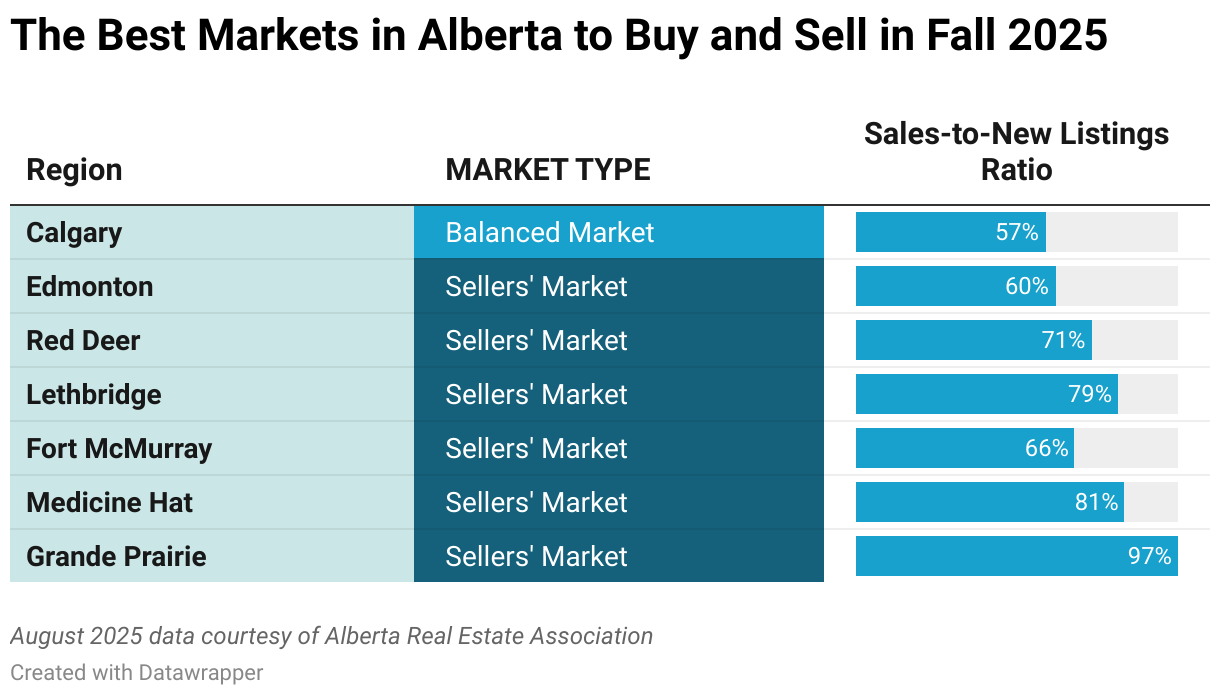
To get a clearer picture of current conditions, we analyzed August 2025 data from local real estate boards, focusing on the sales-to-new-listings ratio (SNLR) across seven major Alberta markets. This measure helps identify whether buyers or sellers hold the advantage: a reading under 40% signals a buyer’s market, 40% to 60% reflects a balance, and over 60% points to a seller’s market.
- Related: Here’s How Many Months of Rent You’d Need to Save for a Home in Calgary and Edmonton in 2025
Calgary cools, Edmonton holds firm
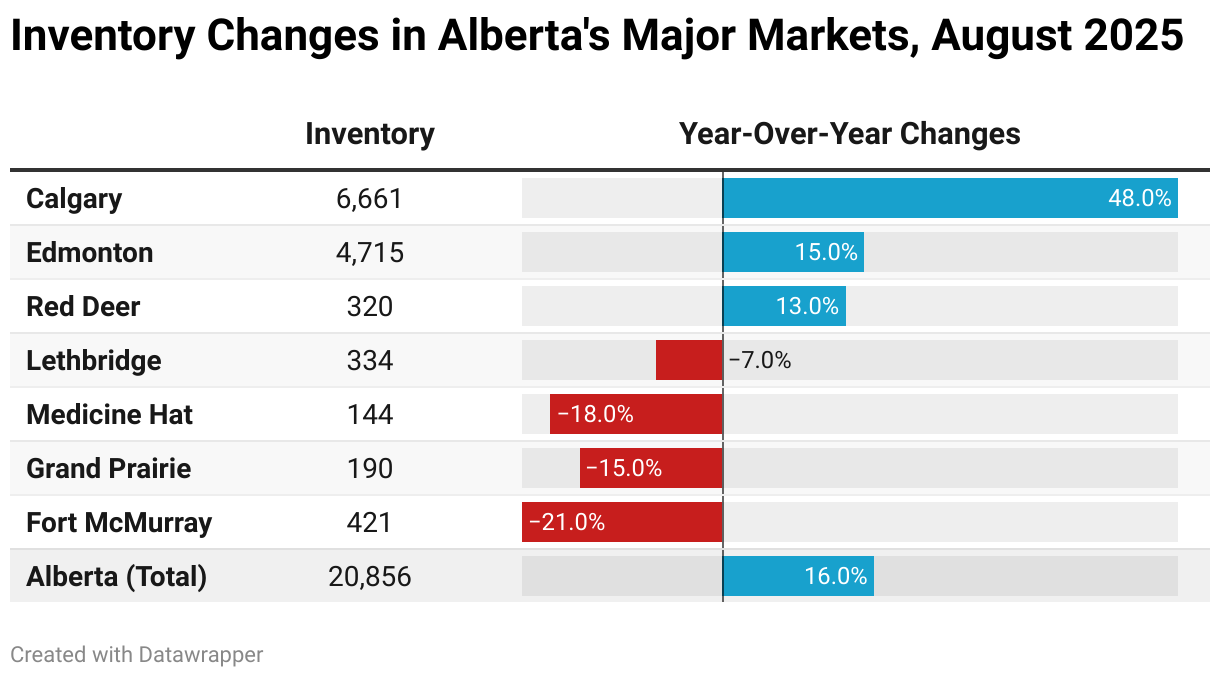
Calgary has cooled notably, moving into balanced territory with a sales-to-new-listings ratio of 57% and a whopping 48% increase in inventory year over year. Edmonton, in contrast, has held its ground in seller’s market territory with a ratio of 60%. Still, Greater Edmonton’s sales volume fell sharply, with 2,382 units sold—down 16.7% month-over-month and 7.8% year-over-year.
Row-townhouses are selling the fastest in Edmonton at an average of 32 days on market in 2025—four days longer than last year but still ahead of other property types. Prices rose 4.3% to $299,000. Apartment condos remain the slowest, averaging 45 days on market (up from 42), though prices climbed 3.8% to $209,000. Overall, homes are taking 37 days to sell, while the benchmark price across all residential properties rose 6.1% to $429,000.
“As school starts up again and life gets busier, the buyers and sellers that are left in the market will have to change up their tactics a bit,” said Darlene Reid in a recent REALTORS Association of Edmonton press release. “Sellers will have to make sure they’re priced right and showing their best, while buyers will be able to negotiate with motivated sellers.”
Secondary markets remain tight
Beyond Alberta’s two largest metros, conditions are even tighter. Red Deer, Lethbridge, Medicine Hat, and Grande Prairie all posted sales-to-new-listings ratios above 70%, underscoring the strength of seller conditions across much of the province.
Calgary is now the only major Alberta market in a balanced territory, while the other six major metros remain sellers’ markets. Sales dropped 9% year-over-year to 1,989 properties trading hands in August. New listings slipped slightly to 3,478, and months of supply jumped 63% year-over-year to 3.35. These changes mark a clear departure from the red-hot conditions Calgary saw in recent years.
Supply climbs in Calgary Row homes and condos see price dips
Row homes and condos are experiencing the biggest price declines, as buyers currently have more options in these segments. In August, row homes dropped 4.8% to $439,600, while apartment condos fell 5.8% to $326,500. Still, as economist Ann-Marie Lurie notes, these declines have yet to erase the gains of recent years.
This August, Calgary recorded a 3.4-month supply—well above the sub-two months seen during the last four years of intense seller conditions. Detached and semi-detached homes are the fastest sellers at 35 days on market, still quicker than row-townhouses (40 days) and apartment condos (47 days), even though all property types are taking longer to sell compared to 2024.
Grande Prairie leads Alberta’s seller’s markets
While many Alberta cities are slowing, Grande Prairie is surging as the province’s strongest year-over-year seller’s market. The city posted a 12% increase in sales compared to last year, with 157 homes changing hands in August. That’s a stark contrast to markets like Calgary and Edmonton, where sales activity has cooled.
Sellers responded with a 31% jump in new listings, bringing 162 properties to market. Yet, even with more choice, overall inventory fell 15% to just 190 homes—proof that demand is outpacing supply at a rapid pace. Homes are being snapped up almost as soon as they’re listed, leaving buyers with limited time to act.
A near-perfect absorption rate
Grande Prairie’s sales-to-new-listings ratio hit an astounding 97%, the highest among Alberta’s major markets. Nearly every home listed found a buyer, pushing months of supply down 24% to just 1.21. This razor-thin supply cements Grande Prairie’s position as the province’s most competitive seller’s market right now.
Prices reflect seller power
The intensity of demand in Grand Prairie is showing up in pricing. The average home price increased 11% year-over-year to $379,317, while the median price remained unchanged at $375,000. Buyers are not only plentiful but also willing to pay top dollar, reinforcing Grande Prairie’s reputation as Alberta’s standout market for sellers in 2025.
Considering a move soon? Zoocasa has thousands of up-to-date listings near you. Start your search today!