

In a city where detached homes feel out of reach, condos remain the entry ticket for buyers determined to plant roots in Toronto. According to the Toronto Regional Real Estate Board (TRREB), the average prices of various property types in Toronto as of August 2025 were as follows: condos at $667,660, townhouses at $915,511, semi-detached homes at $1,131,498, and detached homes at $1,524,066.
These significant price gaps underscore the challenges of climbing the property ladder, and the high entry point of a condo makes it even more challenging to break into that segment. Now that condo supply has increased, with more condos in the market than in years, is the condo sector on the verge of a crash, or is this just another cooling period in a city that has seen its fair share of ups and downs? Looking at sales activity, new supply, and condo price trends from 2023 through 2025, here’s what the numbers reveal.
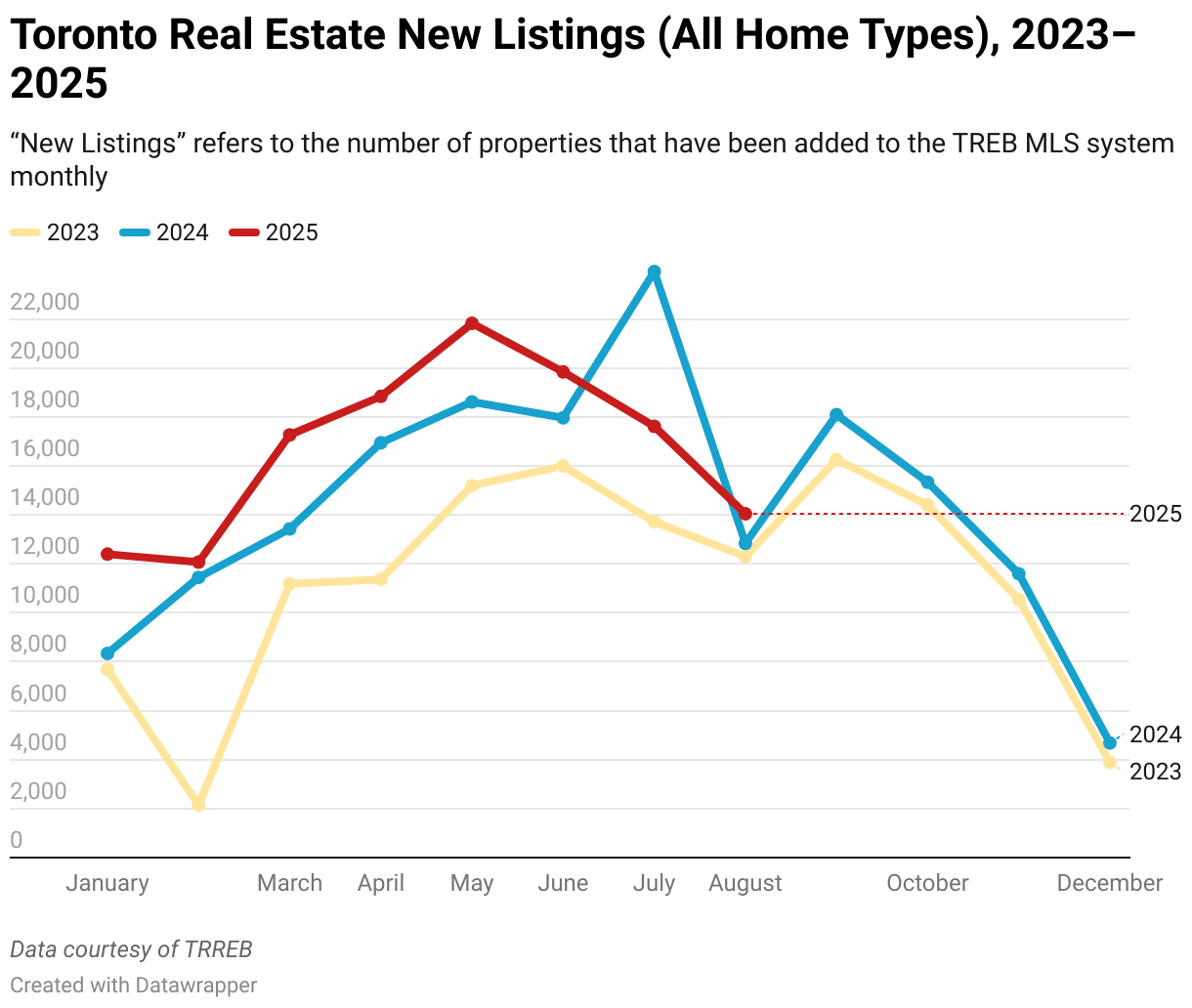
One of the most dramatic changes in Toronto’s housing market has been the sheer wave of new supply hitting the market. Back in 2023, the city saw roughly 124,918 new listings for the year, with monthly volumes topping out around 16,000. Fast forward to 2024, and the pace intensified. July alone brought nearly 24,000 new listings—the single highest monthly total in the dataset. That momentum hasn’t slowed. By 2025, the numbers reached record-breaking territory: April added 18,836 listings, May surged to 21,819, and June followed with 19,839.
Related: 6 Ways Toronto Real Estate Transformed Over the Past 10 Years
Toronto’s Inventory is at a Three-Year High
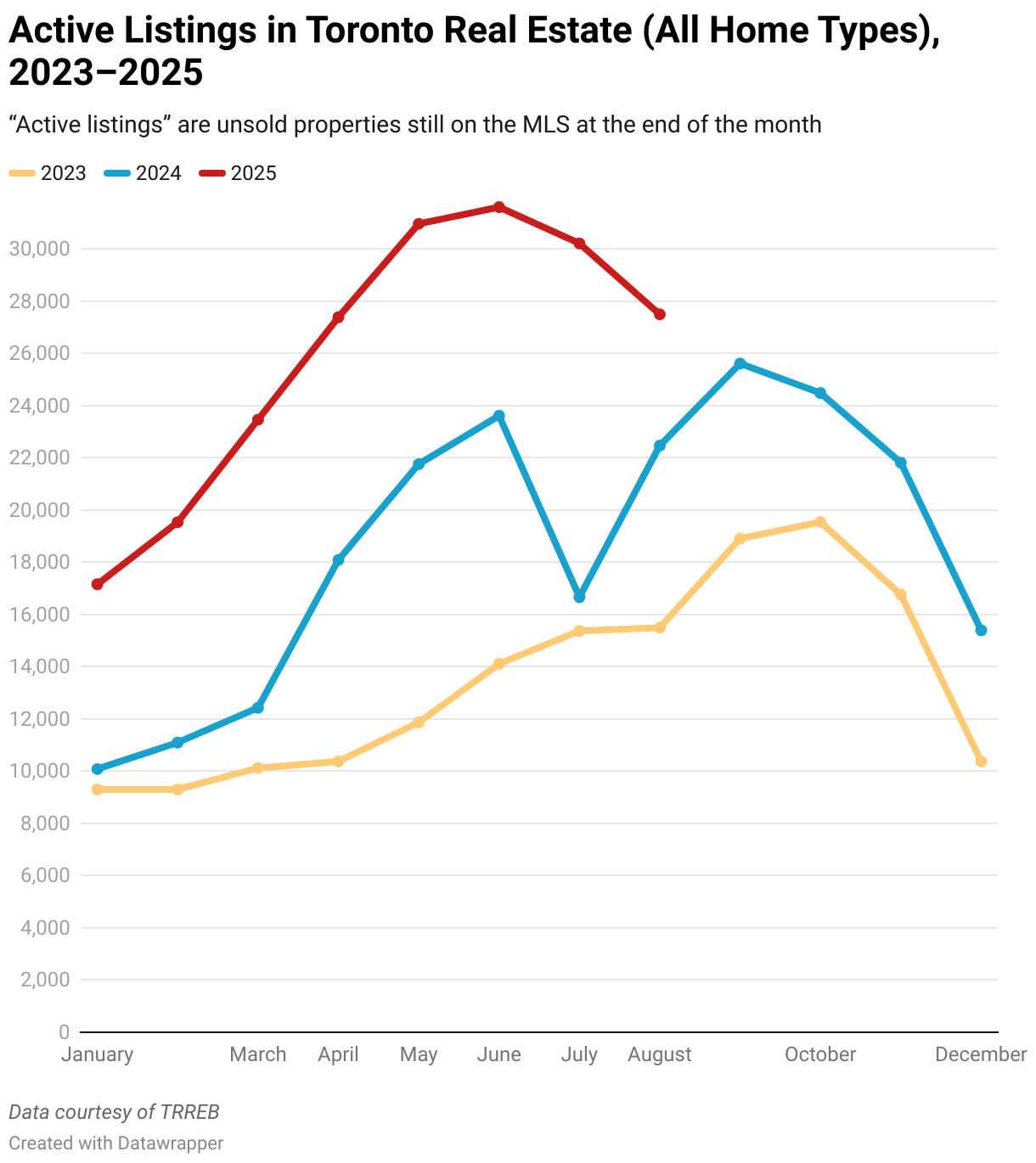
Active listings mirror this trend. In October 2023, inventory peaked at 19,540 homes. By comparison, May 2025 recorded 30,964 active listings, and June climbed further to 31,603—the highest levels seen in three years. That’s about a 62% increase from 2023’s peak of just under 20,000 to over 31,000 homes available in mid-2025.
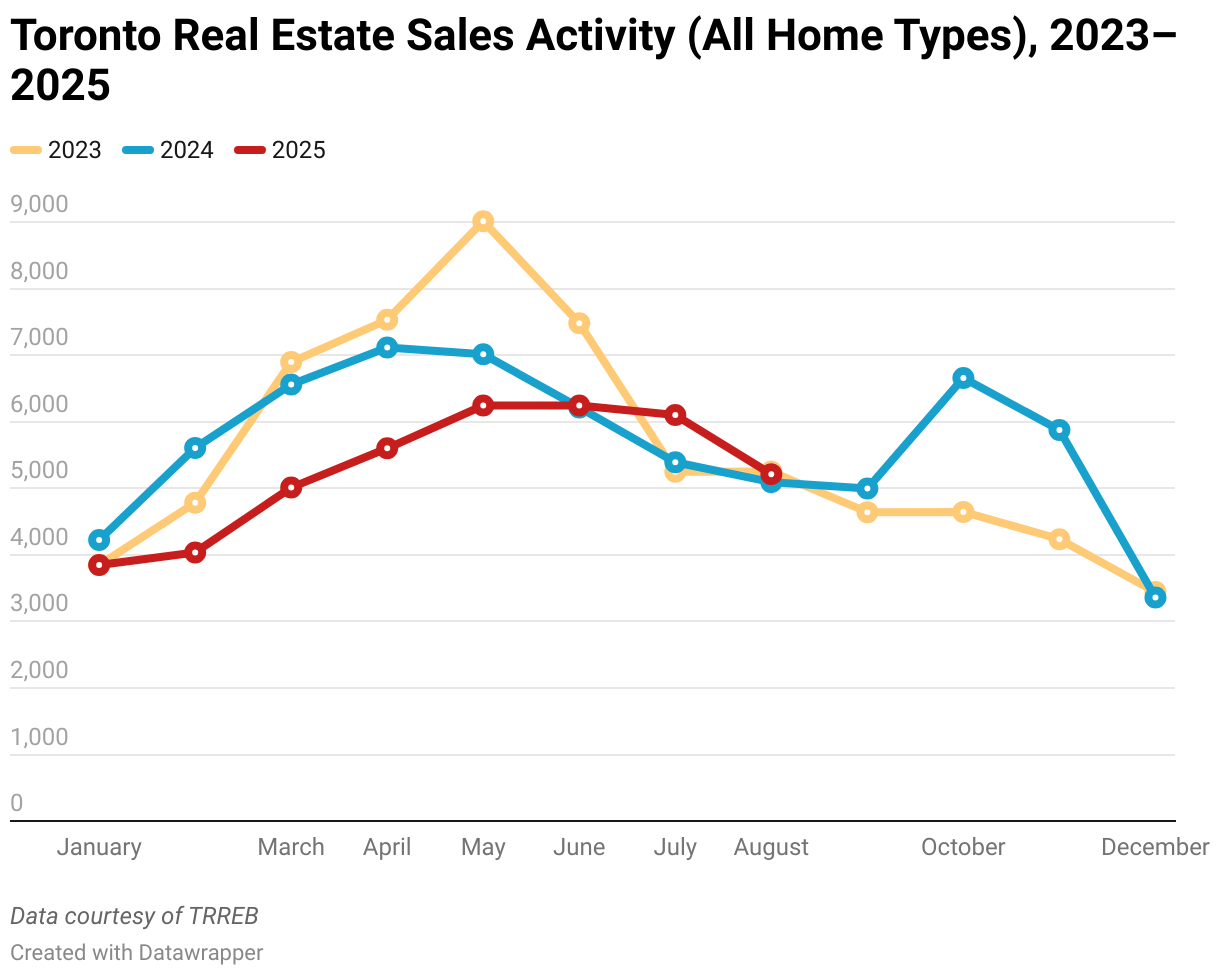
Despite the sharp increase in homes coming to market, sales activity has remained far more subdued. In 2023, transactions peaked at 9,012 in May before slowing, while 2024 delivered a softer spring peak of 7,013 sales, with momentum returning only later in the year. The start of 2025 was even quieter, as January and February trailed behind both previous years. Although sales improved by July with 6,100 transactions, they still fell short of matching the surge in new listings. The growing imbalance between supply and demand is worth noting: inventory is piling up while sales are declining, leading many sellers to lower their expectations.
Toronto’s Condo Price Decline
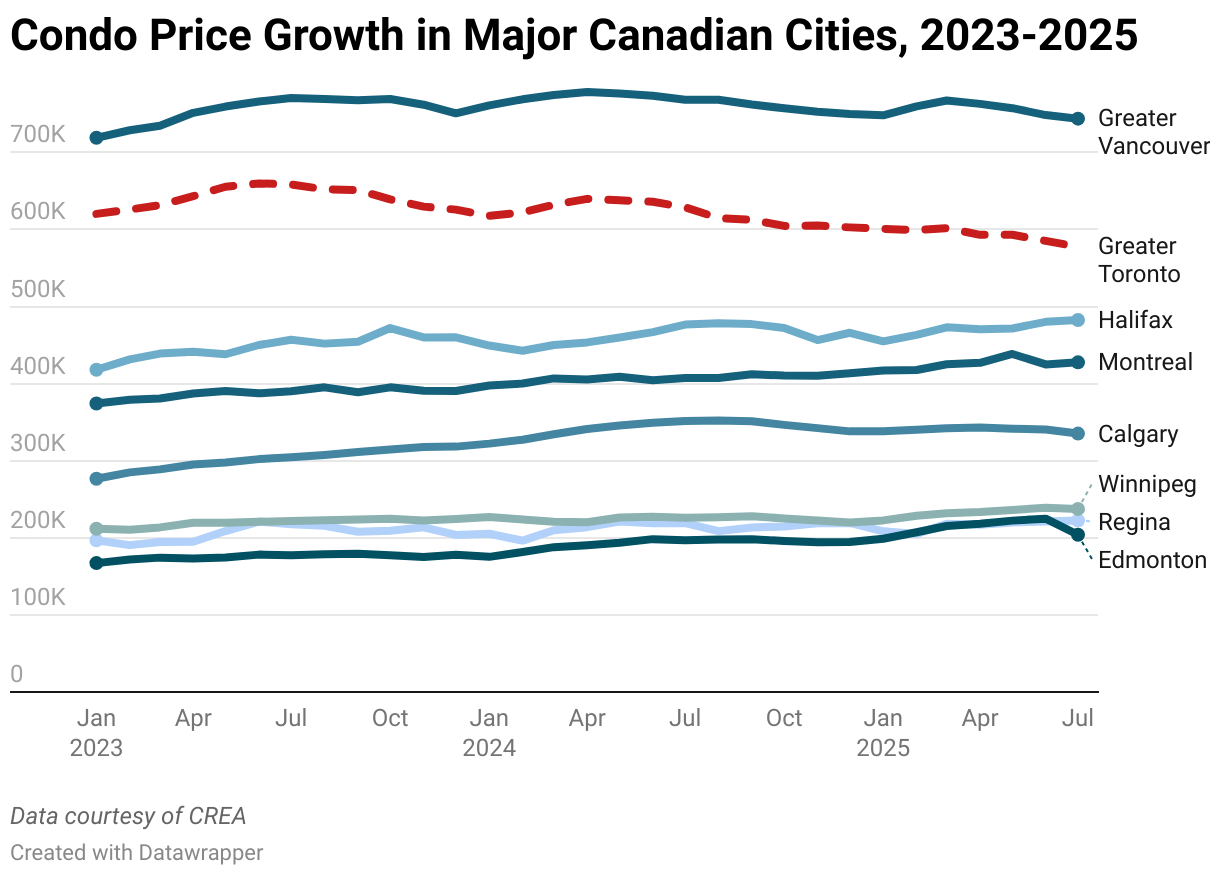
Toronto condo prices have been on a steady decline for over two years, reflecting the fact that new completions and increasing inventory are outpacing buyer interest. In June 2023, the average condo price peaked at $659,700 but fell to $625,700 by December. The following year did not see a recovery; prices briefly rose to $639,700 in April 2024 but then dropped again to $602,700 by the end of the year. In 2025, the correction accelerated, with condos starting the year at $600,800, only to fall to $577,600 by July, marking the lowest point in CREA’s dataset.
Overall, this represents a 12.4% decrease from the peak price of $659,700 in June 2023 to the low of $577,600 in July 2025.
The Condo Market in the 416 is Correcting, Not Crashing
While it’s tempting to label Toronto’s condo market as experiencing a “crash,” the data presents a more nuanced picture. Prices have been declining steadily for over two years, and the surge in inventory in 2025 has intensified this pressure. However, the decline has been gradual rather than abrupt, indicating a prolonged correction rather than a dramatic collapse.
A true crash is typically characterized by a rapid, panic-driven drop of 20–30% within a short time frame. In Toronto, the decrease has been around 13% from peak to present, which is significant but not catastrophic.
TRREB’s Q2 2025 Condominium Market Report points to softer market conditions: condo sales fell nearly 21% year-over-year, new listings increased by more than 39%, the average selling price dropped by 5.9% to $685,961, and properties are now spending an average of 34 days on the market.
In other words, while supply is rising and demand has cooled, the price declines have not been sharp enough to warrant the term “crash.” Instead, the condo market is undergoing a moderate correction, with price values easing but not collapsing.
Related: The Fastest GO Train Commutes to Union Station, Ranked by City
The Price-Point Shaping Toronto’s Condo Market
In Toronto’s condo market, the mid-range price bracket is where most activity is occurring. Nearly one in four sales this past quarter were priced between $400,000 and $599,999, highlighting that affordability continues to drive buyer demand. For many, these condos remain the most attainable entry point in a city where detached and semi-detached homes are often financially out of reach.
TRREB also provides insight into buyer preferences within these price ranges. One-bedroom plus den layouts accounted for a quarter of sales, while standard one-bedrooms made up 17%. Two-bedroom units were the most popular overall, comprising 34% of transactions; however, many are priced above $650,000, making them less accessible for those aiming to stay below the $600,000 threshold. For buyers adhering to that budget, bachelor units, one-bedrooms, and one-bedroom plus den options remain the most realistic choices.
Naturally, these “affordable” options come with considerations. Smaller units may be suitable for singles, students, or couples comfortable with tighter living spaces, but they are less practical for families or buyers seeking additional room.
Even with recent price declines, Toronto’s condo market does not automatically result in broad affordability. Many units (particularly larger layouts or those in sought-after neighbourhoods) still have high price points that limit their appeal to a narrower pool of buyers. In practice, this means the market is attracting specific segments, such as first-time buyers focused on smaller units or investors looking for rental opportunities, rather than meeting the needs of all households.
As TRREB Chief Information Officer Jason Mercer stated in a recent report, “A household earning the average income in the GTA is still finding it challenging to afford the monthly mortgage payment associated with the purchase of an average-priced home. This is even with lower borrowing costs and selling prices over the past year. Further relief in borrowing costs would see an increased number of buyers move off the sidelines to take advantage of today’s well-supplied market.”
Related: I Lived in Toronto Condos for 13 Years, Here’s What I Learned
Ontario’s Condo Prices are Cooling Under Supply Pressure
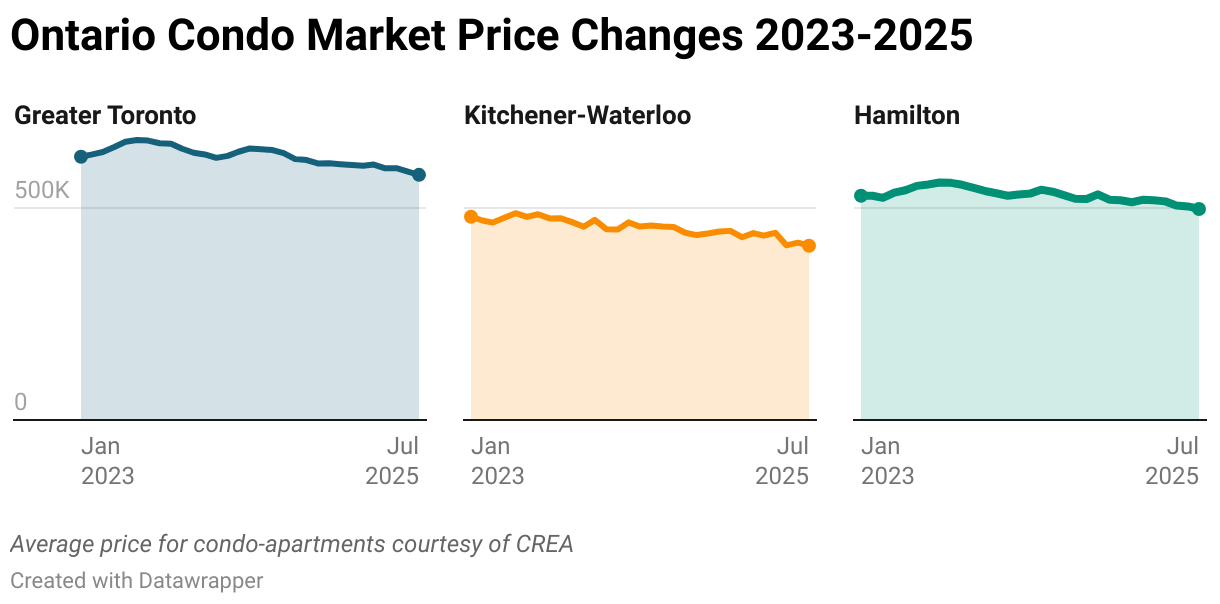
Ontario’s condominium sector has been experiencing a different trend compared to many other regions in Canada. In the Greater Toronto Area, the average price dropped from $620,200 in January 2023 to $577,600 in July 2025, marking a decline of 6.9%. Hamilton also saw a reduction, with prices falling by 5.9%. Kitchener-Waterloo faced the most significant correction in the province, with a decline of 14.3%. The common factor in these areas is that an increase in supply, combined with affordability challenges, has weakened demand, resulting in lower prices even as new units enter the market.
Where are Canadian Condo Prices Increasing?
The strongest gains in the real estate market have been observed in Alberta, driven by affordability and a rapid influx of new residents. In Calgary, condo prices have risen by 21.2% since early 2023, while Edmonton experienced an even higher increase of 22%. In contrast, Greater Vancouver, traditionally one of the most expensive condo markets, saw a more modest rise of 3.4%. This indicates resilience but suggests limited potential for significant price appreciation due to already high price points.
In Atlantic Canada, Halifax condos surged by 15.4%, reflecting strong population growth and continued affordability compared to larger markets. Montreal experienced a similar gain of 14.3%, while Winnipeg and Regina posted increases of 12.2% and 13.1%, respectively.
What’s Really Happening in Toronto’s Condo Market
Toronto’s condo market is cooling, but it isn’t in freefall. Prices have edged lower, listings have climbed, and competition has intensified, yet the shifts reflect a measured correction rather than a collapse. For buyers, the current environment offers more choice and room to negotiate; for sellers, it highlights the need to remain competitive on price. Compared with markets such as Calgary, Edmonton, and Halifax (where home values continue to rise), Ontario stands out as a region under greater pressure. Condos still represent the most accessible step into Toronto’s housing market, though affordability challenges and lifestyle trade-offs remain part of the equation.
Considering buying or selling? The right real estate agent will help you navigate your move with confidence. Start your search today.