

Canadian home prices fell across several major markets in 2025, but buyers who waited for better affordability found themselves in similar or worse positions than they had been a year earlier. The culprit: rising food costs placed a significant strain on the cost of living.
According to Canada’s 2026 Food Price Report, monthly food costs for a family of four increased from $1,336 in 2025 to $1,464 in 2026. This equals an extra $128 per month, or $1,536 per year.This analysis is based on the 50/30/20 budgeting rule: a framework that suggests that 50% of after-tax income should cover necessities (like housing and food), 30% should cover wants, and 20% should be set aside from savings. Between January 2025 and January 2026, monthly food costs for a family of four rose by $128, a uniform increase across the country whose impact varied dramatically based on local home price changes.
Find out how rising food costs impacted the household budgets for the six biggest census metropolitan areas in Canada over the past year.

How Food Inflation Worked Against Buyers
Lower home prices should mean better affordability, but that assumes everything else stays the same. In 2025, the cost of living increased across Canada. Here’s how the $128 monthly increase in food costs reshaped the math in each market.
A Double-Whammy in Montreal
Montreal faced a “double-whammy” as both housing and food costs climbed. A $46 increase in the average mortgage, combined with $128 in food inflation, means families face a total monthly increase of $174.
- Median After-Tax Income: $66,800
- Income Required (2026): $95,328
- The Gap: $28,528 shortfall (widened from $23,104)
Price Drop Reversed in Edmonton
In Edmonton, a $62 drop in monthly mortgage payments was completely erased by the $128 increase in food costs. This resulted in a net monthly loss of $66 for the average household.
- Median After-Tax Income: $88,500
- Income Required (2026): $89,592
- The Gap: $1,092 shortfall (families qualified a year earlier)
Savings Neutralized in Ottawa
Ottawa buyers saw a $191 drop in monthly mortgage payments, but food inflation reduced those savings by 67%, consuming $128 of the benefit.
- Median After-Tax Income: $78,600
- Income Required (2026): $112,800
- The Gap: $34,200 shortfall
Calgary: Marginal Relief
Calgary’s $155 monthly mortgage drop was nearly matched by the $128 food increase, leaving just $27 in net savings.
- Median After-Tax Income: $88,500
- Income Required (2026): $105,936
- The Gap: $17,436 shortfall
Toronto: Significant Savings, Significant Gap
Only in Canada’s most expensive markets were the housing corrections large enough to outpace grocery inflation. Toronto’s housing correction outpaced the grocery hike; a $365 mortgage saving, minus the $128 food hike, left a net gain of $237 per month. However, the median family remains far short of the ideal budget.
- Median After-Tax Income: $78,600
- Income Required (2026): $130,320
- The Gap: $51,720 shortfall
Vancouver: Massive Drop, Extreme Shortfall
A massive $764 mortgage drop in Vancouver allowed buyers to absorb the food hike and still come out $636 ahead monthly. Despite this being the largest gain in the country, the barrier to entry remains the most extreme in North America.
- Median After-Tax Income: $73,900
- Income Required (2026): $216,144
- The Gap: $142,244 shortfall

What This Means for Canadians
The year-over-year comparison shows that buyers who waited for lower home prices in 2025 received little to no benefit in most major markets. Food inflation, a uniform cost affecting all households equally, proved to be the determining factor in whether affordability actually improved or deteriorated.
See the final monthly breakdown of “savings” for 2026 after the $128 food cost addition:
- Vancouver: Savings of $636 per month.
- Toronto: Savings of $237 per month.
- Ottawa: Savings of $63 per month.
- Calgary: Savings of $27 per month.
- Edmonton: Payments of $66 more (savings are wiped out).
- Montreal: Payments of $174 more (due to cost increases).
For median-earning families, the findings are stark. In Montreal and Edmonton, the waiting strategy backfired entirely as rising costs outpaced market cooling. In Ottawa and Calgary, the minimal “savings” (less than $65/month) hardly justify a year’s delay in homeownership.
Meanwhile, in Toronto and Vancouver, while net savings exist, the median family’s earnings remain substantially below what is required to purchase a detached home.
The analysis suggests that in markets where home prices decline modestly (by less than 4%), food inflation and other rising costs will continue to erode or eliminate affordability gains, leaving median-income families persistently unable to enter the housing market.

The Affordability Gap: Median Pay vs. Mortgage Reality
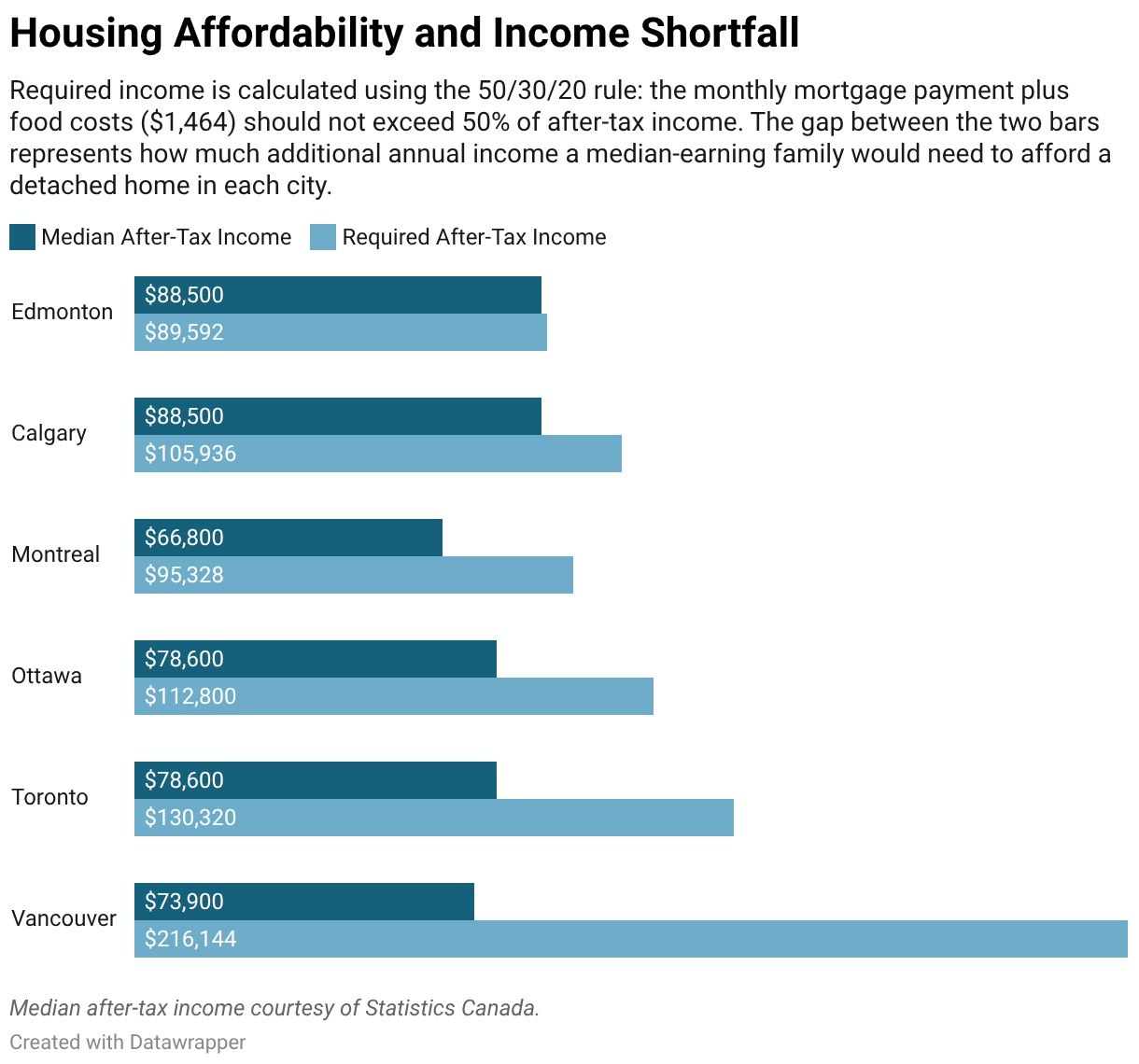
Earning a good salary doesn’t necessarily mean you can afford a detached home, at least not by the numbers. Using the 50/30/20 budgeting rule, we calculated the after-tax income a family of four would need in each city to comfortably cover their mortgage and food costs without stretching beyond the recommended 50% “needs” threshold.
The results reveal a stark disconnect between what Canadians earn and what the housing market demands. In Edmonton, the gap is just over $1,000. In Vancouver, a family would need to nearly triple their income to meet the threshold.
The chart below compares median after-tax incomes with the required living wage for homeownership in each market.
The Rising Cost of Waiting
Looking ahead, early action could be key, as food costs continue to rise, today’s prices may look like a bargain by next spring. With Canada’s Food Price Report projecting annual increases of 4 to 6% through 2027, the required income to cover basic necessities will continue to rise. By 2031, a family of four could be spending $1,780 per month on food, requiring an extra $3,792 in annual food spend.

All Eyes on Edmonton
Despite the fact that affordability “worsened” slightly this year, Edmonton remains the most viable market for a median-income family for three reasons:
While other cities require extra income ranging from $17,000 to $142,000, Edmonton’s shortfall is just $1,092. A modest raise or a slightly larger down payment would instantly bridge this gap.
High purchasing power is also a factor. Residents in Edmonton benefit from some of the highest median after-tax incomes in the country ($88,500) and the lowest detached home prices in this analysis ($556,752).
Ultimately, even with food inflation absorbing the benefit of its 0.6% price drop, Edmonton is the only major city where the 50/30/20 rule is nearly achievable for an average household.
The Future of Affordability in Canada
The numbers paint a big-picture story, but real estate is always local. Market conditions, neighbourhood trends, and your personal financial situation all play a role in determining the right time to buy. Whether you’re in a market where affordability is within reach or navigating one of Canada’s pricier cities, having a knowledgeable local realtor in your corner makes all the difference.
Give us a call today to talk through your home-buying plans.
Methodology
Zoocasa examined the affordability of single-detached homes across six of Canada’s largest CMAs by population. Using average detached home prices from local real estate boards in January 2026, mortgage calculations assume a 20% down payment, 3.69% fixed interest rate, and 25-year amortization. Mortgage payments for 2025 were based on a 3.89% fixed interest rate and 25-year amortization.
Food costs were based on Canada’s Food Price Report projections for a family of four: $1,336 per month in 2025 and $1,464 per month in 2026. Income requirements follow the 50/30/20 budgeting rule, where mortgage and food costs should not exceed 50% of after-tax household income. These requirements are compared with provincial median after-tax incomes from Statistics Canada’s 2023 data (the most recent available).