
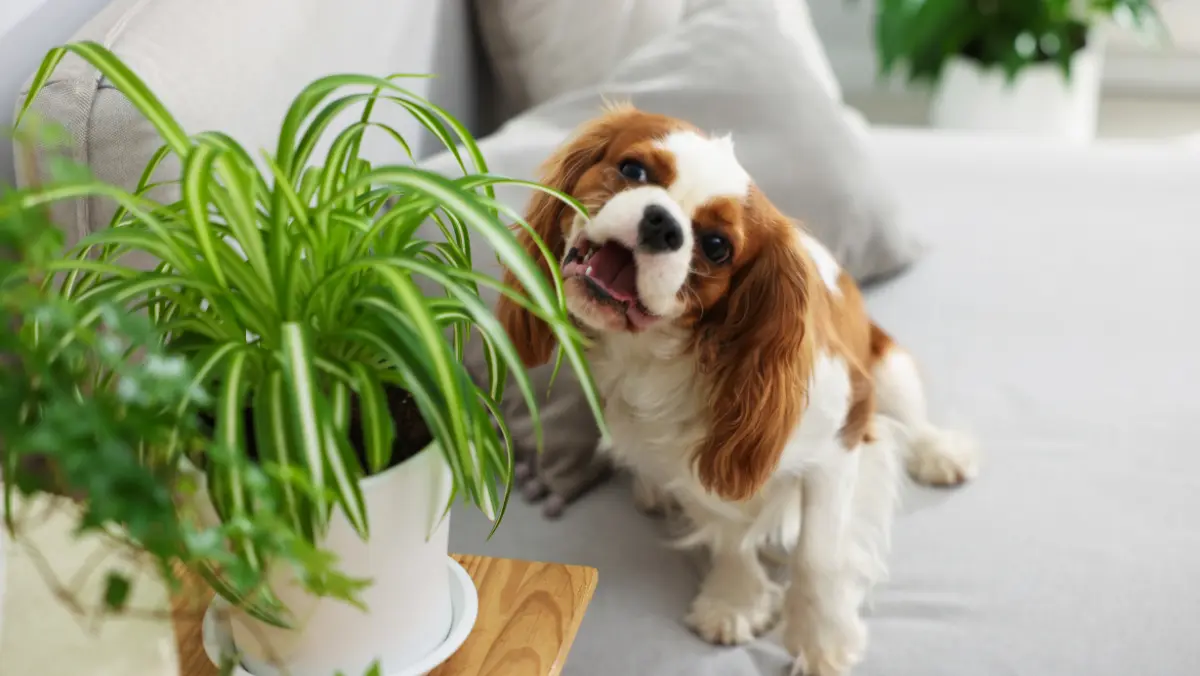
Decorating a first home often includes bringing in a few houseplants to make the space feel more comfortable and lived-in. While plants offer aesthetic and wellness benefits, pet owners need to be selective about what they bring indoors. Many beginner-friendly plants can be toxic to dogs and cats. Here are common plants that may be more dangerous than they seem, along with pet-safe houseplants you can add to your home with confidence.
Are Spider Plants Poisonous to Dogs?
The short answer: no. The spider plant (Chlorophytum comosum) is classified as non-toxic to dogs, cats, and horses by the ASPCA.
However, that doesn’t mean your dog should eat one. “Non-toxic” means it is not poisonous, not that it is harmless to consume. Spider plant leaves are fibrous like many other plants, and if a pet chews and swallows a large amount, it may cause stomach irritation, vomiting, or loose stools for a short time.
The ASPCA’s senior director of toxicology, Dr. Tina Wismer, notes that mild stomach upset from plant material is fairly common and usually resolves on its own. For a small dog, the bigger concern is the long, strappy leaves themselves, which can occasionally be a choking hazard if a determined chewer gets carried away.
Do Spider Plants Really Get Cats “High”?
You may have heard that spider plants contain a catnip-like compound that gives cats a mild “high” by acting on opioid receptors. It is a popular claim, but it is not supported by evidence. Dr. Wismer confirms there is no scientific proof that spider plants contain opioids or any hallucinogenic compounds.
So why do cats seem so obsessed with them? Cats are naturally drawn to long, narrow leaves that sway because their movement resembles prey. It is the same reason they pounce on things like shoelaces or strings. If your cat keeps bothering your plant, hanging it up or trimming the runners can usually fix the issue without worrying about it being poisoned.
The Beginner-Plant Paradox: Starter Plants That Bite Back
Plants are among the top 10 causes of pet poisoning calls handled by the ASPCA Animal Poison Control Centre each year. Many of those cases involve the same plants new owners are often encouraged to buy, especially the so-called “impossible to kill” varieties.
The problem is that durability has nothing to do with pet safety, and some of the toughest beginner plants are also toxic.
Insoluble Calcium Oxalate Crystals (Raphides)
These needle-shaped crystals are found in the leaves and stems of plants in the Araceae family, which includes pothos, dumb cane, peace lily, philodendron, and the ZZ plant. If a pet bites the plant, the crystals are released and can embed in the soft tissues of the mouth and throat.
This causes intense burning pain, drooling, pawing at the mouth, and vomiting. It is usually not life-threatening, but in rare cases swelling can interfere with the airway and become an emergency.
Systemic Toxins
One of the most dangerous is the sago palm (Cycas revoluta), which the ASPCA identifies as toxic to dogs, cats, and horses because it contains cycasin. This toxin targets the liver, and the ASPCA notes that even one to two seeds may be fatal.
Veterinary studies have reported mortality rates of roughly 32% to 50%, though rapid treatment can greatly improve survival. If ingestion is suspected, it should be treated as a medical emergency requiring immediate veterinary care.

Verified Pet-Safe Houseplants For a First Home
All of the plants below are classified as non-toxic to cats and dogs in the ASPCA database. However, if a pet eats too much, the most likely result is a mild and temporary stomach upset.

Pet-Proofing Your Plants
Put Them Out of Reach
Hanging baskets, wall-mounted planters, and high shelves keep foliage out of reach of dogs and less acrobatic cats. Heavy floor planters lift larger specimens above most medium-sized dogs.
Cover The Soil to Stop Digging
A layer of large river stones or pinecones can help keep pets from digging in plant pots. For homes with big dogs, small pebbles should be avoided since they can be swallowed and cause a choking risk.
Aluminum foil is another option, as many pets dislike its feel and the crinkling sound it produces.
Be Skeptical of DIY Deterrents
- Cayenne pepper loses its punch as soon as you water it, and on moist soil it tends to grow mould, so it’s only workable on dry-soil plants like cacti.
- Lemon juice sprayed on leaves can scorch and brown the foliage and leave a sticky residue that attracts pests, so keep it off your plants.
- Coffee grounds readily mould in indoor pots, attract fungus gnats, and carry a risk if a persistent dog eats them.
- Commercial bitter sprays (the bitter-apple type) are the most reliable option that’s also plant-safe; the catch is they wear off and need reapplying every couple of weeks.
Creating a Safe Plant Space for Dogs and Cats
The spider plant earns its spot as a beginner favourite: it’s nearly indestructible, it looks great trailing from a shelf, and it is non-toxic to dogs and cats. From there, focus on pet-safe houseplants like the Boston fern and the Calathea species.
Riskier “easy-care” plants, including pothos and sago palms, are better kept out of the home or placed where pets cannot access them. With some planning, your first home can be both lush and safe for pets.
Ready for a home where your plants and your pets can both thrive? Zoocasa can help you find a space with room for greenery, four-legged roommates, and everything in between. Start your search today.