

Zoocasa
Sold Prices
Map
Market Insights
  • Blog Home
  • For Buyers
  • For Sellers
  • Real Estate News
  • Mortgage News in Canada
  • Free Guides (PDF)
  • Real Estate Infographics
Zoocasa
  • Blog Home
  • For Buyers
  • For Sellers
  • Real Estate News
  • Mortgage News in Canada
  • Free Guides (PDF)
  • Real Estate Infographics
Home Affordability

The Income Bracket You Need to Be in to Buy a Home in these Canadian Cities

Daniel Crook by Daniel Crook
April 5, 2023
in Affordability, Canada, Infographics
Reading Time: 4 mins read
Someone working on a calculator.
Share
Tweet
Share
0 Shares

Housing prices have risen drastically in the last few years, and despite the small correction set about by the consistent interest rate hikes in the last 10 months, they remain quite high. In that time, wages have not risen at the same pace. The question is, are Canadian homes still affordable, and how much do you need to be earning to buy one?

Enjoying our content? Subscribe to our free weekly newsletter to get Canadian real estate market insights, news, and reports straight to your inbox.

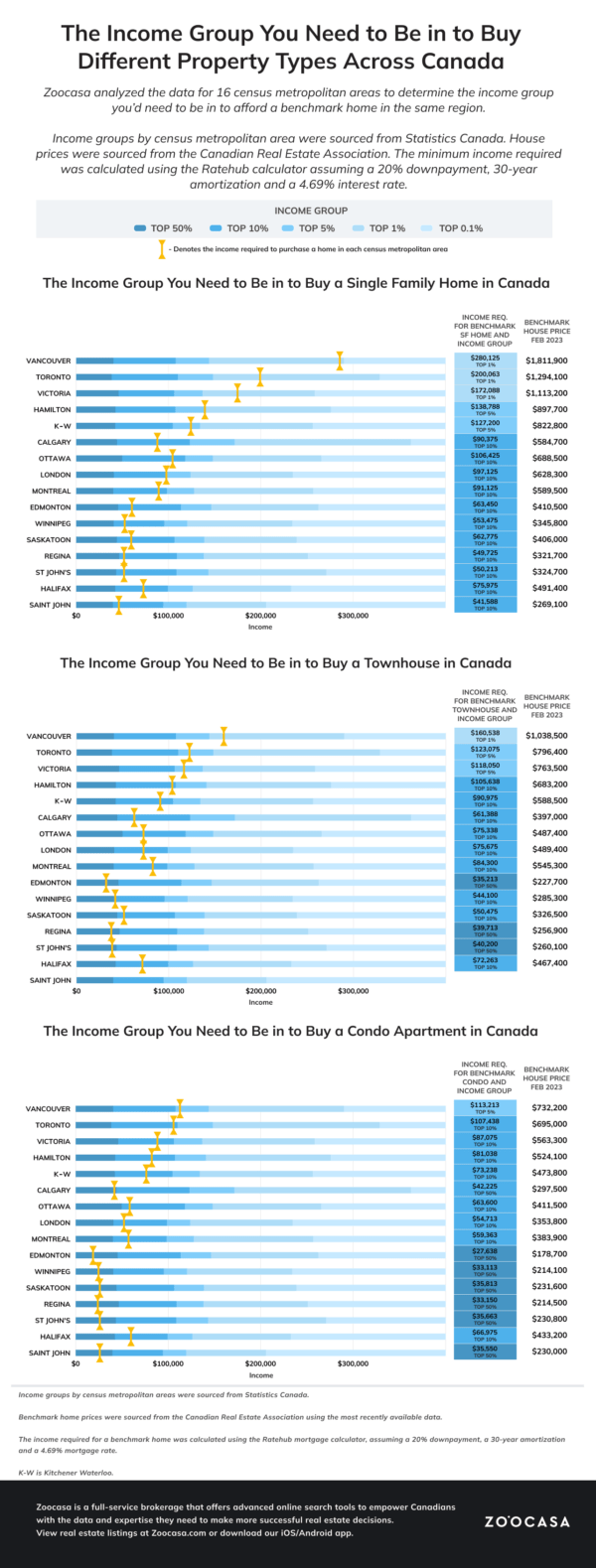
To find out, we analyzed 16 different census municipalities and compared the price for a single family, townhouse and condo apartment to different income groups, from the top 50% of earners to the top 0.1%. Affordability was gauged by determining how much income was needed to afford a home at the benchmark price which is reflected in the income groups in the infographic below.
  • Read: Canadian Regions With Below-Average Home Prices

Detached Affordability is Greatest in the Prairies and the East Coast

The data shows that homes in the Prairies and on the East Coast are more affordable than in Ontario or British Columbia. Buyers would need to be in the top 1% of earners to afford a single-family home in Vancouver, Toronto and Victoria. An income of $280,125 is required to afford a home at the benchmark price of $1,811,900 in Vancouver. However, at the other end of the scale, buyers in Montreal, Edmonton, Winnipeg, Saskatoon, Regina, St John’s, Halifax and Saint John would need to be in the top 10% of earners. 

  • Read: Spring Real Estate Predictions for Canadian Homebuyers

The townhouse chart tells a similar story. A prospective buyer would need to be in the top 50% of earners to buy a home in Edmonton, Regina or St John’s, but a buyer in Vancouver would require an income of $160,538 to afford a townhouse there, planting them firmly in the top 1% of earners.

For Edmonton, Winnipeg, Saskatoon, Regina, St John’s and Saint John, a prospective buyer of a condo apartment would need to be in the top 50% of earners to afford one. The highest income required to afford a home out of all of them is in Saskatoon, where an income of $35,518 would be able to afford a detached home. In Vancouver, on the other hand, a buyer would need to be in the top 5% of earners to afford an apartment, requiring an income of $113,213. 

It is important to note that income scales differently in each city. So while someone in the top 10% of earners in St. John would need an income of $41,588 to afford a home there, in Ottawa, someone in the top 10% would need $106,425 to afford a home there. Housing prices being higher means that the cities with a greater median income will have both pricier income groups and higher required incomes. 

If you’re strating your home search, we can help you! Speak with one of our agents today to learn how we can help you find your next home.


Looking for your dream home?
Contact us today to speak to a Realtor in your area
Previous Post

Real Estate Sellers Benefit as Calgary Inventory Hits Record March Low

Next Post

GTA Home Sales and Competition Up as Toronto Region Buyers Step off Sidelines: TRREB

Daniel Crook

Daniel Crook

Daniel Crook is a Content Marketing Specialist at Zoocasa. Daniel’s insights provide home buyers and sellers with knowledge of local and national markets to aid them in their real estate pursuits. Daniel covers a multitude of topics, ranging from mortgages to local market trends, as well as data-driven reports uncovering national trends. His work has been featured in outlets such as BNN Bloomberg, CTV News, the National Post and the Globe and Mail. You can find all his latest insights on the Zoocasa blog.

Related Posts

Affordability Reports

Why Hitting a 10% Down Payment Matters More Than Saving $50,000 for a Home

January 26, 2026
Canada

Why Newfoundland’s Real Estate Market Feels So Frustrating Right Now

January 22, 2026
Dad and baby at home
Affordability Reports

Decoding Canada’s Price-to-Rent Ratios in 2026 

January 19, 2026

Blog Search

No Result
View All Result

Newsletter Sign-up

Join a community of 130,000+ subscribers. Don't miss important real estate news, market data, and buying and selling tips.

Recent Articles

A married couple stands in a living room holding each other.

The Savings Gap: How Being Single or Married Affects Your Timeline to Homeownership

January 28, 2026
A person handing someone else a pair of house keys.

What Happens to a Mortgage When an Owner Dies in Ontario

January 27, 2026

Why Hitting a 10% Down Payment Matters More Than Saving $50,000 for a Home

January 26, 2026
Diners enjoying a meal at a restaurant, with wine glasses and plates on the table, creating a lively dining atmosphere.

The Best Mexican Restaurants in Toronto for Every Kind of Diner 

January 25, 2026

Featured Listings

7 Cheapest Oceanfront Properties in Florida You Can Buy Now

January 23, 2026

Unique Homes in the US: Top Picks from 2025

January 10, 2026
cabin home

6 of the Smallest and Coziest Homes Currently for Sale

November 20, 2025
luxury home

3 of the Most Expensive Homes in Canada for Sale Right Now 

November 6, 2025
first-time home buyer programs and rebates

Social Media

250 The Esplanade Suite 408 Toronto, ON M5A 4J5

Stay Connected

  • Blog Home
  • For Buyers
  • For Sellers
  • Real Estate News
  • Mortgage News in Canada
  • Free Guides (PDF)
  • Real Estate Infographics
No Result
View All Result

Zoocasa © 2007–2022. The trademarks MLS®, Multiple Listing Service® and the associated logos are owned by The Canadian Real Estate Association (CREA) and identify the quality of services provided by real estate professionals who are members of CREA.