
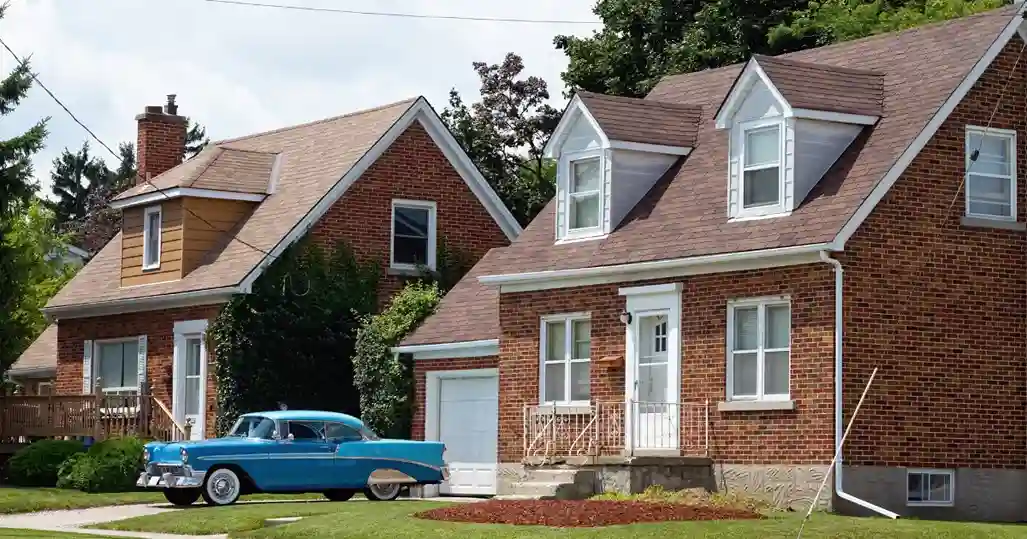
In 1965, Gatorade was invented, The Beatles’ “Help!” topped the charts, and The Sound of Music premiered. Beyond the pop culture milestones, that year also marked the last time you could buy a home for under $20,000.
Fast forward sixty years, and a lot has changed in the housing market. Not only do homes cost significantly more, but the median annual income now covers a smaller percentage of the total home price.
So, it’s not just nostalgia that makes everything seem cheaper in the past; the data supports this. Zoocasa dived into the numbers to see exactly how much the median family income and the median sales price of a new home have changed from 1965 to 2025. And one thing is clear: housing affordability has deteriorated.
Why it’s Harder than Ever to Buy a Home
In 1965, the median sales price of a new home was just $19,800. That’s approximately $206,000 in today’s dollars, which is still only half the price of a new home in 2025.
But the affordability gap widens further when comparing income-to-price ratios. Family household incomes in 1965 were equivalent to 34.8% of the total cost of a new home, while in 2025, its equivalent to just 26.4% of a new home. So what caused this nearly 10% drop?
For a long time, income growth was steadily rising. Between 1955 and 1985, the growth rate accelerated dramatically in each decade. The median family income increased by 56.4% from 1955 to 1965, then by 99.3% in the following decade, and peaked with a 102.2% increase from 1975 to 1985.
However, after 1985, income growth slowed considerably. The rate dropped from 48.6% in 1985-1995 to 40.7% in 1995-2005. Over the next ten years (2005 to 2015), the median family income increased by just 24.4% to $72,165. Most recently, from 2015 to 2025, growth recovered modestly, rising by 50.5%.
At the same time, new home prices skyrocketed. In nearly every decade, new home price growth outpaced income growth, contributing to the widening gap.
From 1955 to 1965, new home prices rose by 69%, only slightly ahead of the 67.9% increase in income. The following decade (1965 to 1975) marked the last time incomes exceeded new home price growth until 2015, rising by 99.3% while new home prices grew by 97%. After 1975, home price growth dominated until 2015. Home prices surged, posting decade increases of 116% (1975-1985), 59% (1985-1995), and 75% (1995-2005).
Though the pace of home price growth has slowed in the past two decades, it will be a while before the affordability gap can close, particularly as other costs are simultaneously rising.
It Now Takes Three Times Longer to Save for a Down Payment
Home prices are just one piece of the puzzle to becoming a homeowner. Before a buyer can even face the final purchase price, they must first save for a down payment, which is typically 20% of the purchase price. But Americans are saving a lot less than they did in the past, which is prolonging down payment savings timelines and pushing up the ages of first-time home buyers.
According to the Federal Reserve Bank of St. Louis, the personal saving rate was consistently above 10% during the 1960s, 70s, and mid-80s. This meant that homebuyers in 1965 and 1975 could save for a 20% down payment in less than five years. Achieving a faster down payment savings timeline offers several benefits, including more rapid access to home equity, increased flexibility for upsizing, and ultimately, enhanced financial stability.
Aside from the pandemic years of 2020 and 2021, the personal saving rate has remained below 10% since 1985, only briefly crossing that threshold in temporary spikes. That, combined with the fact that homes cost more, means homebuyers now need to save for 14.8 years for a down payment—adding ten years to the time it took in 1965.
The result is delayed equity building, widening wealth inequality, and fewer young buyers. The data dramatically illustrates this: according to NAR, the median first-time homebuyer in 2025 is now 40 years old. This represents a major shift from 1985, when many of today’s first-time buyers were born, and it took just six years to save for a down payment. The delayed start also impacts the overall market: the homeownership rate for those under 35 was a high 45.5% in 1985, but has dropped significantly to just 36.4% in 2025.
How Other Prices Compare
While all costs have risen over the last sixty years, the rate of increase for new homes is almost unmatched. From 1965 to 2025, new home prices have risen by a whopping 1,975%. Meanwhile, the median family income increased by an impressive 1,478%, but this is still 500 percentage points lower than the new home price appreciation.
Even costs that seem dramatically inflated pale in comparison to housing. For example, bananas increased by 319% and eggs jumped by 523%. However, these increases represent less than one-third of the 1,975% growth observed in new home prices.
Ultimately, if wage growth continues to lag behind housing costs, then an entire generation of prospective homebuyers may be sitting on the sidelines for decades. And while the path to homeownership is undeniably more complicated now than in 1965, it’s not impossible.
If you’re considering a move in 2026, success hinges on tailoring your strategy to the hyper-local market dynamics. Start your search today! You might just find an affordable home in the area you’ve been dreaming of.