

As housing prices and the cost of living continue to rise across Canada, reducing financial strain has become a priority for many. One effective way to ease your budget is by cutting non-essential expenses. With the average cost of car ownership reaching approximately $1,400 per month—covering payments, insurance, fuel, maintenance, and parking—Zoocasa explored how reallocating that money toward housing could significantly affect your family’s finances.
The report examined how transitioning from a two-car household to one or eliminating a car could improve housing affordability across different regions in Canada. By analyzing average car-related expenses, Zoocasa looked at how these savings could be redirected to help cover mortgage or rent. For the mortgage calculations, Zoocasa based their estimates on a 25-year term, with a 20% down payment and a 3.99% interest rate. Average rental prices were sourced from Zumper.
Car Ownership Methodology:
According to Autotrader data, a new car’s average selling price in September 2024 was $66,187. Meanwhile, Statistics Canada’s October 2024 data shows that the average APR on new auto loans is now 6.87%. Based on these figures, financing a brand-new car over an eight-year term would cost approximately $898 monthly.
Total Monthly Breakdown = $1427
- Car payment: $898
- Gas: $250
- Upkeep: $62.77 (Seasonal tires, oil changes, cleaning).
- Insurance: $95.23
- Parking: $121
Related: The Benefits of Owning vs Renting a Home
What Forgoing Car Ownership Costs Could Look Like For You
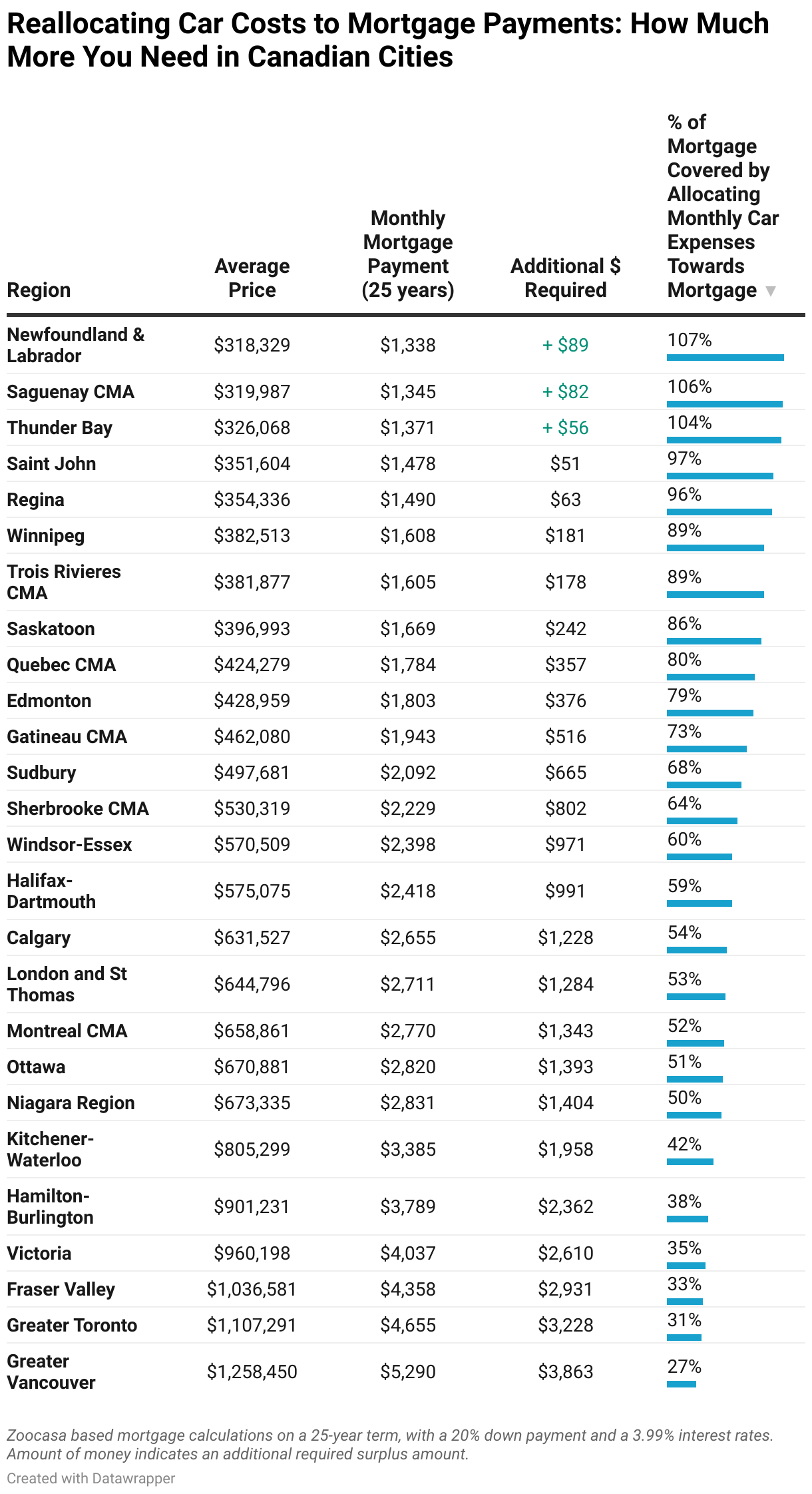
In 42.3% of the cities analyzed families that reduce from two-car to one-car households could save over 70% of their monthly mortgage costs. There’s a trade-off: realistically, many of Canada’s most walkable cities have higher rents and mortgage payments but offer the convenience of reduced car dependency, making daily tasks easier without a vehicle. For example, it’s more feasible for someone in Kitchener-Waterloo, an area known for its post-secondary institutions, to get around the core thanks to a bus system, light rail transit, and bike lanes without a car. With an average home price of $805,299 and a monthly mortgage of $3,385, utilizing car expenses towards the monthly mortgage will cover 42%.
In contrast, in the Niagara Region, with an average price of $673,335 and a monthly mortgage averaging $2,831, utilizing car expenses toward the mortgage would cover 50%. Still, getting around without a car might not be as easy. Currently, the Niagara Region reports, “Residents without a car in the Niagara Region are at an economic disadvantage. Without a car, residents are less mobile and less able to access opportunities that could improve their quality of life”. In that case, sacrificing going from a two-car to one-car household might be more of a challenge.
Is Walking and Public Transit Feasbile All Year Long?
When choosing where to live, people need to think beyond just housing costs. Car dependability plays a big role, as owning a car is a major expense. Winter weather also affects whether someone can rely less on a vehicle.
Take Vancouver, for example. Although it’s one of the most expensive cities in Canada, its mild winter temperatures, averaging around zero degrees, make walking feasible most of the year. In contrast, Calgary often experiences winter temperatures that drop to negative 30 degrees, making walking less practical.
However, the financial impact of cutting car expenses is particularly striking in Calgary. Eliminating car costs could reduce a typical $2,655 monthly mortgage payment by 54%, bringing it down to $1,228. In Vancouver, however, the savings from going car-free only reduce the average $5,290 monthly mortgage by 27 percent. Ultimately, cutting back on car-related expenses doesn’t drastically save money for homeowners, but it does provide a significant start toward making extra payments to the mortgage.
Although the savings may be more minor compared to other parts of the country, reducing or eliminating car ownership in urban areas like bigger major cities is more achievable. Major urban areas’ extensive public transit systems, particularly in central areas, enable many residents to rely less on cars without compromising convenience. Similarly, reducing car ownership is a practical option in cities with solid walkability and well-developed public transit networks.
However, sacrificing the convenience of a two-car household can be very efficient in cutting down family spending: in Newfoundland & Labrador and Saguenay, allocating monthly car expenses can cover 107% of a typical mortgage—the highest percentage in the study—ultimately giving a family a surplus of $89 each month. Similarly effective places with similar savings include Thunder Bay (106%) and Saint John (104%).
Related: Why Newfoundland and Labrador Are Canada’s Best-Kept Secret
Car Payments and Rent Costs in Major Metropolitan Areas
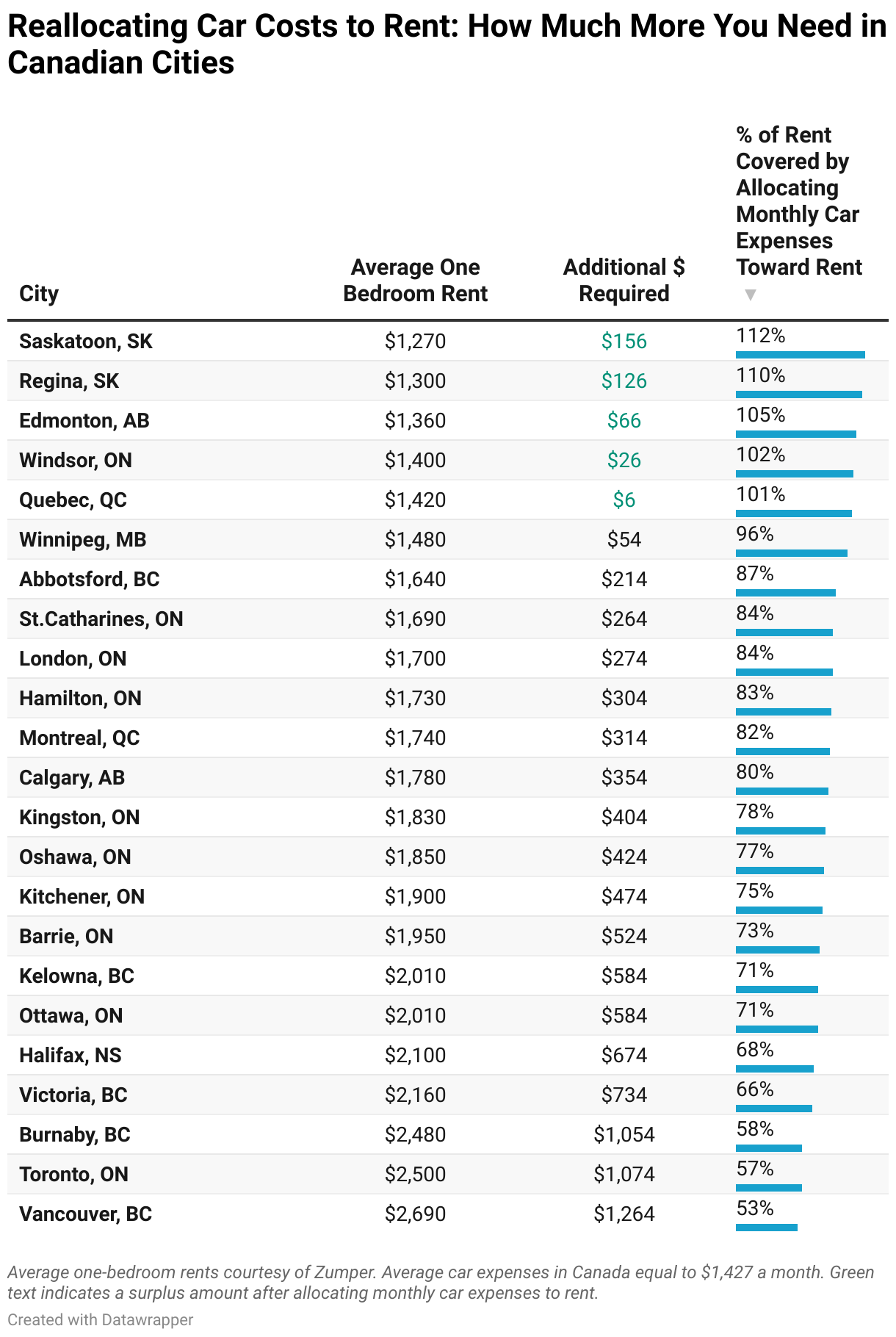
To illustrate, in Montreal, using the amount spent on one car could cover 82% of a renter’s monthly housing costs, while in Toronto, it could cover 57% of the rent for a one-bedroom apartment. Reallocating the total cost of car ownership provides a substantial financial cushion that can be used towards higher rent or saving for and paying for a down payment faster.
Reducing car ownership and improving housing affordability depends on local public transit infrastructure and personal lifestyle needs. In cities with well-developed transit systems, reallocating car costs can help homeowners and renters manage housing expenses more effectively. Understanding how transportation and housing costs interact can lead to better financial decisions, whether paying off a mortgage faster, saving for a down payment, or investing in properties. Public transit infrastructure is crucial in making this strategy feasible, especially for renters who benefit more significantly. However, moving to more affordable areas outside major urban centers may lower rent and mortgage costs. Additionally, the need for one or two cars per household must be factored in when transitioning from a transit-friendly region to a car-dependent one.