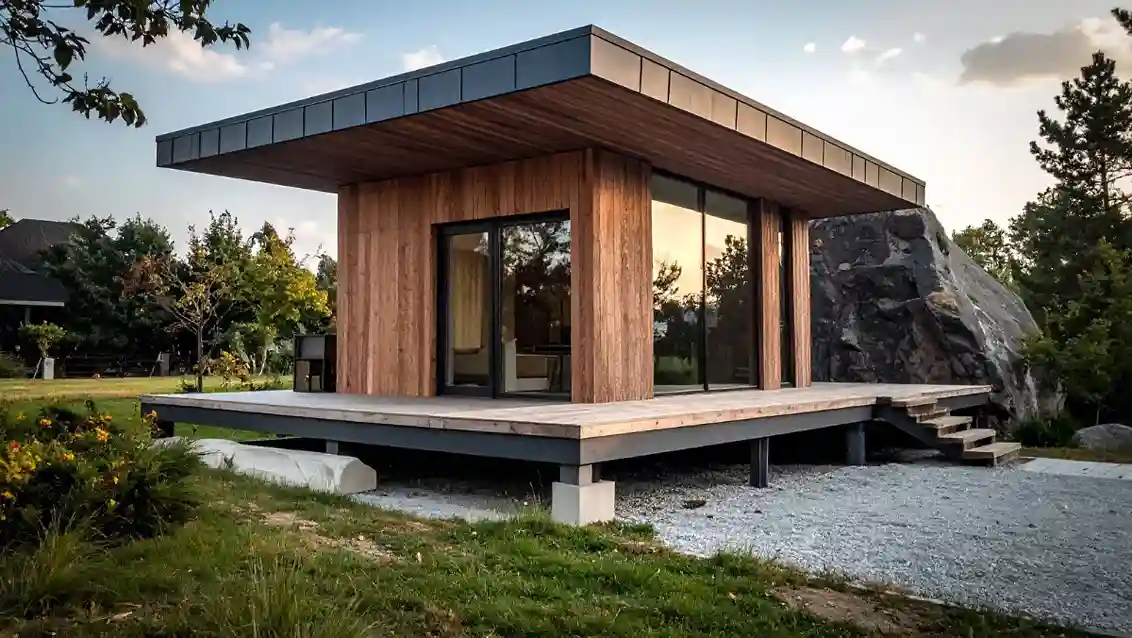
Florida’s housing shortage has made accessory dwelling units (ADUs) one of the state’s fastest-growing housing trends. For homeowners looking to create rental income or increase property value, building a backyard home can be an attractive option. The challenge is that ADU rules vary widely from city to city. Orlando has some of the most flexible regulations in Florida, while other municipalities have much stricter requirements.
Here’s what the current rules allow and what it typically costs to build an ADU.
Is It an RV or Is It Real Estate?
The biggest mistake buyers make is assuming every tiny home follows the same rules. In Florida, the first question isn’t how big the home is. It’s how the home is legally classified.

If a tiny home is built on a chassis with wheels and a tow hitch, Florida treats it as a recreational vehicle rather than a permanent home. That means it falls under RV standards instead of the Florida Building Code. The distinction matters because most residential zoning districts across Florida do not allow someone to live full time in an RV on a standard single-family lot. Place one in a backyard anyway, and the consequences can be serious, including code enforcement action, utility shutoffs, and an order to remove the structure.
Put that same unit on an engineered foundation, however, and the legal picture changes. It can qualify as an ADU under Florida Statute 163.31771, defined as a secondary living unit located on the same property as a primary home. Florida has also adopted rules for homes under 400 square feet that allow lower ceiling heights, alternative stair designs, and other small-home standards. Those changes are what make many tiny homes legally buildable in the first place.
Florida’s ADU Law Has a Gap, And It’s Not the One Most People Think
Florida took a major step toward expanding ADUs in 2025 with the passage of Senate Bill 184. The law requires every city and county to allow at least one ADU on a single-family lot. It also protects a homeowner’s homestead exemption after adding an ADU and limits how much parking local governments can require.
However, the law leaves several key decisions to local governments. It does not set a statewide maximum size for ADUs or prevent cities from enforcing owner-occupancy requirements.
Lawmakers attempted to address those issues in 2026 through Senate Bill 48. The proposal would have allowed ADUs up to 1,000 square feet across Florida and prohibited owner-occupancy mandates. Although it passed the Senate unanimously, the bill stalled in the House and never became law.
As a result, Florida’s ADU rules still vary widely by municipality. Limits on size, occupancy, and rental use continue to depend on local zoning, making the location of a property just as important as the property itself.
Orlando Solved Its Housing Math With a Backyard Loophole
Orlando has emerged as one of Florida’s most ADU-friendly cities, and its regulations are becoming a benchmark for other municipalities. While ADUs are allowed in most residential zoning districts, the size of the unit depends on the size of the lot.
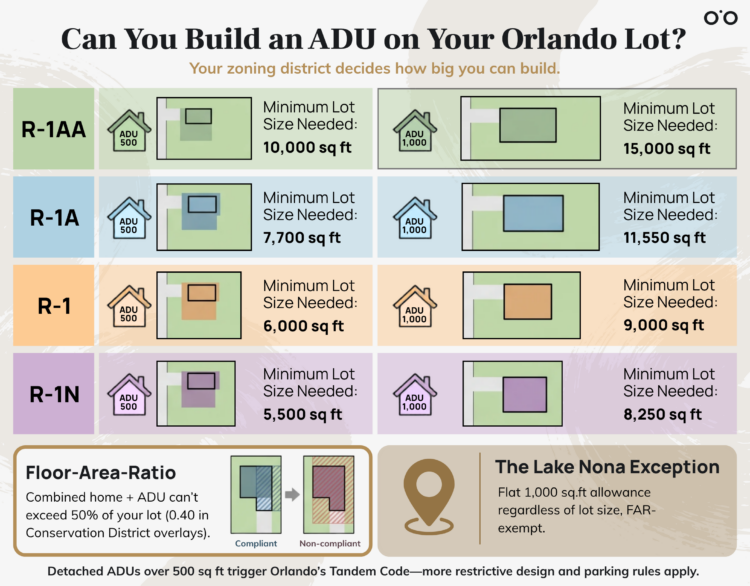
For example, homeowners on an R-1 lot need at least 6,000 square feet to build a 500-square-foot ADU. A 9,000-square-foot lot is required to build the maximum 1,000-square-foot unit. Orlando also limits how much of the property can be developed. The combined floor area of the main home and ADU cannot exceed 50% of the lot, while driveways, patios, buildings, and other hard surfaces are capped at 55% of the property.
Projects become more complex once a detached ADU exceeds 500 square feet. At that point, it must meet the city’s Tandem Development standards, which include additional design and parking requirements.
Lake Nona is the exception. Properties within the Lake Nona Planned Development can build an ADU up to 1,000 square feet regardless of lot size, and they are exempt from the city’s floor area ratio (FAR) limits.
Orlando also offers financial incentives to encourage ADU construction. Through its ADU Incentive Program, eligible homeowners can receive a $10,000 construction rebate, along with full waivers for impact fees and permit fees. To qualify, the ADU must be rented to a household earning no more than 120% of the area’s median income for at least 12 of the first 24 months. The program has $1.5 million in funding and awards incentives on a first-come, first-served basis.
Nine Cities, Nine Different Rulebooks
The moment you leave Orlando, the rules start to change. St. Petersburg, Tampa, and Jacksonville all make room for ADUs, but each city has its own requirements. West Palm Beach sits at the other end of the spectrum, where detached ADUs are much harder to build.

St. Petersburg
St. Petersburg ties ADU eligibility to both zoning and infrastructure requirements. Neighborhood Traditional zones require a minimum 4,500-square-foot lot, while Neighborhood Suburban zones require at least 10,000 square feet. New construction must also comply with the city’s stormwater standards, including gutter and underdrain installation. To encourage affordable housing, the city offers construction grants in the South Side Community Redevelopment Area for homeowners who rent to households earning up to 120% of the area median income.
Tampa
Tampa’s rules are more restrictive than Orlando’s. Traditional ADUs are permitted only in eight designated neighborhoods, including Seminole Heights and Tampa Heights. Elsewhere, homeowners may build an Extended Family Residence, but the unit is limited to 600 square feet and must be occupied by a family member. Rental use is not permitted.
Jacksonville
Compared with many other Florida cities, Jacksonville places fewer restrictions on ADUs. The city allows them by right in most residential zones, limits them to 1,000 square feet, and does not require homeowners to live on the property. Those rules reflect Jacksonville’s local zoning policies rather than statewide requirements. Nearby Beaches municipalities have their own zoning codes, which are generally more restrictive.
West Palm Beach
West Palm Beach is on the strict end of Florida’s ADU rules. You can only build them in one zoning district, SF14, and detached units are basically off the table. On top of that, any rental has to be at least 183 days, which is one of the longest minimum lease requirements in the state.
What It Costs to Build Small
ADUs might look affordable at first, but in Florida, that final cost can climb quickly. Hurricane standards and wind-load requirements add a lot to construction costs compared to other states.
A typical detached 750-square-foot ADU costs between $92,000 and $234,000 turnkey. Framing, roofing, and interior finishes account for a significant portion of total costs. Pricing varies by construction type. Internal conversions generally start near $40,000, while fully detached units with independent utility connections can exceed $250,000. Factory-built modular units fall in the $129,000 to $200,000 range, and offer shorter construction timelines compared with site-built homes.
The Reality Behind Florida’s Tiny Home Rules
Senate Bill 184 opened the door for accessory dwelling units in Florida, but the full set of reforms in Senate Bill 48 never made it through. That means most of the real rules are still set by individual cities. In places like Orlando and Jacksonville, building a second unit can be fairly straightforward and even come with incentives. In other cities, the rules are much tighter and make ADUs harder to build.
Thinking about a Florida property with ADU potential? Start your search with Zoocasa today.