
The American housing market has entered a new phase. What began as a short-term reaction to the pandemic has now solidified into a long-term shift in where people choose to live. As remote work becomes more established and inventory accumulates, buyers are slowing down and thinking long-term. In 2026, the small town versus big city debate is no longer just about preference; it’s about value, risk, time, and the total cost of ownership.
The National Housing Market in 2026
New construction data shows where the pressure is building. Median prices for newly built homes fell 8.0% year over year to $392,300. Builders are cutting prices to meet buyers where they are, but this shift isn’t happening everywhere at once. New home sales jumped 42.1% in the South, while the West saw a 24.8% drop. That gap shows just how split the market has become.
Inventory is also reshaping the market. More homes are available, and listings are sitting on the market for longer, giving buyers more choice and more room to negotiate. It’s a clear shift from the fast, competitive pace of the early 2020s.
Mortgage rates have also settled, so buyers aren’t reacting to every small change. According to Freddie Mac, the average 30-year fixed rate now stands at 6.16%—nearly one full percentage point lower than it was in 2025. This means buyers can now focus on the true cost of ownership, including property taxes, insurance, climate risk, and ongoing maintenance. These expenses often add up faster in big cities than in small towns or secondary markets.
Some Markets Are Rising, While Others Stall
Not all markets are moving together. A new report from Zoocasa shows that while parts of the South and West are correcting due to oversupply, the Midwest and Northeast continue to outperform, driven by affordability and limited inventory.
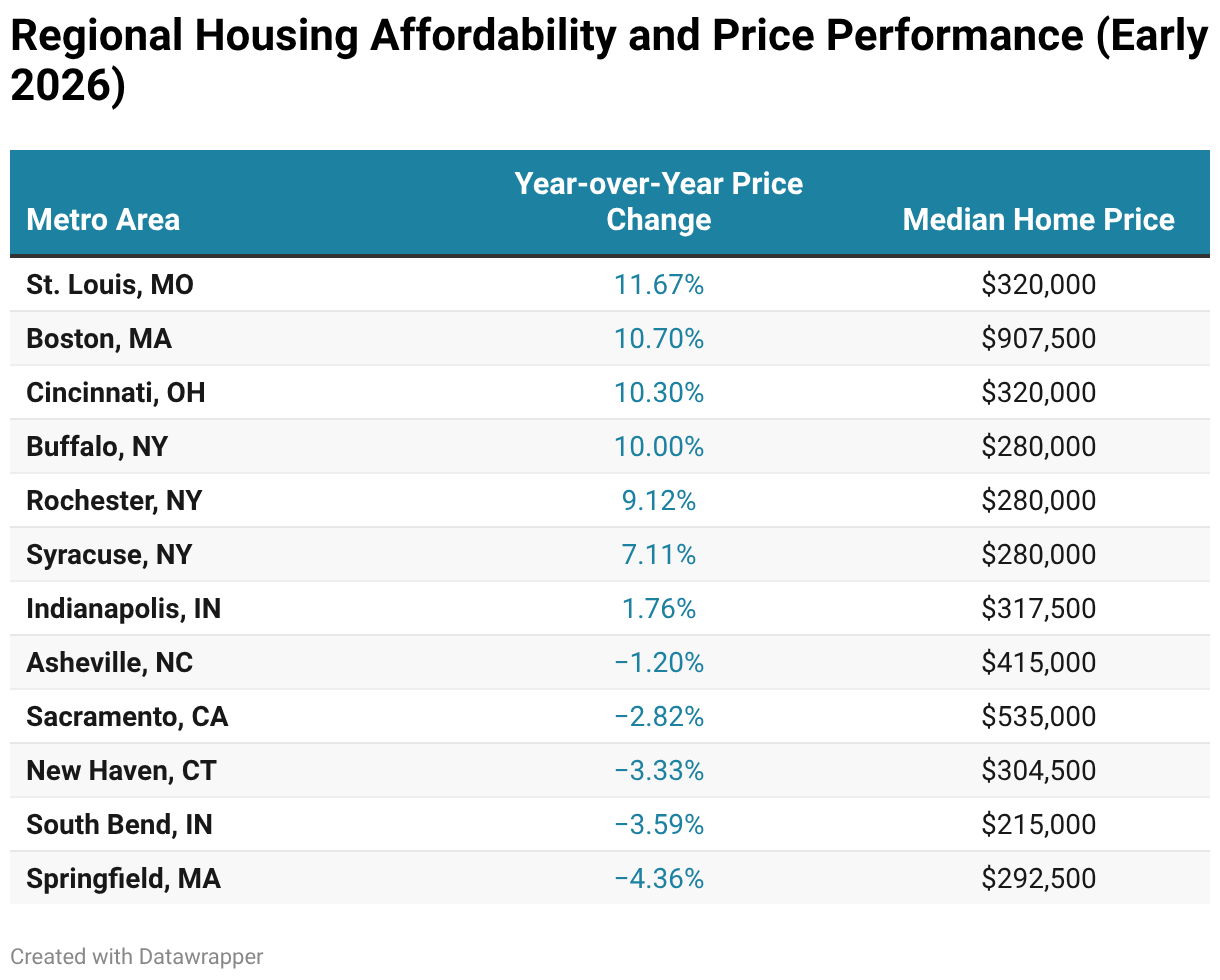
As buyers are priced out of major cities, many are shifting to regions with lower entry points, including parts of the Midwest and areas like Upstate New York. With affordability pressures unlikely to ease in primary markets anytime soon, this trend is expected to carry through late 2026.
Secondary metros such as:
are projected to see price growth in 2026, proving that buyers are prioritizing entry price and stability over scale and hype.
California
Los Angeles vs. San Luis Obispo
Los Angeles remains one of the most expensive housing markets in the country, with a median price of $970,000. However,
- Homes take longer to sell
- Buyer sensitivity is rising
- Commutes average nearly an hour each way
- Climate risk—especially wildfires—has become unavoidable
The biggest downside isn’t price alone; it’s the “time tax” and growing insurance exposure.
San Luis Obispo represents the small-town alternative. Despite similar price points to LA, the experience is entirely different:
- Average commute: ~20 minutes
- Strong walkability and access to nature
- High rental demand from students and remote workers
The trade-off? Inventory scarcity. With only a handful of homes selling each month, buyers must be patient.
Texas
Austin vs. Fredericksburg
Austin has undergone one of the largest market corrections in the US
- Inventory surged
- Median prices have dropped from the mid-2022 peak
- Negotiation power returned to buyers
Fredericksburg tells a different story:
- Prices remain elevated
- Sales volume collapsed
- Homes take 100+ days to sell
In the small town versus big city equation, Austin absorbs change through pricing, while Fredericksburg absorbs it through inactivity. Buyers must choose between flexibility and patience.
Florida
Miami vs. Mount Dora
Miami’s appeal hasn’t faded, but its cost structure has exploded:
- Average annual insurance premiums can exceed $15,000
- Climate risk affects nearly every property
- Owning now costs thousands more per month than renting
This has created a new migration driver: insurance affordability.
Mount Dora offers:
- Lower home prices
- Lower insurance exposure
- Rents below the national average
Buyers are trading coastal access for predictable ownership costs, making inland small towns increasingly competitive.
Small Town Versus Big City: Pros and Cons


Choosing the Right Map for Your Life
In 2026, the small town versus big city debate is about where your life performs best. Big cities are correcting and rebalancing, whereas small towns are maturing and professionalizing. Both offer opportunities, but only when buyers understand the full picture.
Ready to move to a market that fits your needs? Discover listings on Zoocasa and start your search today.